
Every call-off set up the same way, and seen together
A framework promises consistency across suppliers and years. Each call-off is its own NEC contract, with its own notices and clocks. Contract Status runs those call-offs in one place, so you can see what is happening across the framework rather than asking.
What it does, and what it does not
Under the NEC4 Framework Contract, each package is placed under another NEC contract, often an ECC, an ECSC or a PSSC. That is the part Contract Status is built for. Each order is recorded as a contract of the right form with its supplier on the other side, its Options, periods and clauses.
It does not run the framework's own procedures, such as the steps you follow before an order is placed. The Framework Contract is not one of the contract forms in the app, and there is no tool for the selection procedure, for tendered rates or for allocating work between suppliers. Keep those where they are. If your framework needs them in the same system, tell us at the demo so we can talk about it honestly.
A day with NEC, without it and with it
| When | Without it | With Contract Status |
|---|---|---|
| New call-off | Someone copies an old contract file, and forgets to change a Z clause or a period. | The contract starts from a saved set-up: type, Options, periods, programme requirement and clauses. Every copy is independent. |
| Changing a term | A framework change has to be made across twenty live orders, one at a time. | Copy a set-up to the contracts you tick, after a preview naming any contract left alone and why. |
| Supplier review | Each supplier gives you their own KPI figures, and you can't check them. | The registers are shared. Replies, programmes and payment dates are on the same record for both sides. |
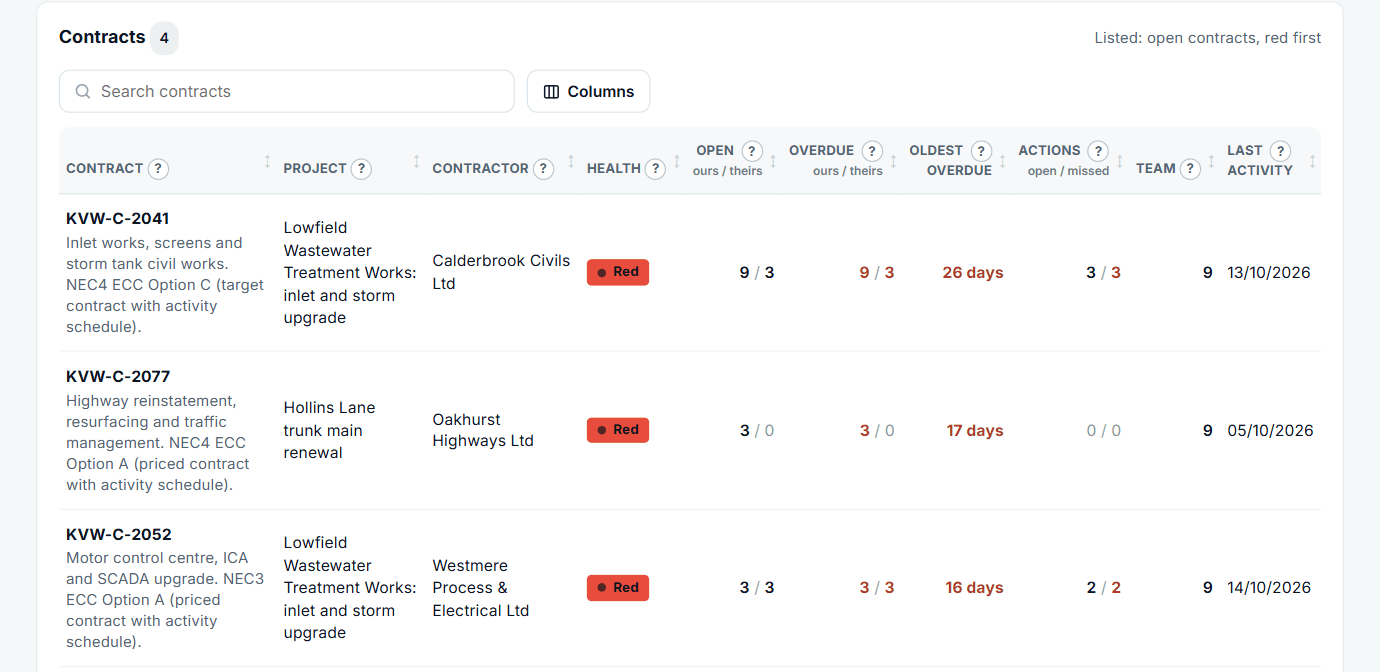
| Board update | You collect a status from each order manager. | Contract Intelligence shows the health of every contract. A status report downloads for each one. |
| End of a call-off | The file disappears with the team. | Close it out: open items closed, a pack with history and documents, view only, and it can be reopened. |
What you get across the framework
Forms that match your orders
NEC4 ECC, ECSC, PSC, PSSC and TSC, among others, each recorded as itself, with its own Options, words, registers and rules. The compensation event limit on an NEC4 ECSC order is four weeks, for example, not the ECC's eight.
One library, many orders
A live standard clause library, your own versions, and a Z clause library you can add to any contract. The contract page lists anything that differs from your library.
One view of health
Overdue items against each order's own time limits, Unknown where a rule cannot be checked, tasks on alerts, and PDF and spreadsheet downloads.
Task Orders
On a term service contract, Task Orders have their own register, with quotations and acceptance or assessment. Clause 19 is where the form deals with these.
Portfolio reporting
A data feed sends 12 registers to Power BI or Excel. Records from one account never mix with another.
Spending limits
Money approvals mean an over-limit quotation decision or Task Order gets one sign-off, by the first person whose limit covers it.
Suppliers on the same terms
Each supplier's people see only their own contracts, with their own drafts private until they send them. They follow the same record layout on every order, so a supplier who works on five of your call-offs only has to learn it once.
For a clear look at a supplier's performance, the reports can show the replies, payment dates and programmes by contract. PMO Insights shows the subcontractors with the most programme problems. No figures are entered by the supplier just for your report: they come from the work itself.
The app does not score suppliers against framework KPIs under Option X20. If you measure those, the data feed is the place to start. It gives you dated facts about replies, programmes and payments, which are usually the hardest part of a supplier review to agree on.
See it, try it, read up
Talk through your framework
Tell us the forms your orders use and how many suppliers you have. We will show what fits, and say clearly what does not.