
Tests, searches and Defects, each with a date and an owner
The Supervisor's role is narrow in the contract and busy in real life. Inspection notices come by phone, Defects sit in a snagging list and the defects date arrives before anybody expects it. Contract Status gives the quality side of the contract its own registers.
A day with NEC, without it and with it
On site, on the phone and at your desk. It is the same work: the difference is the trail it leaves.
| When | Without it | With Contract Status |
|---|---|---|
| On arrival | The Contractor says a pour is at 2pm, by text. You are not sure when they told you, or who else knows. | The test or inspection is on its register with its notice date. A notice given at or after the planned start is marked late. |
| On the walk | You spot a cracked chamber cover, photograph it and promise yourself you will write it up. | You add the Defect on a phone with its location and photo, and submit it. The other side is told at once. |
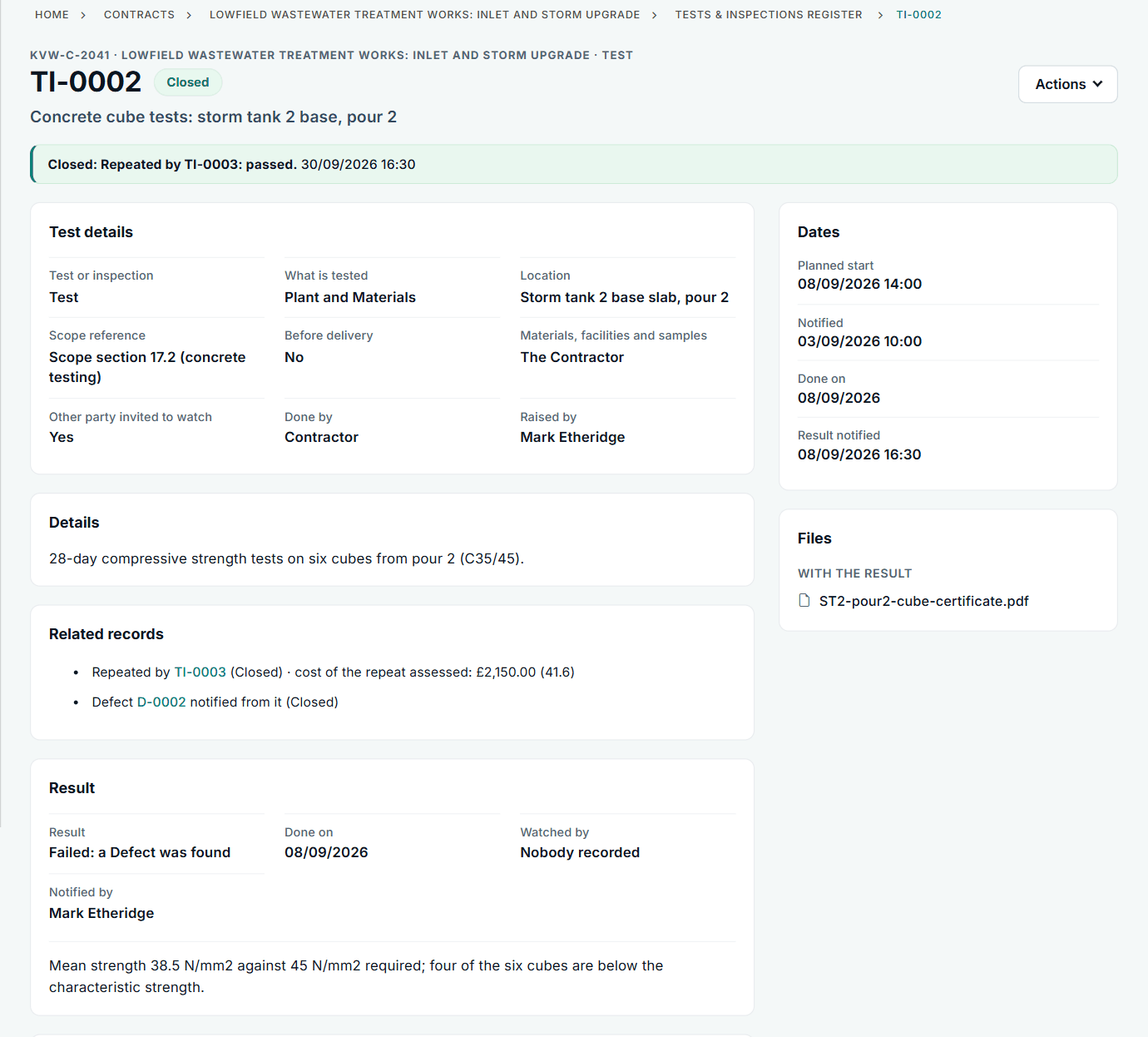
| Lunchtime | A test fails. The result, the correction and the repeat become three separate conversations. | Record the result, choose Notify the Defect, then Arrange the repeat. When the repeat passes, the failed test closes. |
| Afternoon | You suspect work behind a lining is wrong, and instruct a search in a meeting. | The instruction to search goes on its register with your reasons and a date for the findings. |
| Later | Nothing was found. Weeks later nobody has dealt with the compensation event. | From the record, the event opens filled in. Or you record why it is not one. |
The clauses you answer for
NEC4 ECC numbers first, with NEC3 in brackets where they differ. A contract's own numbers show on its records.
- 41.3 (NEC3 40.3): notice before a test or inspection. Each side tells the other before it starts, and the result after. The app records both.
- 41.5 and 60.1(11) (NEC3 40.5): no unnecessary delay. A dated record shows when the notice came and when you attended.
- 41.6 (NEC3 40.6): the cost of a repeat. The Project Manager assesses it. The cost is on the repeat's record.
- 43.1 (NEC3 42.1): a search, with reasons. The form asks for them. No reasons, no instruction.
- 43.2 (NEC3 42.2): notifying Defects. Both sides notify what they find, until the defects date.
- 44.2 (NEC3 43.2): the defect correction period. Recorded from the Contract Data, so each Defect can be dated.
- 60.1(10): a search that finds nothing. Unless the Contractor gave too little notice before covering up work, that is a compensation event.
Why this is worth having
Works where you are
The contract pages and registers work on a phone and an iPad, with photos added as files. Tables become blocks you can read in the rain.
Only the client side closes a Defect
A Contractor can say it is done. The closing decision stays on your side, and the reply stays on the record.
Corrected by others
If the Contractor does not correct a Defect in time, mark it as corrected by others, with who and the cost. Clause 46.1 has the Project Manager assess it, and the cost carries to the final account.
Files that stay with the record
Test certificates, photos and marked-up drawings stay with the notice they relate to. They appear in the close-out pack, not in your download folder.
The contract words
NEC3 contracts say Employer and Works Information, NEC4 contracts say Client and Scope. A subcontract puts the Contractor in the Supervisor's place. The record follows the form.
Registers per form
Forms without Tests and Inspections or Instructions to Search, such as a Professional Service Contract, do not show those registers at all.
Honest limits
Contract Status is not a site inspection app with checklists and drawing overlays. It is the contractual record of what was notified, when, and what happened next. If you already have a quality system, keep it, and use this for the notices the contract asks for. Clause 40 in NEC4 asks for a quality management system and plan, and those can go in the submissions register for acceptance.
See it, try it, read up
The Contractor hasn't corrected a Defect
A Defect goes uncorrected. Contract Status keeps the notice and reply, and the Client side can record it as corrected by others, with the final account cost.
See the exampleThe Supervisor has notified a Defect
A contractor gets a Defect notice. In Contract Status: the record, the reply with fault, cause and action, the discussion and who closes it.
See the exampleWe instructed a search and found no Defect
A Supervisor's search finds no Defect. Contract Status records the reasons, the findings and the decision, and opens the compensation event filled in.
See the exampleSee the quality side of a contract
We will take a failed test through to the repeat on sample data, and show what the Contractor sees.