
Get paid for what the contract says you should be paid for
NEC gives a Contractor real entitlement, but only if the procedure is followed. Eight weeks, three weeks, a notice on its own. Contract Status keeps that procedure in front of your team, on your client's contracts and on your own subcontracts.
Whose side is it on?
Neither. It records what the two sides did and when, and it does not decide who is right. That is exactly why it helps a Contractor: when the record is complete and shared, a good notification is hard to lose, and a late reply is hard to deny. Your drafts stay with your company until you submit them. Your internal discussions are not visible to the client, and the client's private programme review notes are not visible to you.
You can use it in two ways. Where your client runs its contracts on Contract Status, you work in the same record, as the other side. And on your own account, you can run your subcontracts, as the Contractor, with Contractor's Instructions in place of Project Manager's Instructions, and the Subcontractor on the other side.
A day with NEC, without it and with it
Without it. The foreman mentions that the ground has been wetter than the site investigation said. Nobody writes it down. Three weeks later the QS hears about it in a meeting. Someone asks whether we early warned. A notification goes out in a monthly report, which is not where it should be, and the Project Manager says nothing. Five weeks on, nobody is sure whether a reply was given, and the planner is asked to work out the delay from a programme that was never accepted.
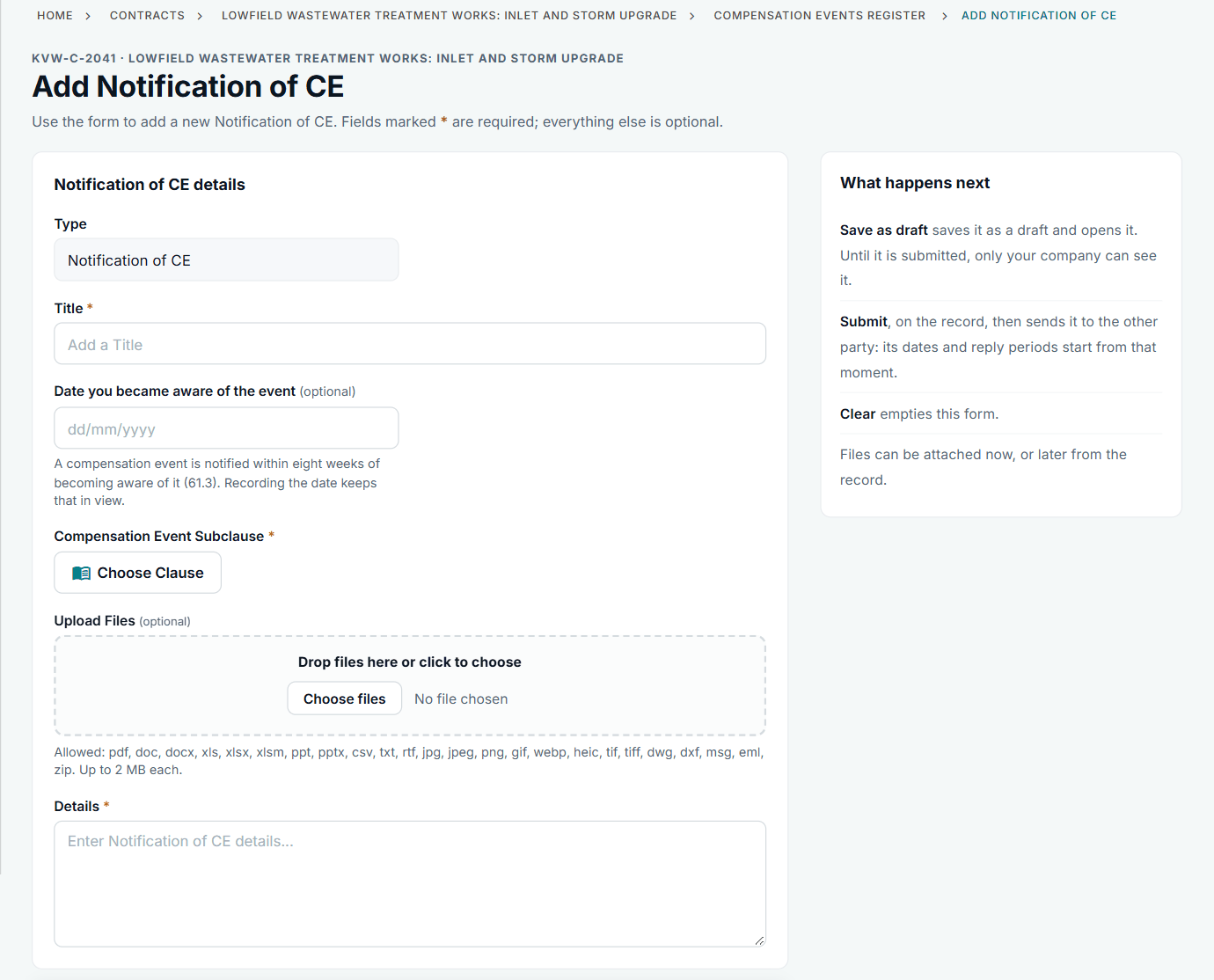
With it. The early warning goes on the register the same day, with the date. A compensation event record is drafted, your team sees the date you became aware, and the eight weeks are in view. It is submitted by itself, as a notification. The Project Manager's week is on their Action List and on yours. If it passes, you decide whether to give notice that the reply is late. It never happens automatically, and the choice is always yours. If you do, the record counts two weeks down for both sides.
Where a Contractor wins or loses
Standard NEC4 ECC references; your Contract Data and Z clauses can change them.
61.3: notify within eight weeks
A late notification generally loses the change to the Prices and dates, apart from the exceptions the clause gives. Record the date you became aware, and the app can warn you.
15.1 and 61.5: warn early
If an experienced contractor could have warned and you did not, the event is assessed as if you had. A dated register entry settles that question.
62.3: quote within three weeks
The amount, the dates and the build-up go on one record. A contractor account can use money approvals to hold a large quotation for sign-off before it goes.
61.4, 62.6 and 64.4: when they do not reply
Give notice of the failure from the record, see two weeks counted down, then record it. A quotation treated as accepted implements its event like any other.
31.2 and 31.3: the programme
The submit page shows what a programme must show. NEC4 allows a notice of failure and a one-week clock if the two weeks pass without an answer.
Clause 50: apply before the assessment date
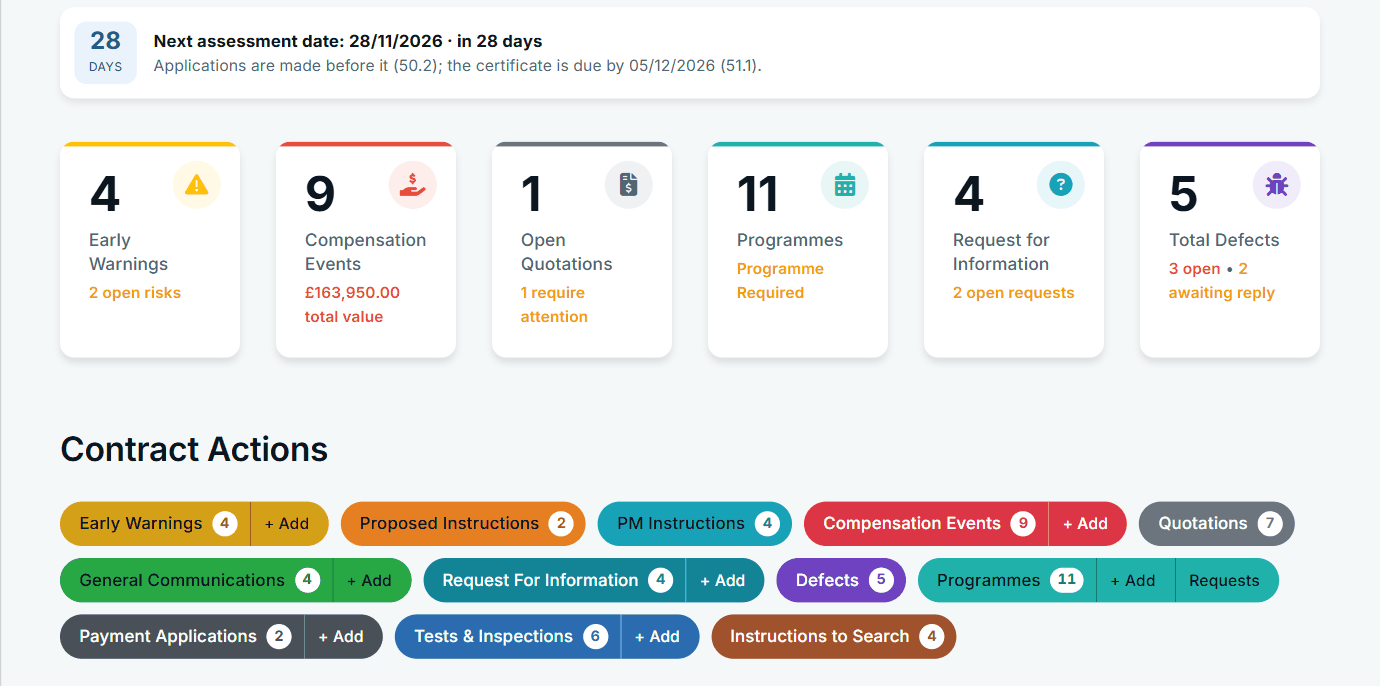
A countdown shows the next assessment date. Implemented events are carried to the payment form as changes to the Prices, once each.
Keep your side private until you are ready
- A draft is seen only by your company; the other side sees a greyed "Draft by..." line so references stay in order
- Files on a draft are private until it is sent
- Draft with AI, where it is switched on, drafts a reply from your points; you check it, change it and send it yourself
- An administrator can check what a colleague sees, read only and logged
- Your own name for each role and field, and your own clause wording for your subcontracts
When a reply is due from you
You owe replies too: to communications, RFIs and subcontractor notices. The Action List separates your actions from other companies' actions, so a Friday check takes minutes.
See it, try it, read up
The Contractor hasn't corrected a Defect
A Defect goes uncorrected. Contract Status keeps the notice and reply, and the Client side can record it as corrected by others, with the final account cost.
See the exampleThe Contractor hasn't given a quotation
The quotation date has passed. Contract Status shows the Project Manager the next step: a Project Manager's assessment, recorded against the event.
See the exampleA subcontractor's notice that affects the main contract
How a contractor running subcontracts in Contract Status records a subcontractor's early warning, and what it still has to pass up to the main contract.
See the exampleSee it from the Contractor's side
No commitment. We will just walk a compensation event through on sample data, from where you sit.