
An NEC contract rewards contractors who notify on time, keep the programme current and quote properly, and it punishes those who treat paperwork as something for the end of the job. Change is paid for when it is notified and priced, usually in advance, so there is no final account to catch things later.
This page covers what matters most on the NEC4 Engineering and Construction Contract (ECC), from tender to the end of the job. For the role itself, see the Contractor under NEC. It is part of the wider guide to managing NEC contracts.
At tender: what to price and query
- Read the Z clauses first. Amendments often shift risk or shorten notice periods. Price them, or query them.
- Check who carries ground and weather risk. Read the Site Information, any limits stated in the Contract Data, and how 60.1(12) and 60.1(13) work with them. Weather data in particular drives whether you get paid for bad weather.
- Consider the Main Option. On Option A you carry your own cost risk, and on C you share it. See choosing a main Option.
- Set the Fee thoughtfully. It covers what isn't in Defined Cost (52.1), so compare it with your actual overheads and the Schedule of Cost Components.
- Allow for the admin. Quotations, programme revisions and meetings take planner and QS time. Price those people in.
Three things to protect on site
1. Your entitlement
Under clause 61.3, an event you notify more than eight weeks after becoming aware that it has happened generally doesn't change the Prices or dates, unless it came from a Project Manager or Supervisor action. Train your foremen and engineers to report anything unusual on the day. Don't let anyone wait until a QS has a full cost picture.
Warn as well. If an experienced contractor could have warned of an event and you didn't, it can be assessed as though you had (61.5, 63.7). The missed early warnings guide works through what that can cost.
2. Your programme
Delay is measured on the Accepted Programme, so an out-of-date one weakens your position. Submit on time, show real logic, and keep your float visible. Without an accepted first programme where none is identified in the Contract Data, the assessment holds back 25% from the Price for Work Done to Date (50.5). Terminal float and time risk allowance are worth keeping intact, since they are what protect you from your own delays. See terminal float.
3. Your cash
- Apply before every assessment date (50.2). It affects how the amount due is worked out.
- Check the certificate within the week it's issued, and raise differences quickly.
- Get compensation events implemented. An event that is notified but not quoted usually isn't in the Prices, and so isn't in your cash.
- Know your Option. Under C, D and E, unsupported cost can become Disallowed Cost. See Disallowed Cost.
Traps that catch contractors
| Trap | Why it hurts | Do this instead |
|---|---|---|
| Doing extra work on a verbal request | Without an instruction, it might not be a compensation event | Ask for the instruction, and record your request |
| Assuming a Project Manager's silence is fine | Deemed acceptance only follows your own notice of the failure | Chase, then notify the failure (61.4, 62.6, 64.4, 31.3) |
| Under-quoting to keep things friendly | Once implemented, the assessment generally doesn't change even if you were wrong (66.3) | Forecast carefully and name your risk allowance |
| Using rates from tender on a compensation event | It's a Defined Cost assessment, not a remeasure | Build it up from forecast cost plus Fee |
| Letting an acceptance reassure you | Acceptance doesn't change your responsibility (14.1) | Keep checking your own design and programme |
| Forgetting your subcontractors' periods | A subcontract's clocks don't wait for yours | See managing NEC subcontracts |
A worked illustration
A fictional Option A job, with illustrative figures. A Contractor's bad ground costs it £60,000 and three weeks. Records show the foreman knew in March, the QS noticed in June, and no warning was given.
- Result if notified in April: a quotation for around £60,000 and three weeks, assuming 60.1(12) is made out.
- Result if notified in late June: more than eight weeks since awareness, so probably nothing. The Contractor carries the cost, and delay damages under Option X7 may follow.
One short email from site in March would have made the difference. Under NEC3 ECC the eight-week rule is the same, though the wording on what starts the clock differs. If you're used to JCT, the idea of a claim at the end of a job doesn't carry across, which is worth raising with your team. The JCT to NEC translation may help.
Related guides
- Managing NEC Contracts: A Practical Guide
- An NEC Guide for Clients
- An NEC Guide for Subcontractors
- An NEC Guide for Consultants
- Managing NEC Subcontracts
- Making Clause 10 Work in Practice
How this looks in Contract Status
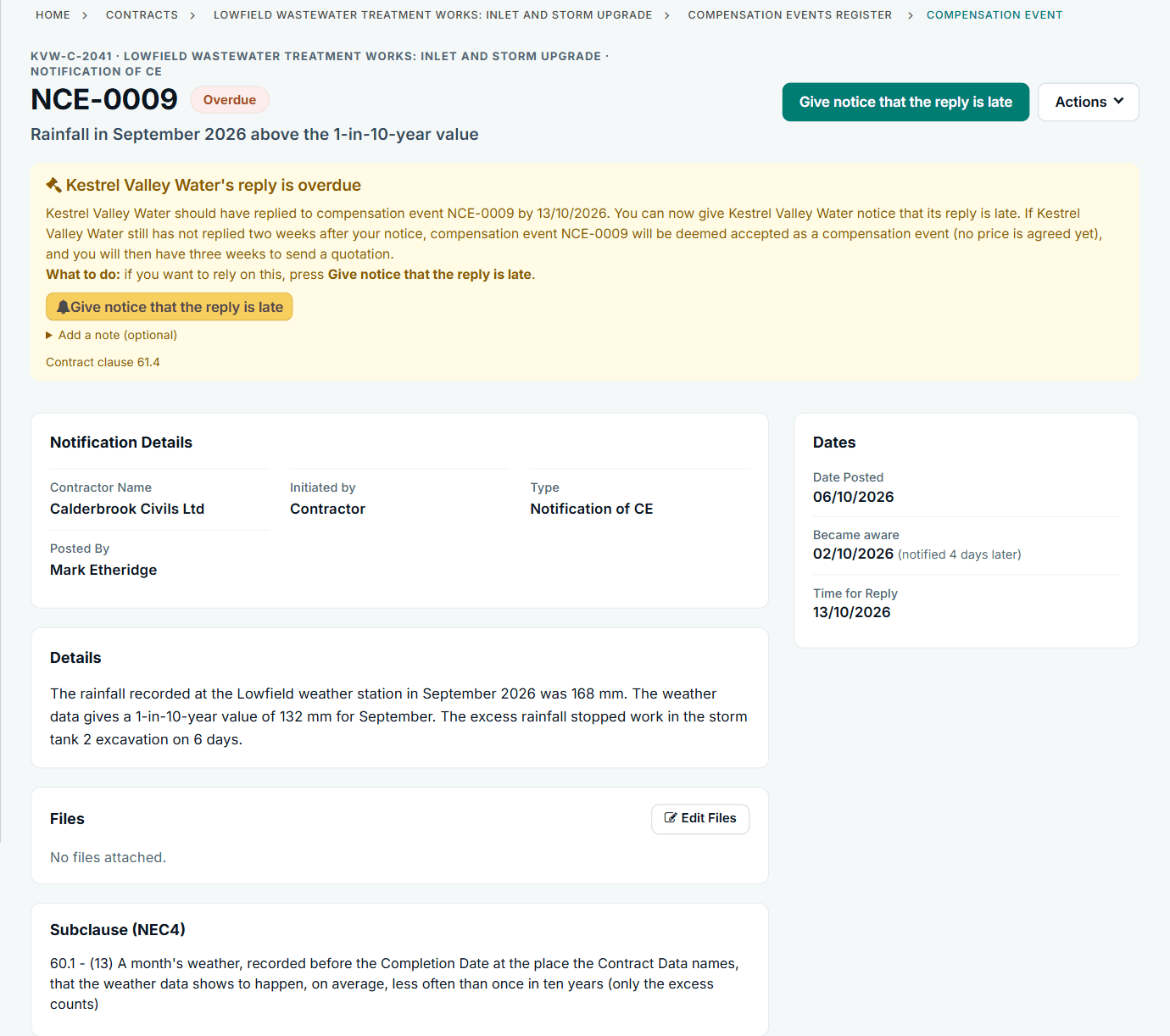
A late reply in Contract Status: the banner, the clause and the button for the notice. See the worked example.
See how this works in practice
Click through Contract Status with sample contracts: raise the notice, reply to it, and watch both sides of one record.
Take the guided tour Book a demo
Get free NEC templates, use the free NEC tools or download free NEC templates.
This guide is general information in our own words, not legal advice. Your contract and its Contract Data always govern. NEC, NEC3 and NEC4 are trade marks of Thomas Telford Ltd; Contract Status is not affiliated with or endorsed by NEC.