
NEC contractor obligations start with one main duty: Provide the Works in accordance with the Scope (20.1). Around that sit many process duties, from early warnings and programmes to quotations and Defects, and missing some of them costs money even if the building work is fine.
This list uses the NEC4 Engineering and Construction Contract (ECC). In NEC3 the Scope is the Works Information, and some numbers differ. See how the Contractor fits in with the others in the NEC roles guide.
Building and design
| Duty | Clause |
|---|---|
| Provide the Works as the Scope requires | 20.1 |
| Design what the Scope says the Contractor designs, and submit particulars for acceptance before proceeding | 21.1, 21.2 |
| Submit the design of an item of Equipment if instructed | 23.1 |
| Provide each named key person, or an accepted replacement | 24.1 |
| Remove a person if instructed, with reasons | 24.2 |
| Co-operate with Others and share the Working Areas as the Scope says | 25.1 |
| Provide what the Scope says it will provide | 25.2 |
| Remain responsible for subcontracted work | 26.1 |
| Submit each proposed Subcontractor, and the subcontract documents where required, for acceptance | 26.2, 26.3 |
| Get any approval its design needs from Others | 27.1 |
| Provide access to the work for those named | 27.2 |
| Obey instructions the contract allows | 27.3 |
| Follow the health and safety requirements in the Scope | 27.4 |
Time
- Finish in time: Completion must not fall after the Completion Date (30.1).
- Meet each Key Date's Condition (30.3). If it is missed and the Client pays more as a result, the Contractor pays the assessed extra (25.3).
- Submit the first programme if the Contract Data doesn't name one, within the period given (31.1). Show what 31.2 asks for.
- Submit revised programmes when instructed, and at the intervals in the Contract Data (32.2).
A programme that isn't accepted causes real problems. It can result in part of the payment being held back (50.5) and in the Project Manager making its own assessment of compensation events (64.1). The NEC programme guide goes through this.
Quality and Defects
- Run the quality management system, and provide the policy statement and quality plan for acceptance (40.1, 40.2).
- Do the required tests and give notice in time for them to take place before the work is covered (41.3).
- Keep Plant and Materials requiring testing off the Working Areas until they have passed (42.1).
- Search for a Defect if instructed (43.1).
- Notify Defects it finds, up to the defects date (43.2).
- Correct Defects whether notified or not (44.1), and each notified one within its defect correction period (44.2).
Notices, quotations and money
| Duty | Clause | Why it matters |
|---|---|---|
| Give early warnings as soon as aware | 15.1 | Otherwise a related compensation event may be assessed as if a warning had been given (61.5, 63.7) |
| Attend early warning meetings when instructed | 15.2 | Shared solutions and a clear record |
| Notify an ambiguity or inconsistency | 17.1 | The Project Manager then says how it is resolved |
| Notify any compensation event the Project Manager hasn't, no later than eight weeks after first knowing of it | 61.3 | A late notice can lose the change, with some exceptions |
| Submit quotations within three weeks of the instruction | 62.3 | Otherwise the Project Manager may assess instead |
| Apply for payment before each assessment date | 50.2 | New in NEC4 |
| Insure as required, and provide certificates for acceptance | 84.1 | Needed before the starting date |
The contract also asks all involved to act as it states (10.1) and in mutual trust and co-operation (10.2). The Contractor carries its liabilities under section 8, covered in the Contractor's liabilities guide.
What people get wrong
- Waiting for the instruction. If the Project Manager should have notified a compensation event and hasn't, the Contractor can still notify. Don't assume someone else is tracking it.
- Treating acceptance as a shield. The Project Manager's acceptance of a design leaves the Contractor's design liability in place (14.1).
- Appointing a Subcontractor first and submitting afterwards. The name has to be accepted before the appointment.
- Working on unaccepted design. Starting before acceptance is a risk even when programme pressure is high. Chase the reply, and remember that a late one may be a compensation event.
- Pricing only cost, not time. A quotation must include any delay, with a programme update if needed (62.2).
A pre-start checklist
- Read the Scope and Contract Data with the delivery team, not only the commercial team.
- List every periodic duty and put it in a shared diary.
- Confirm the key people and what happens if one leaves.
- Prepare your subcontractor submissions early.
- Flow the right obligations into your subcontracts, with periods short enough to meet your own. See back-to-back subcontracts.
- Check the insurance certificates are ready.
- Set up the registers for compensation events, early warnings and Defects.
For the full management picture from your side of the table, see NEC for contractors.
Related guides
- NEC Roles: Who Does What on an NEC Contract
- The Client's Role Under NEC
- The Service Manager
- The Consultant Under the PSC
- The NEC Supervisor
- The Supervisor Under NEC4
How this looks in Contract Status
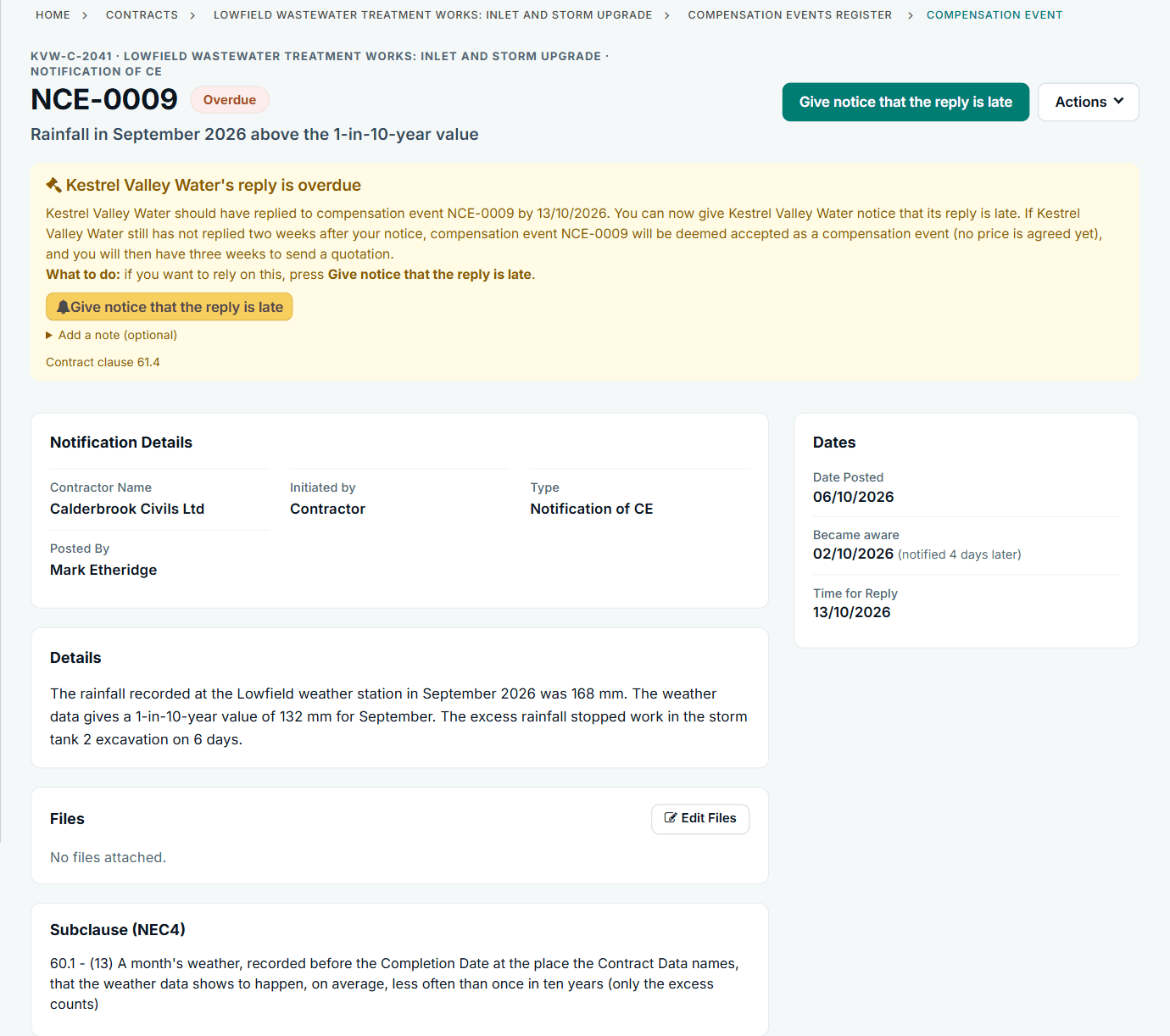
A late reply in Contract Status: the banner, the clause and the button for the notice. See the worked example.
See how this works in practice
Click through Contract Status with sample contracts: raise the notice, reply to it, and watch both sides of one record.
Take the guided tour Book a demo
Try an NEC role-play, use the free NEC tools or download free NEC templates.
This guide is general information in our own words, not legal advice. Your contract and its Contract Data always govern. NEC, NEC3 and NEC4 are trade marks of Thomas Telford Ltd; Contract Status is not affiliated with or endorsed by NEC.