
An NEC commercial manager controls the contract's commercial position by controlling its deadlines, its forecast and its records. Under NEC, entitlement and money are mostly settled during the job, so a problem left for the end of the project may already be lost.
The role isn't named in the contract. You act for the Client or Contractor, and your team's actions usually need to come through a named role or a Party. This guide uses the NEC4 Engineering and Construction Contract (ECC), and is written mainly from the Contractor's side, with Client notes. See the NEC roles guide for who holds which power.
Seven things to control
| Control | Why it matters | Evidence that it is under control |
|---|---|---|
| Notification of events | Late notice can lose the change (61.3) | Each event has a date of awareness and a notice date within eight weeks |
| Quotations | Late ones hand the assessment over to the Project Manager (64.1) | A log with every due date, with nothing overdue |
| Replies from the other side | Silence can be turned into acceptance (61.4, 62.6, 64.4) | Reminders and failure notices issued on the right day |
| Accepted Programme | Baseline for delay on every event (63.5) | Latest programme accepted, or reasons recorded |
| Forecast of final position | Shows the board where the job is heading, including the share | Monthly reconciled forecast with named risks |
| Cost records | Disallowed Cost on Options C to E | Samples of timesheets and invoices tied to Defined Cost |
| Subcontract alignment | Periods can differ, leaving you squeezed | A table of main contract periods against subcontract ones |
The monthly commercial review
- Register review. Go through the compensation event register: new, quoted, implemented, disputed, plus the value and age of each.
- Unnotified matters. Ask the site team what has changed that isn't yet on any list. Most lost entitlement starts here.
- Early warnings. Does each significant commercial risk appear on the register? A missing warning can reduce a later assessment (61.5, 63.7).
- Payment. Check the last certificate against the application, explain any difference and follow the pay less position where Option Y(UK)2 applies.
- Forecast. Compare forecast final cost with the Prices. Under Options C and D, look at the likely share under clause 54.
- Disputes. Note live disputes, with their dates. Under W1, the ECS sets short windows and it's easy to miss one. See the time bars guide.
Control the people as well as the paper
Commercial failure under NEC is often a communication failure. A planner knows of a late delivery, a site manager knows the Client changed its mind, and nobody tells the person who sends the notice. Three simple habits help:
- A short weekly conversation with each section lead, with one question: "What changed?"
- A rule that no one agrees a commercial point in a meeting without a follow-up in the proper form.
- A named deputy for each deadline owner.
A worked example: a report that hides a problem
A fictional Option C job, illustrative figures. A monthly report shows 42 compensation events and a forecast margin of 4%. Looks fine. Breaking down the register shows something different:
| Status | Number | Value |
|---|---|---|
| Implemented | 20 | £610,000 |
| Quoted, within the reply period | 6 | £90,000 |
| Quoted, reply overdue | 9 | £340,000 |
| Notified, no quotation yet | 7 | Unknown |
The margin relies on £340,000 that has no answer, and no failure notices have gone out. The action is clear: notify the failures where the contract allows, decide what you will accept, and show the board a range rather than a single figure. If you're on the Client's side and these are your replies that are overdue, this is a serious exposure: once the Contractor notifies the failure, continued silence means the quotations are treated as accepted at their stated value.
Notes for a Client-side commercial manager
- Your budget doesn't alter a compensation event test, so plan your contingency for what the contract may require.
- Track the Project Manager's reply workload as a commercial risk in itself.
- Set approval limits that fit the contract's periods. A two-week reply can't sit through a monthly approvals meeting.
- Audit Defined Cost as you go on cost-based Options. See audit under NEC.
At close-out
Don't rely on a final account stage. NEC4's final assessment (53.1) becomes conclusive unless a dispute is referred within the time allowed (53.3). So keep an up-to-date list of what remains open as the Defects Certificate approaches, and diarise the dates. See the final assessment guide.
Related guides
- NEC Roles: Who Does What on an NEC Contract
- What an NEC Contract Manager Does
- Project Manager Instructions
- NEC Accreditation: How It Works
- Senior Representatives
- An NEC Guide for Quantity Surveyors
How this looks in Contract Status
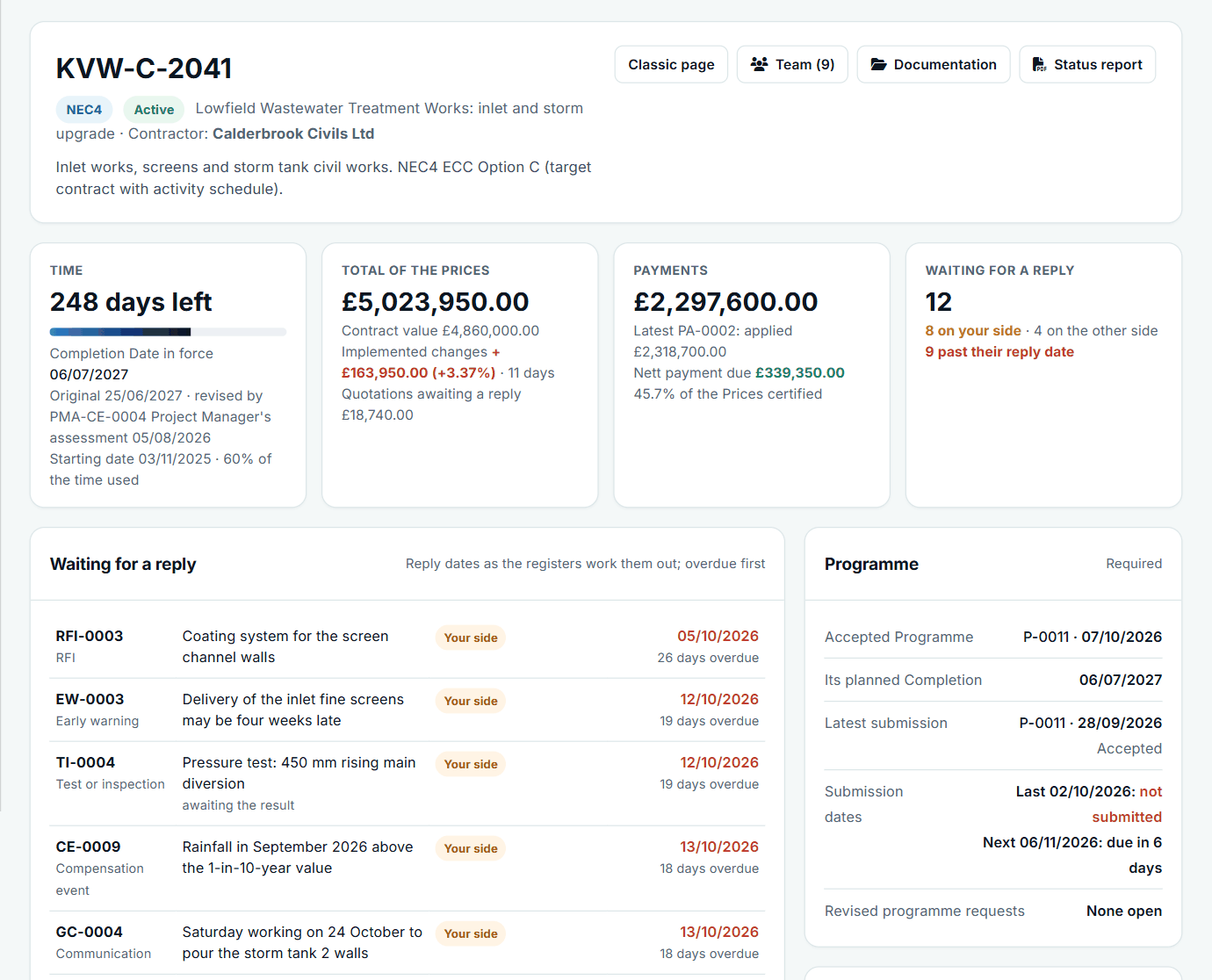
A contract at a glance: time, the total of the Prices, payments and replies waiting. See the worked example.
See how this works in practice
Click through Contract Status with sample contracts: raise the notice, reply to it, and watch both sides of one record.
Take the guided tour Book a demo
Try an NEC role-play, use the free NEC tools or download free NEC templates.
This guide is general information in our own words, not legal advice. Your contract and its Contract Data always govern. NEC, NEC3 and NEC4 are trade marks of Thomas Telford Ltd; Contract Status is not affiliated with or endorsed by NEC.