
The NEC Project Manager manages the contract for the Client: it gives instructions, accepts or rejects submissions, deals with compensation events, assesses payment and decides Completion. It isn't a Party to the contract, yet almost every process in the NEC4 Engineering and Construction Contract (ECC) runs through it.
The role is named in the Contract Data and carries the same title in NEC3. For how it sits beside the other roles, see who does what on an NEC contract.
Where the authority comes from
The authority comes from specific clauses, not from a general power to direct the job. If the contract gives an action to the Project Manager, it can take that action. If it doesn't, the Project Manager has no contractual power to take it, however senior the person.
| Power | NEC4 ECC | What to remember |
|---|---|---|
| Change the Scope or a Key Date | 14.3 | Normally a compensation event, 60.1(1) or 60.1(4) |
| Delegate its actions | 14.2 | Tell the Contractor first |
| Accept or refuse submissions | 13.4 | Refusal needs reasons |
| Accept a programme | 31.3 | Only the reasons the contract allows |
| Stop work or prevent its start | 34.1 | A compensation event, 60.1(4) |
| Assess compensation events | 64.1 | In the cases listed, not as a matter of preference |
| Assess the amount due | 50.1 | On each assessment date |
| Decide Completion | 30.2 | Certify within one week |
Whose side is the Project Manager on?
It is appointed by the Client and can properly take the Client's interests into account where the contract leaves a choice open. Clause 10.1 still requires it to act as the contract says, and clause 10.2 asks for mutual trust and co-operation (in NEC3, both ideas are in 10.1). So the working rule is this:
- Where the contract gives a choice, such as whether to change the Scope, the Project Manager can follow the Client's preference.
- Where the contract sets a test or a method, such as whether an event is a compensation event or how it is assessed, the answer comes from that test. A Client's budget doesn't alter it.
Pressure to refuse a valid compensation event doesn't remove the entitlement. It tends to move the argument to the Adjudicator, and interest and cost can grow in the meantime.
What happens if the Project Manager doesn't act
This is the part of the job that catches out people from other contract forms. Staying silent is rarely a safe option.
- A late reply to a Contractor's communication is a compensation event, 60.1(6).
- If there is no answer to a notified compensation event, a quotation or a programme, the Contractor can notify the failure. Continued silence means the matter is treated as accepted (61.4, 62.6, 64.4 and, new in NEC4, 31.3).
- Withholding an acceptance for a reason the contract doesn't give is itself a compensation event, 60.1(9).
- Going back on a decision already given to the Contractor is a compensation event, 60.1(8).
The practical answer is cover and tracking. Name a delegate for leave, and watch every period for reply from the day a submission arrives.
What the Project Manager can't do
- Vary the contract itself. Changes to the conditions, as opposed to the Scope, need the Parties' agreement. Clause 12.3 deals with this.
- Remove responsibility from the Contractor. Accepting something doesn't change the Contractor's duty to Provide the Works or its design liability (14.1).
- Do the Supervisor's job without authority. Instructing a search for a Defect is given to the Supervisor (43.1), unless that action has been delegated.
- Ignore internal approval limits safely. Limits set by the Client generally bind the person inside the Client's organisation. Check any Z clause before relying on one against the Contractor, and don't let an approval chain run past a reply period.
What people get wrong
A fictional example. A Project Manager on a school extension sends the Contractor an email: "Client would like the rooflights upgraded, please make that happen." The Contractor does the work and later notifies a compensation event. The Project Manager replies that nothing was formally instructed.
That reply is unlikely to help. The email came from the right role, in a recorded form, and it asked for something that alters the Scope. The better course would have been a clear instruction citing 14.3, a notification under 61.1 and a request for quotations under 61.2, all at once. See how to issue instructions for the steps, and the responsibilities checklist for the full list of tasks and periods.
Who can do the job
The Contract Data needs a name. That can be someone employed by the Client or an outside consultant, and the Client can change them under clause 14.4 by notifying the Contractor. Whoever holds the role needs the time for it: a person acting as Project Manager across several jobs can quickly run out of days, and the contract doesn't stop the clock for a busy workload. Some Clients ask for a formal qualification, which is covered in the accreditation overview.
Related guides
- NEC Roles: Who Does What on an NEC Contract
- NEC Project Manager Responsibilities Checklist
- The NEC Supervisor
- The Supervisor Under NEC4
How this looks in Contract Status
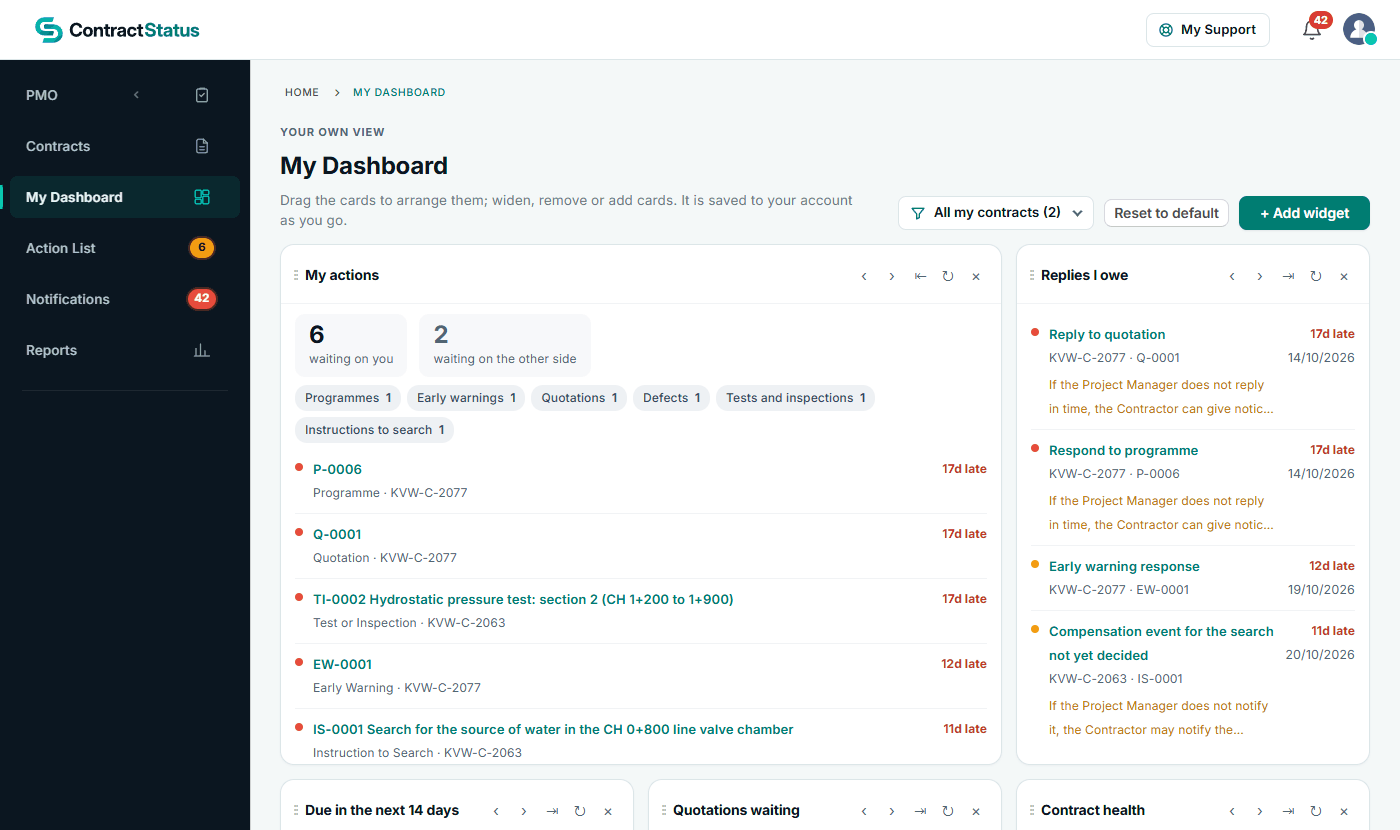
My Dashboard: what is waiting on you and which replies you owe. See the worked example.
See how this works in practice
Click through Contract Status with sample contracts: raise the notice, reply to it, and watch both sides of one record.
Take the guided tour Book a demo
Try an NEC role-play, use the free NEC tools or download free NEC templates.
This guide is general information in our own words, not legal advice. Your contract and its Contract Data always govern. NEC, NEC3 and NEC4 are trade marks of Thomas Telford Ltd; Contract Status is not affiliated with or endorsed by NEC.