
An NEC quantity surveyor forecasts more and looks back less. Change is priced at the time it happens, as an effect on Defined Cost plus the Fee, and not valued later against bill rates. On cost-based Options, the job also includes checking what cost the contract allows.
The contract doesn't actually mention a QS. You act for a Party or as a delegate of the Project Manager under clause 14.2, and you need that authority clear before you issue anything. This guide uses the NEC4 Engineering and Construction Contract (ECC). The NEC roles guide explains the named roles.
What changes from traditional contracts
| Traditional habit | NEC approach |
|---|---|
| Value variations using rates in the bill | Assess the effect on Defined Cost, with the resulting Fee (63.1). Rates are used only if both sides agree. |
| Settle the final account after Completion | Each compensation event is priced and implemented as you go, and generally isn't reopened (66.3). |
| Claim for loss and expense later | Time and money for a Client-side event are dealt with together, in one quotation (62.2). |
| Interim valuation of work done | The amount due is assessed on each assessment date, starting from the Price for Work Done to Date (50.1). |
| Contingencies held for change | Each quotation carries its own risk allowance, and the Contractor keeps or bears the difference once it is implemented |
Learn these definitions first
- Defined Cost: what the Schedule of Cost Components says counts, not everything you spent.
- Disallowed Cost: what the Project Manager takes out under Options C, D and E, such as cost lacking proper records.
- The Fee: the percentage on top, which covers overheads and profit outside Defined Cost.
- Price for Work Done to Date: how the payment figure is reached, which varies by main Option.
What the work looks like under each Option
| Option | Main QS task |
|---|---|
| A: activity schedule | Check which activities are complete. Activity schedule structure matters, because it drives cash flow. |
| B: bill of quantities | Measure work done. Handle changes in the final quantity under 60.4 to 60.6. Compensation events are still assessed on Defined Cost. |
| C: target with activity schedule | Audit Defined Cost, compare it with the target, and forecast the share under clause 54. |
| D: target with bill | As for C, with measured work setting the target. |
| E: cost reimbursable | Audit Defined Cost. There is no target. |
| F: management contract | Audit what is paid to Subcontractors, with its own payment rules. |
The NEC3 share clause was 53, not 54, and clause 53 in NEC4 is now the final assessment. Check the number on any old template.
A worked example: quoting a compensation event
A fictional Option C contract with illustrative figures and a Fee of 10%. An instruction under 14.3 adds a retaining wall. The instruction sets the dividing date, so all of this cost is forecast.
| Item | Amount |
|---|---|
| People (forecast) | £18,000 |
| Equipment | £7,000 |
| Plant and Materials | £22,000 |
| Risk allowance for matters with a real chance of occurring | £3,000 |
| Forecast Defined Cost | £50,000 |
| Fee at 10% | £5,000 |
| Change to the Prices | £55,000 |
Include the delay to planned Completion, measured against whichever Accepted Programme applied at the dividing date (63.5). If the Project Manager accepts, the event is implemented on that figure, and if the wall ends up costing more, the Prices don't move again. On Option C, the extra cost then flows through the target share. The Schedule of Cost Components guide explains how each line is built up.
What QSs get wrong when new to NEC
- Pricing from the bill by habit. Agree it first if you want to use rates.
- Leaving out time. A quotation needs the effect on dates too, even if it is nil.
- Missing the clock. Three weeks to quote, with two for a reply, leaves little room for slow subcontractor prices.
- Treating records as optional. Under cost-based Options, cost can be disallowed if it isn't justified by the accounts and records.
- Assuming a late event is safe. The eight weeks in 61.3 is one you must watch. See clause 61.3.
- Comparing NEC with a final account. On NEC4, the final assessment under 53.1 comes after the Defects Certificate, and it becomes conclusive unless a dispute is referred in time (53.3).
Monthly routine
- Prepare the application (or check it, if you act for the Client) before the assessment date.
- Review the compensation event register: what is due, what is overdue, what is implemented.
- Update the forecast of final cost and, on target contracts, the share.
- Reconcile site records to Defined Cost.
- Note anything for an early warning.
The NEC payment and Defined Cost guide has the rules behind each of these steps.
Related guides
- NEC Roles: Who Does What on an NEC Contract
- An NEC Guide for Commercial Managers
- What an NEC Contract Manager Does
- Project Manager Instructions
- The Adjudicator
- Senior Representatives
How this looks in Contract Status
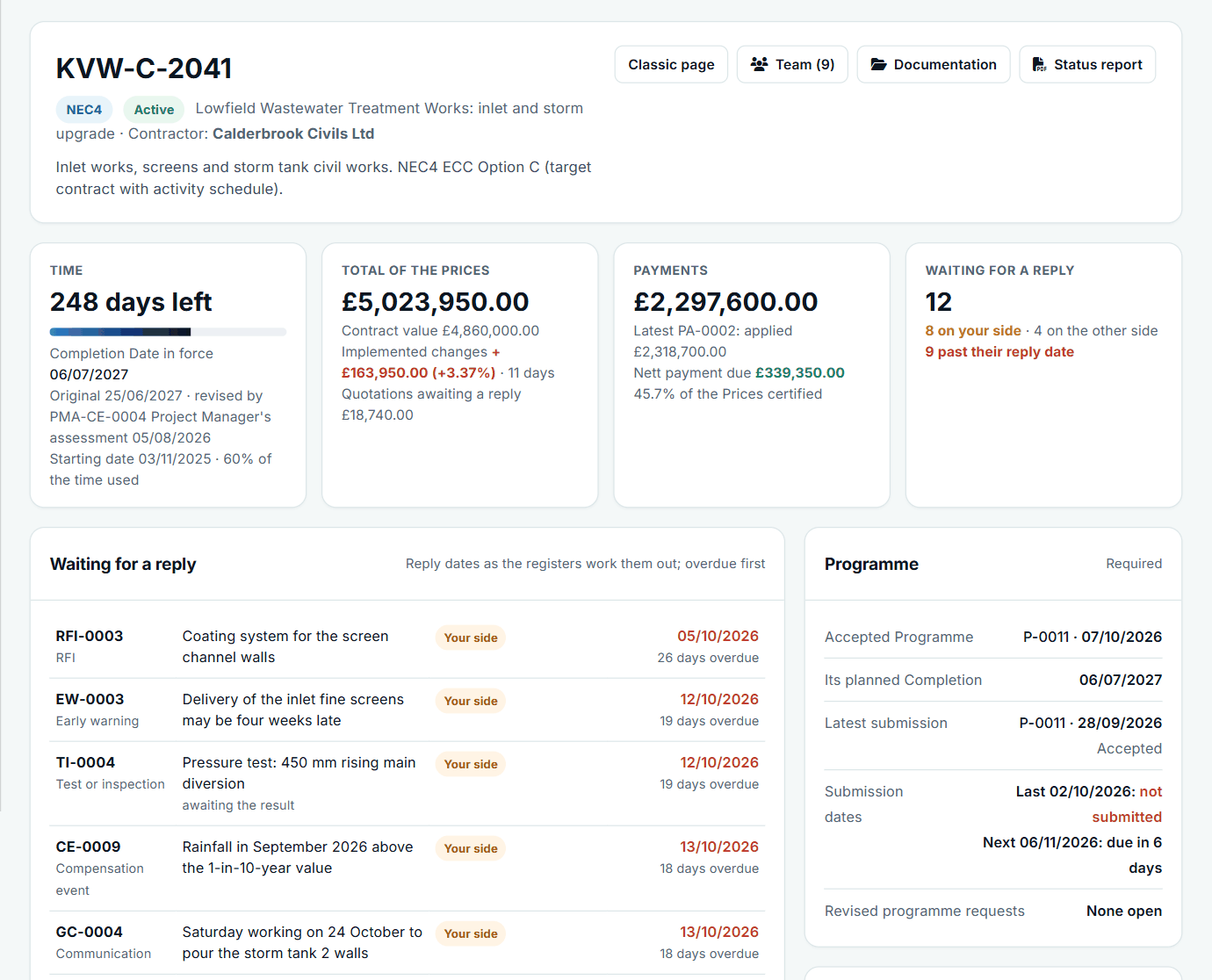
A contract at a glance: time, the total of the Prices, payments and replies waiting. See the worked example.
See how this works in practice
Click through Contract Status with sample contracts: raise the notice, reply to it, and watch both sides of one record.
Take the guided tour Book a demo
Try an NEC role-play, use the free NEC tools or download free NEC templates.
This guide is general information in our own words, not legal advice. Your contract and its Contract Data always govern. NEC, NEC3 and NEC4 are trade marks of Thomas Telford Ltd; Contract Status is not affiliated with or endorsed by NEC.