
NEC clause 61.3 gives the Contractor eight weeks from becoming aware of a compensation event to notify it. Miss that and, for most events, the Prices and dates do not change, however strong the event would otherwise have been.
It is the harshest rule in the compensation event process, and the one most likely to decide a contested event. It also has limits that are widely misunderstood. This page reads it for NEC4 ECC and notes NEC3; see the compensation events guide for the rest of the route. Other NEC forms have different periods: the NEC4 subcontract uses seven weeks, for example.
When the eight weeks start
| Edition | Clock starts on becoming aware | Effect |
|---|---|---|
| NEC4 ECC | That the event has happened | An event expected but not yet happened hasn't started the clock |
| NEC3 ECC | Of the event | Open to the argument that the clock starts when you first know of an event that is coming |
In both, it is awareness of the event, not awareness that it might be a compensation event. Time doesn't wait until someone in the commercial team realises it has contractual significance. If the foreman knew on Monday, assume the Contractor knew on Monday.
Which events are exempt
The time bar doesn't apply if the event arises from an instruction, notification, certificate or changed decision of the Project Manager or Supervisor (NEC3 also mentions correcting an assumption). These are the events that clause 61.1 says the Project Manager should notify. So the bar bites hardest on the following:
- Late access, or late Client-provided items: 60.1(2), (3)
- Others' work: 60.1(5)
- Missed replies: 60.1(6)
- Physical conditions and weather: 60.1(12), (13)
- Client's liabilities, breach and prevention events: 60.1(14), (18), (19)
A separate outer limit still applies to all events. Clause 61.7 stops notifications late in the contract: after the defects date in NEC3, and tied to the Defects Certificate in the NEC4 subcontract. Check the NEC4 ECC wording in your own contract.
How it works in NEC4's reply
Under NEC4 ECC, late notification is one of the listed reasons the Project Manager can give under clause 61.4 when saying the Prices and dates won't change. NEC3's 61.4 doesn't list it, though the bar still applies through 61.3. So a Project Manager relying on it under NEC3 should say so with reference to 61.3 itself.
A worked example
A fictional water treatment job. On 3 March, the Contractor's team hit an old concrete slab that the Site Information doesn't show. The site team works round it for three weeks. On 28 April, the QS spots the extra cost and asks whether it should be a compensation event.
| Date | Position |
|---|---|
| 3 March | Event happened; team aware. The clock starts |
| 28 April | Eight weeks exactly: this is the last day to treat as safe |
| 29 April onwards | Project Manager can reply that it is out of time |
The Contractor has hours, not weeks. The notice should go in that day, stating 3 March as the date of awareness, even though the costing isn't finished. A notice doesn't need a price, so an incomplete costing is no reason to wait.
Practical steps
- Brief site teams that any surprise, delay or Client failure gets reported the same day, even if it looks small.
- Review diaries, RFIs and meeting notes each week for anything that could be an event. A weekly contract routine helps.
- Log the date of awareness for each possible event, and count eight weeks from it.
- Notify early, on a one-event, one-notice basis. If it fails the tests, you've lost nothing.
- Set the deadline a week short. Don't plan to use the last day.
For the Project Manager
Keep the Contractor's date of awareness on record. If you think a notice is late, say so promptly, explain why and identify the evidence. If you already know of the event and could reasonably have notified it yourself, consider whether it really comes under 61.3. Don't let a time bar point go unanswered for weeks, since silence has its own consequences under 61.4.
Whether a time bar can be overcome by waiver, estoppel or some other argument is a legal question for your adviser. It is safer to treat it as absolute. More on the other limits to watch is in the guide to NEC time bars.
Related guides
- NEC Compensation Events: The Complete Guide
- Clause 61.4: Project Manager Decision
- Clause 61.5: Failure to Give an Early Warning
- Quotations for Compensation Events
- How to Notify a Compensation Event
- Clause 61.1: Project Manager Notification
How this looks in Contract Status
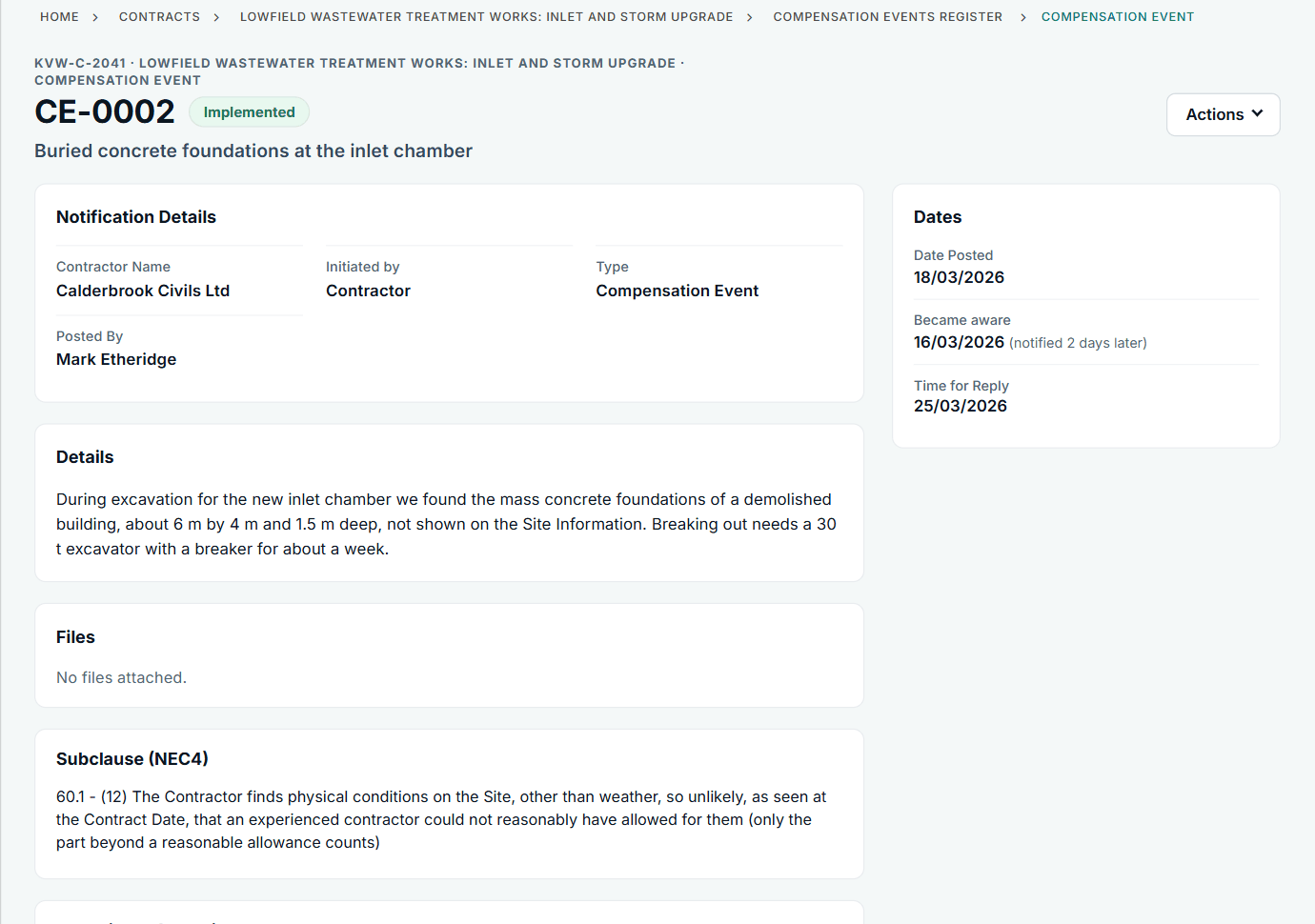
The record shows the date you became aware and how long you took to notify. See the worked example.
See how this works in practice
Click through Contract Status with sample contracts: raise the notice, reply to it, and watch both sides of one record.
Take the guided tour Book a demo
Take the NEC4 ECC quiz, use the free NEC tools or download free NEC templates.
This guide is general information in our own words, not legal advice. Your contract and its Contract Data always govern. NEC, NEC3 and NEC4 are trade marks of Thomas Telford Ltd; Contract Status is not affiliated with or endorsed by NEC.