
NEC clause 62.3 gives the Contractor three weeks to submit a quotation after being instructed, and the Project Manager two weeks to reply after it is submitted. Those are the standard ECC periods in both NEC3 and NEC4. Other NEC forms set different ones: the NEC4 subcontract has two weeks and four weeks, for example.
The reply period is fixed here and isn't the general period for reply in the Contract Data. That's easily missed. For how these periods fit into the rest of the route, see the compensation events guide.
The periods
| Action | By | Period | Clause |
|---|---|---|---|
| Submit quotation | Contractor | 3 weeks from the instruction | 62.3 |
| Reply | Project Manager | 2 weeks from submission | 62.3 |
| Submit revised quotation | Contractor | 3 weeks from the instruction | 62.4 |
| Extend either | Both, by agreement | Before the submission or reply is due | 62.5 |
| Quotation for a proposed instruction | Contractor (NEC4) | Check clause 65 in your contract | 65 |
NEC4 ECC's reply is an acceptance, an instruction for a revised quotation, or a statement that the Project Manager will assess the event. NEC3 ECC adds a fourth reply, for proposed instructions, that the instruction won't be given or the changed decision won't be made. NEC4 moved that to clause 65.
Extending the time
Clause 62.5 allows extension, and it's tighter than people assume:
- Both have to agree. Neither side can extend unilaterally.
- The agreement has to come before the submission or reply falls due. After that, it is too late to rely on this clause.
- The Project Manager tells the Contractor of the extension. Record the new date.
Extensions are sensible when the scope of the event is still being worked out, for example if a subcontractor's price depends on a survey. If the effects are genuinely uncertain, another option may fit better: the Project Manager can state assumptions under 61.6, which lets the quotation go ahead on time.
A worked timeline
These dates are from a fictional contract in a non-leap year, with all periods running in full and no extensions:
| Day | Event |
|---|---|
| 2 February | Project Manager instructs a quotation |
| 23 February | Quotation due (3 weeks) |
| 9 March | Project Manager's reply due, if the quotation arrived on the last day |
If the Contractor submits early, say on 11 February, the reply is due by 25 February. The two weeks run from submission, not from the end of the Contractor's period.
If the Contractor is late
The Contractor doesn't lose the event. Instead, the Project Manager gets the right to assess it (64.1). In practice, that means the Project Manager's figures, possibly on a less complete understanding of the cost, and they will be hard to reopen once implemented. Clause 64.3 gives the Project Manager the same three-week length of time from when the need for an assessment became apparent.
If the Project Manager is the one who needs longer, it doesn't lose anything by asking early. If you are a Contractor who needs more time, ask before the date, explain why and propose a new date. A late request is a request for a favour, not an exercise of the clause.
If the Project Manager is late
The Contractor can notify the failure to reply. If there's still no reply two weeks after that notification, the quotation is treated as accepted (62.6). The treated acceptance guide gives the details and exceptions.
Keeping track
Each open quotation has its own dates, and on a busy job many will be running at the same time. Log the instruction date, the due date, the submission date and the reply due date for each. The compensation event register and the guide to tracking periods for reply show how to do this without relying on memory. What the quotation should say is covered in the guide to NEC quotations.
Related guides
- NEC Compensation Events: The Complete Guide
- Failure to Reply: Treated Acceptance
- Revised Quotations: When and Why
- When the Project Manager Assesses a Compensation Event
- Clause 61.5: Failure to Give an Early Warning
- Quotations for Compensation Events
How this looks in Contract Status
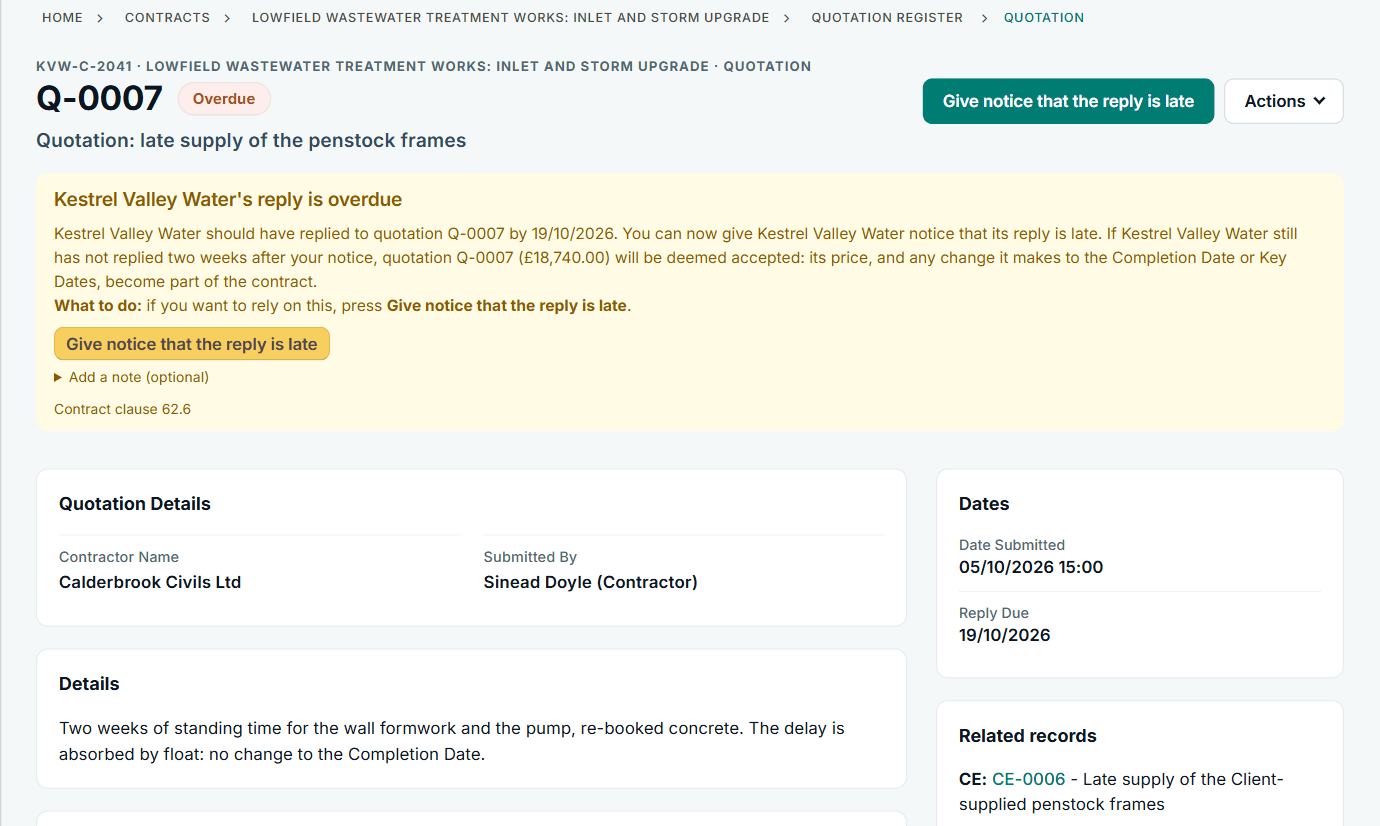
An overdue quotation from the Contractor side, with the notice under 62.6. See the worked example.
See how this works in practice
Click through Contract Status with sample contracts: raise the notice, reply to it, and watch both sides of one record.
Take the guided tour Book a demo
Take the NEC4 ECC quiz, use the free NEC tools or download free NEC templates.
This guide is general information in our own words, not legal advice. Your contract and its Contract Data always govern. NEC, NEC3 and NEC4 are trade marks of Thomas Telford Ltd; Contract Status is not affiliated with or endorsed by NEC.