
Under clause 60.1(7), it's a compensation event when the Project Manager instructs how to handle a valuable or historic object, or one of other interest, found on the Site. Note what the trigger is: the instruction, not the discovery.
That event pairs with clause 73.1, which sets out what happens when a find is made. It's the same in NEC3 and NEC4 ECC. The contract covers the commercial side only, through the normal compensation event process, and the law may add its own duties for finds such as human remains or items that could be treasure, so take advice on that part.
The sequence under clause 73.1
- The Contractor finds an object and has no title to it, however valuable.
- The Contractor tells the Project Manager.
- The Contractor leaves it where it is until instructed. Moving it without an instruction breaches the clause.
- The Project Manager instructs how to deal with it, and notifies a compensation event with that instruction (clause 61.1).
- The Contractor quotes for the effect of the instruction.
Because the instruction causes the event, the Project Manager notifies it. The Contractor can do so under 61.3 if that doesn't happen. A claim based on an instruction falls outside the time bar.
What counts as an object?
The contract doesn't give a list. Archaeological remains, old coins and historic structures are the obvious cases. "Other interest" is wide, and could include something of scientific or geological interest. An old foundation or a redundant culvert with no value or interest is more likely to be tested as a physical condition under 60.1(12), which has a much harder test.
| 60.1(7) object | 60.1(12) physical condition | |
|---|---|---|
| Trigger | An instruction on dealing with the find | Encountering the condition |
| Was it foreseeable? | Not part of the test | The heart of the test |
| Who normally notifies? | Project Manager | Contractor, and the time bar applies |
| What is assessed? | The effect of the instruction | Only the difference from what was reasonable to allow for |
If a find is both, the instruction route is usually the stronger.
How it is usually evidenced
- The record of the find: date, location, photographs and who was told.
- The Project Manager's instruction, and any later ones as specialists set out their requirements.
- Records of resources held or moved, and the area affected.
- Specialist attendance records, if the instruction requires the Contractor to work around them.
Worked example
A fictional water main replacement across farmland on Option C, with illustrative figures. In week 9, the trench gang uncovers what looks like a medieval pottery kiln, and tells the Project Manager the same day. Two days later, the Project Manager instructs that no work happens within 30 metres of the find until archaeologists have recorded it. The Contractor is to provide fencing and allow them access. A compensation event is notified with the instruction.
The archaeologists need three weeks. The gang moves ahead to the next section, leaving a gap to come back to.
| Effect | Defined Cost |
|---|---|
| Fencing and welfare for the archaeology team | £3,100 |
| Moving the gang and plant past the exclusion zone, and returning | £5,600 |
| Traffic and landowner access arrangements kept in place | £4,300 |
| Time-related cost for one week's delay to planned Completion | £9,000 |
| Total (the Fee is then added) | £22,000 |
The duration of the archaeology isn't known when the quotation is due, so the Project Manager states an assumption of three weeks (61.6). If it takes five, that becomes a corrected assumption, rather than a dispute about a wrong forecast.
Scope clauses for known archaeological areas may already require a watching brief or set out a procedure. If this work is already in the Scope, it should already be priced, so an instruction following that procedure may have little effect to assess. An instruction going beyond it is where the money lies.
How it is assessed
The dividing date is the day of the instruction (63.1). The two days before that, between the find and the instruction, are worth noting. The gang stopped because clause 73.1 forbids moving the object, but that standing cost came before the instruction, so it isn't obviously an effect of it. Show those days separately in the quotation, explain them and expect a discussion. A quick instruction keeps the gap short. Delay follows the normal programme-based approach, and the rest follows the usual assessment rules.
What people get wrong
- Notifying the discovery and calling that the event. Under this entry, no instruction means no event, so tell the Project Manager promptly and press for an instruction. Silence may lead to a separate question under 60.1(18) or to a complaint about the delay.
- Carrying on digging. Besides the legal risk, moving the object without instructions breaks the clause and undermines any assessment based on the disruption.
- Selling or keeping finds. The Contractor has no title. Materials dug up in the ordinary course are treated differently under 73.2, so a load of spoil isn't caught, though the coin in it is.
- Forgetting that an instruction to stop is a separate event. A stop instruction can also sit under 60.1(4). Quote once for the effect, and cite both.
Related guides
- NEC Compensation Events: The Complete Guide
- Compensation Event: A Changed Decision
- Compensation Event: Withholding Acceptance for Other Reasons
- Compensation Event: Tests and Searches Finding No Defect
- Compensation Event: Client or Others Not Working as Stated
- Compensation Event: Late Reply to a Communication
How this looks in Contract Status
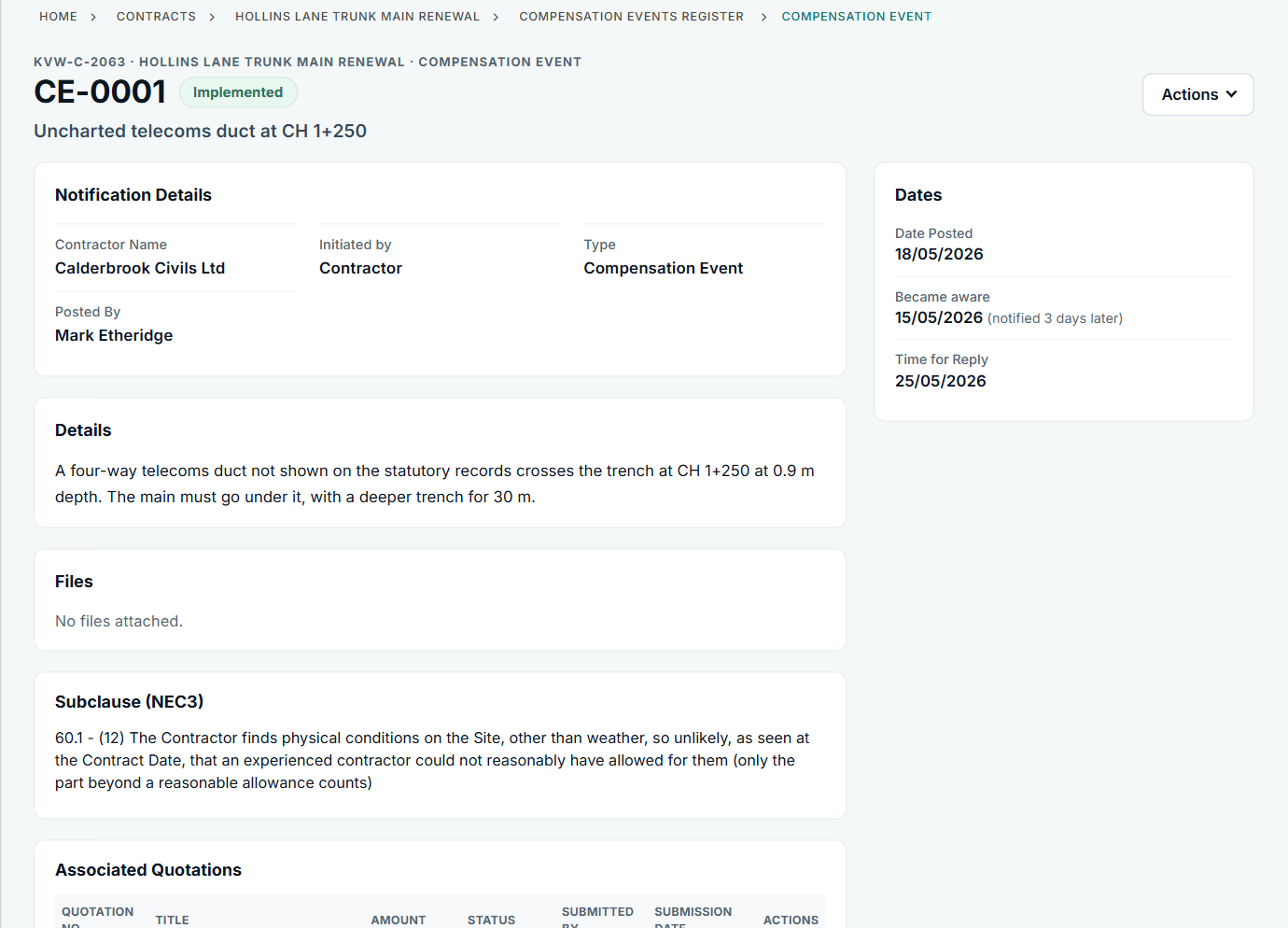
An uncharted duct notified as a compensation event on an NEC3 contract. See the worked example.
See how this works in practice
Click through Contract Status with sample contracts: raise the notice, reply to it, and watch both sides of one record.
Take the guided tour Book a demo
Take the NEC4 ECC quiz, use the free NEC tools or download free NEC templates.
This guide is general information in our own words, not legal advice. Your contract and its Contract Data always govern. NEC, NEC3 and NEC4 are trade marks of Thomas Telford Ltd; Contract Status is not affiliated with or endorsed by NEC.