
A compensation event is an event, listed in an NEC contract, for which the Contractor does not carry the risk. If one happens and it affects cost or time, the Prices and the Completion Date are reassessed so the Contractor isn't left worse off because of it. So when someone asks what is a compensation event, the short answer is: NEC's one mechanism for changing price and time.
The name is slightly misleading. It isn't a damages claim, it isn't necessarily a payment to the Contractor, and in limited cases it can reduce the Prices. It is a change to the contract's commercial baseline, worked out at the time.
What it covers
Under NEC4 ECC, the core list is at clause 60.1 and has 21 entries. They range from a Project Manager's instruction changing the Scope to unforeseeable ground conditions, exceptional weather and the Client missing a date on the Accepted Programme. The full NEC4 list shows each one. If it isn't listed there or in the Options you chose, it isn't a compensation event, although 60.1(18) catches a Client's breach of contract that nothing else covers.
What it replaces
Readers from other forms often look for these terms and don't find them. Under NEC they all come through the same door:
| Familiar idea | Under NEC |
|---|---|
| Variation or change order | An instruction changing the Scope, 60.1(1) (Works Information in NEC3) |
| Extension of time | A delay to the Completion Date, assessed within the same event |
| Loss and expense | The effect on Defined Cost, assessed within the same event |
| Unforeseen ground conditions claim | 60.1(12) |
| Client breach claim | 60.1(18), if no other event applies |
The practical difference is that price and time are settled together, for each event, close to when it happens. There is no separate claim at the end. Clause 63.6 makes the point that these changes are the parties' only rights in respect of the event.
What it gives each side
- The Contractor gets a changed price, based on the effect on Defined Cost plus the Fee, and more time if planned Completion moves or a Key Date is affected. It has a route to payment that doesn't depend on proving a breach.
- The Client gets an early view of what each change costs, while decisions can still be influenced, and a cut-off that stops old events being raised late.
- The Project Manager gets a clear set of questions to answer at each stage, each with its own deadline.
Why it matters so much
Compensation events decide the final commercial outcome on most NEC jobs, and the process is time-limited on both sides. A Contractor who misses the eight weeks under clause 61.3 can lose the entitlement altogether. A Project Manager who doesn't reply can find a quotation has been treated as accepted. Neither of these depends on whether the underlying event was strong or weak.
A quick test
When something happens on site, ask these questions in order. They mirror what the Project Manager will consider under clause 61.4.
- Is it on the list in your contract, including the Options and any events added in the Contract Data?
- Has it happened, or is it expected to?
- Was it free of any fault of the Contractor?
- Does it affect Defined Cost, Completion or a Key Date?
- If the Contractor is the one notifying, is it within the time allowed?
Five yeses mean it should go forward to quotation. The answer to the first question is worth writing down, with the sub-clause, in your notice.
Things it is not
- Not an early warning. A warning flags a risk; it doesn't start this process. They often concern the same matter, but they are separate notices.
- Not a final account item. Each event is implemented on its own and normally stays settled.
- Not limited to additional work. A late drawing or a test that holds work up may add no work at all and still qualify.
- Not an all-purpose remedy. The Contractor's own errors, and risks the contract leaves with it, stay with the Contractor.
For the full picture, including how the process and assessment work, go to the NEC compensation events guide. Readers more familiar with JCT may also find the JCT to NEC translation useful.
Related guides
- NEC Compensation Events: The Complete Guide
- The Full List of NEC4 ECC Compensation Events
- The Full List of NEC3 ECC Compensation Events
- The Compensation Event Process Step by Step
How this looks in Contract Status
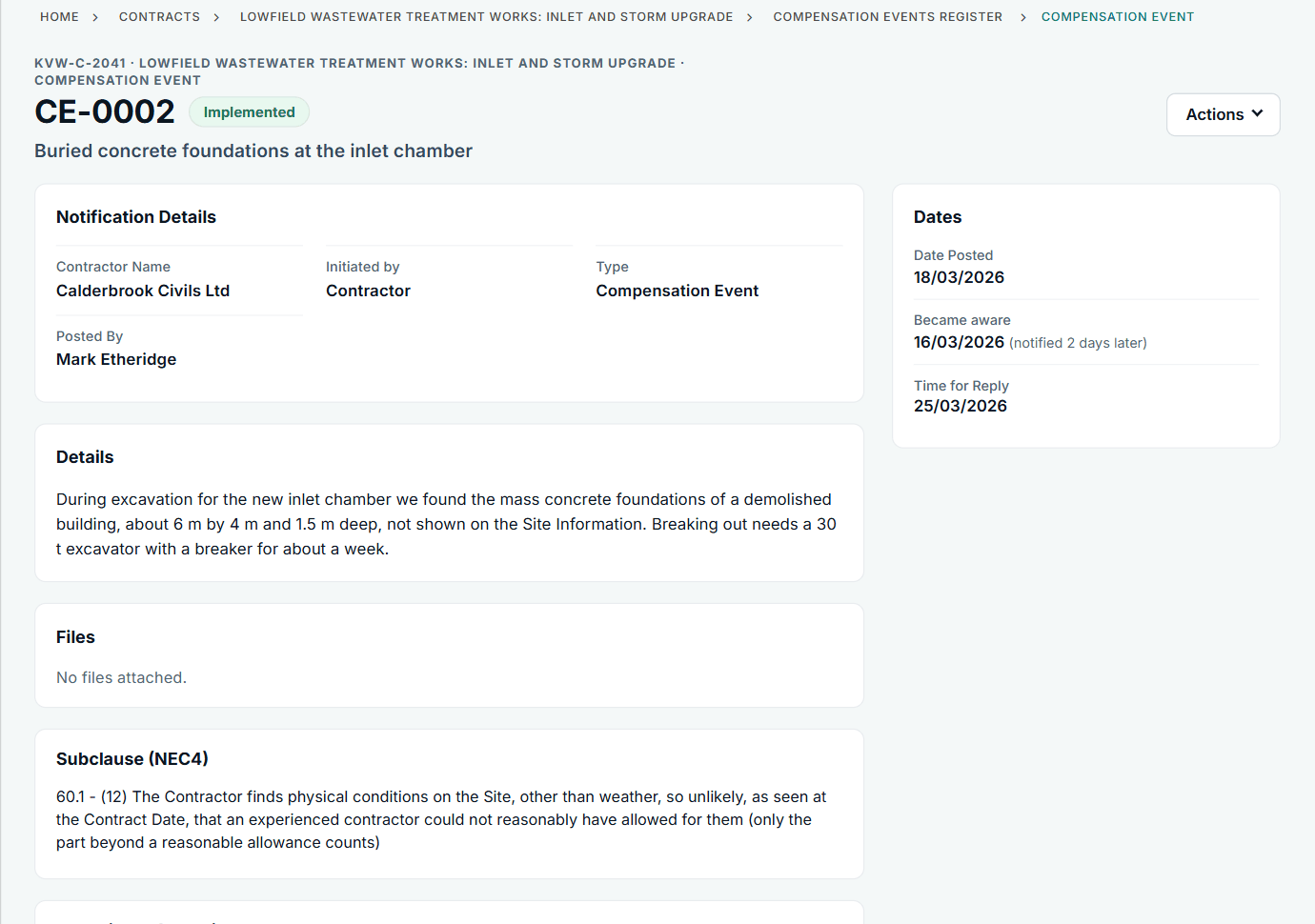
The record shows the date you became aware and how long you took to notify. See the worked example.
See how this works in practice
Click through Contract Status with sample contracts: raise the notice, reply to it, and watch both sides of one record.
Take the guided tour Book a demo
Take the NEC4 ECC quiz, use the free NEC tools or download free NEC templates.
This guide is general information in our own words, not legal advice. Your contract and its Contract Data always govern. NEC, NEC3 and NEC4 are trade marks of Thomas Telford Ltd; Contract Status is not affiliated with or endorsed by NEC.