
Yes. You can notify a compensation event without an early warning. NEC doesn't make a warning a condition of notification, so a compensation event without early warning remains valid under both NEC3 and NEC4 ECC. What can change is the assessment: if an experienced contractor could have warned, the event may be priced as though it had.
So the warning and the event are two separate mechanisms that overlap. This page explains how to run them side by side. The compensation events guide has the rest of the process.
How the two compare
| Early warning | Compensation event notice | |
|---|---|---|
| Purpose | Flag a risk so that it can be avoided or reduced | Start the process for changing Prices and dates |
| Who gives it | Contractor or Project Manager | Project Manager or Contractor, depending on the cause |
| Trigger | Becoming aware of a matter that could affect time, cost or quality | An event on the contract's list |
| Clause (NEC4 ECC) | Clause 15 | Clauses 61.1 and 61.3 |
| Clause (NEC3 ECC) | Clause 16 | Clauses 61.1 and 61.3 |
| Deadline | As soon as you become aware | Eight weeks for the Contractor, from awareness |
| Admission of anything? | No | Claims entitlement, for the Project Manager to answer |
The three scenarios
1. A warning was given, then an event arises
This is the ideal order. The warning goes on the register, and the parties discuss it. If the matter turns out to be a compensation event, the Contractor still notifies it separately. A warning doesn't stop the eight weeks. The assessment should reflect whatever was decided at the meeting.
2. No warning could have been given
A sudden event, such as a storm beyond the weather test or an unexpected collapse, may give no warning opportunity. The Contractor just notifies. If the Project Manager has no basis for a statement under clause 61.5, the assessment isn't affected.
3. A warning could have been given, but wasn't
The Contractor can still notify. If the Project Manager decides an experienced contractor could have warned, it says so in the instruction to submit quotations, and the event is assessed as if the warning had been given. The rule that does this is 63.7 in NEC4 ECC and 63.5 in NEC3 ECC. For how this affects the figures, see what happens when an early warning is missed.
What not to do
- Don't hold back a notice because you didn't warn. Lateness under 61.3 is much more damaging than a 61.5 statement: one can lose the event, while the other only adjusts it.
- Don't send a late warning as cover. Issuing one after the event, without saying so, won't help and could look bad in the record. If you did know earlier, deal with that honestly.
- Don't use one document for both. They do different jobs, and clause 13 asks for notifications to be separate. Two documents on the same day are fine.
- Don't assume the Project Manager's own knowledge fills the gap. It might be a useful answer to a 61.5 statement in practice, but the clause itself asks what the Contractor could have done.
What to do when both are needed
Suppose a Contractor learns on Tuesday that the Client's fabricated steel will arrive three weeks late, against a date on the Accepted Programme. Nothing has happened yet, and it's a fictional example. A sensible sequence:
- Give an early warning notice that day.
- Ask for it to be added to the register, and for a meeting to discuss options.
- Notify the compensation event under 60.1(3). It's expected to happen, so the Contractor can do that now under 61.3.
- Prepare the quotation when instructed, showing the options discussed.
Under NEC4, the eight weeks run from awareness that the event has happened, and a notice at this point is early. It does no harm, and it gets the discussion started. Further reading is in what should be an early warning.
Related guides
- NEC Compensation Events: The Complete Guide
- Compensation Event vs Relief Event
- Keeping a Compensation Event Register
- Compensation Event Flow Chart Explained
- Compensation Events Under Option C
- Compensation Events Under Option E
How this looks in Contract Status
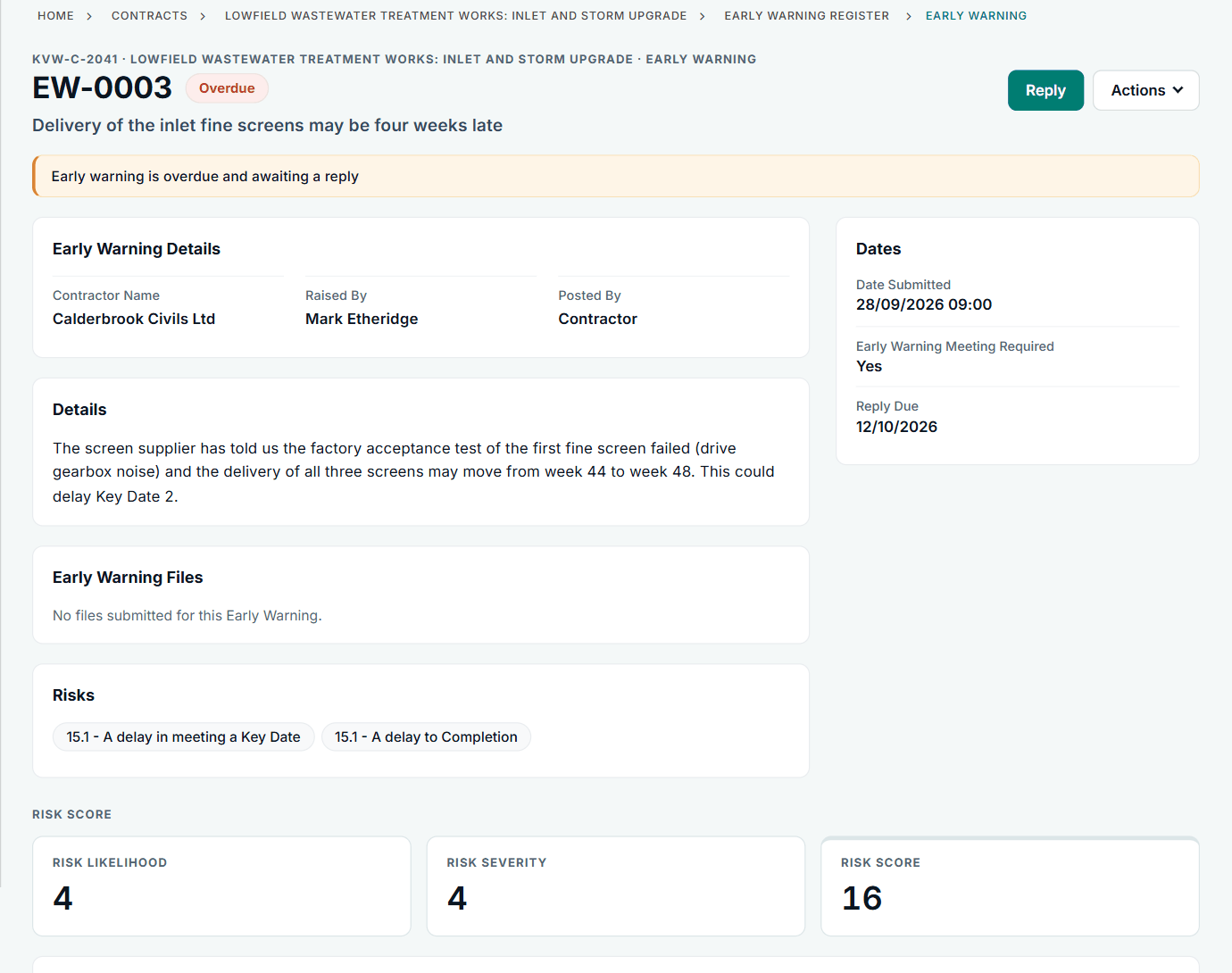
An early warning in Contract Status, with its risks, reply date and score. See the worked example.
See how this works in practice
Click through Contract Status with sample contracts: raise the notice, reply to it, and watch both sides of one record.
Take the guided tour Book a demo
Take the NEC4 ECC quiz, use the free NEC tools or download free NEC templates.
This guide is general information in our own words, not legal advice. Your contract and its Contract Data always govern. NEC, NEC3 and NEC4 are trade marks of Thomas Telford Ltd; Contract Status is not affiliated with or endorsed by NEC.