
An NEC quotation for a compensation event is the Contractor's proposal for how the Prices, the Completion Date and Key Dates should change, with details of its assessment and any programme alterations. It isn't a tender price or a commercial offer: it is an assessment, and it follows the rules in clause 63.
Clause 62.2 sets out the content in NEC4 ECC and NEC3 ECC. The Contractor sends it within three weeks of being instructed (clause 62.3). The overall route is in the compensation events guide.
What goes in
| Part | What to provide |
|---|---|
| Reference | The event, its notice and the instruction to quote |
| Change to the Prices | The total, built up from Defined Cost done, forecast Defined Cost and Fee, in the form your main Option requires |
| Delay | Change to the Completion Date and each affected Key Date, or a clear statement of none |
| Details | People, Equipment, Plant and Materials, subcontractors and any charges behind the figures, with quantities and rates |
| Risk allowances | What each one covers, its likelihood and how you sized it |
| Programme | Alterations to the Accepted Programme if the remaining work changes, or a marked-up extract showing the critical path |
| Assumptions | Any stated by the Project Manager under 61.6, used as given |
| Basis | The dividing date, and how the effect is measured against it |
The quotation template lays this out. The cost basis comes from the Schedule of Cost Components, and rules for the assessment itself are on the page for clause 63. Parties can also agree rates or lump sums (63.2 in NEC4; 63.14 in the relevant NEC3 Options).
Dealing with the programme
If the event alters the programme for the remaining work, the alterations go in the quotation. That doesn't mean a full replacement programme each time. It means showing the planned sequence before and after, with enough detail for the Project Manager to check the delay claimed.
Two points deserve extra care:
- Use the Accepted Programme in force at the dividing date as your starting point (NEC4). See assessing delay to Completion.
- If the programme required under the contract hasn't been sent, or the latest has been rejected for a contract reason, the Project Manager can assess the event itself under clause 64. A good quotation can be defeated by a programme problem.
Alternative quotations
Under clause 62.1, the Project Manager can instruct alternative quotations after discussing with the Contractor the practical ways of dealing with the event. The Contractor provides those and can add others of its own. The discussion comes first, so the instruction shouldn't just appear in the post.
Here's a fictional example: a Client's signalling equipment will arrive six weeks late. Illustrative options might be:
| Quotation | Approach | Prices | Delay |
|---|---|---|---|
| A | Hold the sequence and wait | +£85,000 | 6 weeks |
| B | Re-sequence with a second crew | +£120,000 | 2 weeks |
| C | Contractor's idea: temporary hire of equivalent equipment | +£150,000 | None |
The Project Manager picks the option suited to the Client's priorities and accepts that quotation. This is one of the more useful features of the clause, and one of the least used.
Common mistakes
- Pricing at tender rates. Unless agreed otherwise, the assessment is about Defined Cost and Fee, not bill rates. This surprises many people from a measured contract background.
- A single lump figure. With no details, the Project Manager has grounds to send it back or make its own assessment.
- Stacked contingencies. Risk allowances are allowed for matters with a significant chance of occurring (63.8 in NEC4; 63.6 in NEC3), not as a general margin. Each one should be explained.
- Pricing other events into this one. Matters that are compensation events in their own right should be notified and assessed separately.
- Waiting to see actuals. The contract expects a forecast for work still outstanding at the dividing date, and it assumes prompt, competent reaction (63.9 in NEC4; 63.7 in NEC3).
- Ignoring early warning statements. If clause 61.5 has been invoked, address it.
Quotations for proposed instructions
The Project Manager can also ask for a price before deciding whether to instruct something. In NEC4 ECC this has its own clause, 65: the Project Manager says by when it may give the instruction, and the Contractor doesn't act on it unless it's given. If the quotation isn't accepted, 60.1(20) makes that a compensation event in its own right, so the Contractor can recover its cost of pricing. Under NEC3, proposed instructions sit in 61.2 and 62.3. The NEC4 proposed instructions guide has more.
Related guides
- NEC Compensation Events: The Complete Guide
- Clause 62.3: Time to Submit and Reply
- Failure to Reply: Treated Acceptance
- Revised Quotations: When and Why
- Clause 61.4: Project Manager Decision
- Clause 61.5: Failure to Give an Early Warning
How this looks in Contract Status
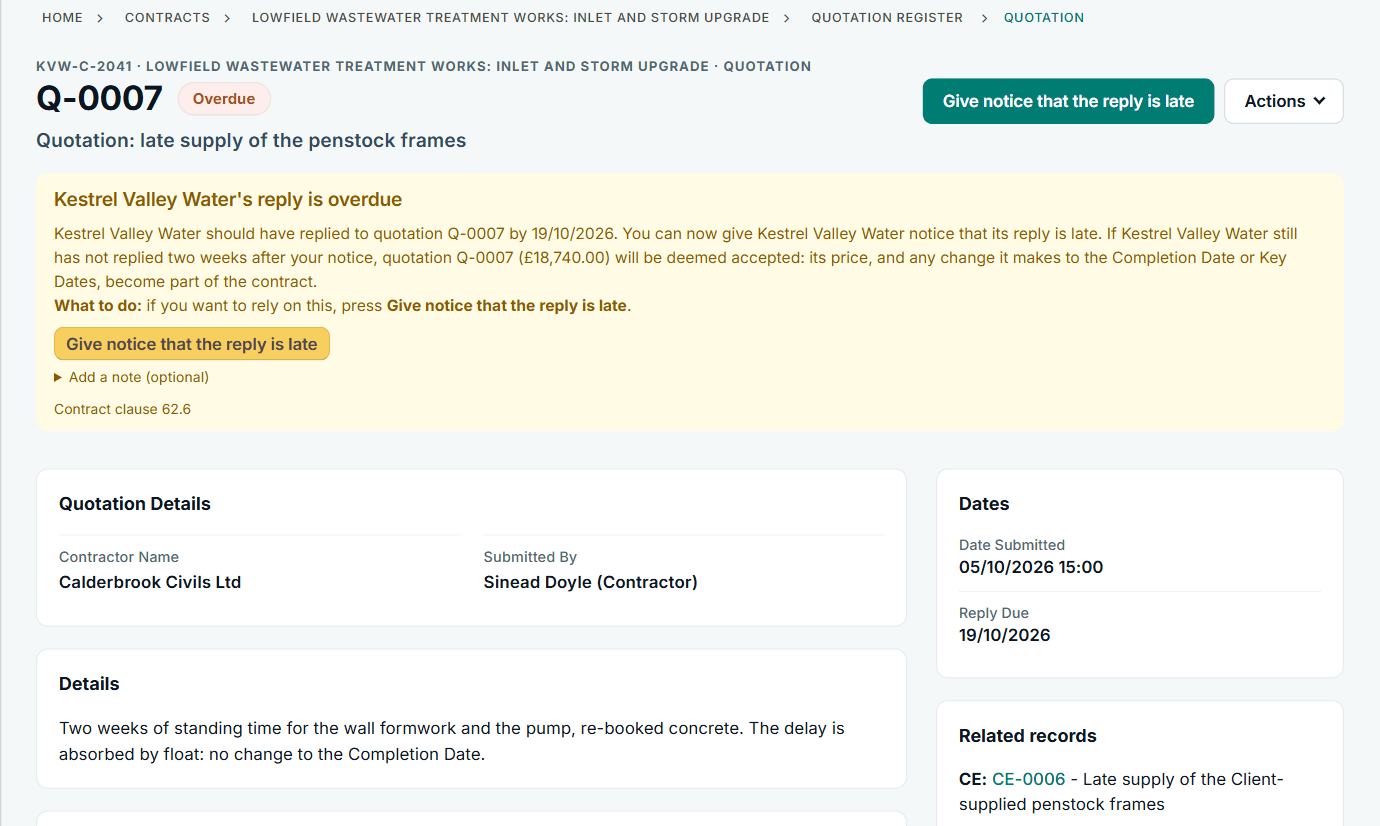
An overdue quotation from the Contractor side, with the notice under 62.6. See the worked example.
See how this works in practice
Click through Contract Status with sample contracts: raise the notice, reply to it, and watch both sides of one record.
Take the guided tour Book a demo
Take the NEC4 ECC quiz, use the free NEC tools or download free NEC templates.
This guide is general information in our own words, not legal advice. Your contract and its Contract Data always govern. NEC, NEC3 and NEC4 are trade marks of Thomas Telford Ltd; Contract Status is not affiliated with or endorsed by NEC.