
Clause 60.1(6) makes it a compensation event when the Project Manager or Supervisor doesn't reply to a Contractor's communication within the period the contract requires. It's an easy one to prove and often a small one to value, so whether it's worth notifying depends on what the delay did.
The wording is effectively the same in NEC3 and NEC4 ECC. The main difference sits around it: NEC4 has more deemed-acceptance rules, which can apply in addition to this and the other compensation events.
What triggers it
- It's a communication from the Contractor. The other way round isn't covered, and neither is a late reply from the Client itself.
- The contract requires a reply. Clause 13.3 sets the general period for reply where a reply is required, and 13.4 requires an answer to anything submitted for acceptance. A general update or a question with no contractual basis doesn't start a clock, however courteous a reply would be.
- The period passes with no reply. A timely reply that says no is still a reply. If that "no" is for a reason the contract doesn't give, look at 60.1(9) instead.
Which period applies?
| Communication | Period | Also in play |
|---|---|---|
| General communication requiring a reply | The period for reply in the Contract Data | 13.3 |
| Submission for acceptance | The period for reply, unless stated otherwise | 13.4 |
| Programme for acceptance | Two weeks under 31.3 | NEC4 has a deemed acceptance route; NEC3 doesn't |
| Contractor's notified compensation event, or quotation | The periods in 61.4 and 62.3 | Deemed outcomes after a further notice (61.4, 62.6) |
Periods can be extended under 13.5 only if both sides agree before the reply is due. An extension agreed in time means no event. One proposed after the deadline doesn't fix the lateness, though the Contractor can decide not to pursue it. Many contracts amend these periods, so check your own Contract Data and Z clauses.
How it is usually evidenced
This one lives on dates: when the communication was issued, when the reply fell due and when it actually came. On top of that, you need to show what the Contractor couldn't do in the meantime. Contract correspondence logs do the first part, and diaries, order records and programme updates do the second. Clause 61.4 will take you nowhere without an effect on Defined Cost, Completion or a Key Date.
Worked example
A fictional hospital plant-room refurbishment on Option A, with illustrative figures. The period for reply is two weeks. On Monday 2 February, the Contractor submits a proposed mechanical Subcontractor for acceptance under clause 26.2. It can't appoint the firm until accepted. The firm's price holds until 20 February, and the plant has a 16-week lead time.
| Date | What happened |
|---|---|
| 2 Feb | Submission |
| 16 Feb | Reply due. Nothing received. The Contractor reminds the Project Manager the same day, and warns of the price expiry |
| 25 Feb | Acceptance arrives, nine days late. The Subcontractor's price has gone up £6,500, and the plant order goes in nine days later |
| 26 Feb | Contractor notifies under 60.1(6) |
The plant delivery sits on the critical path, and float on that route is four days. So planned Completion moves by five days. The assessment covers the £6,500 Subcontract increase, five days of time-related cost at an illustrative £2,300 a day (£11,500) and the resulting Fee. Whether the price increase is recoverable in full turns on what the Contractor could reasonably have done to avoid it, as 63.9 assumes a competent, prompt reaction. Asking the firm to extend its price would have been a sensible first move, and this should be on the record.
How it is assessed
The Contractor notifies the event, so the time bar in 61.3 applies, because a late reply is silence rather than an instruction or notification. The dividing date is the day of notification. The effect is measured from what was planned on the Accepted Programme current at that date, as usual for any assessment.
What people get wrong
- Notifying every late reply. Where nothing was affected, the answer is a 61.4 reply that nothing changes. Tracking late replies and raising them at a progress meeting often works better.
- Not notifying the one that mattered. Small delays can matter when they hit a long-lead order. Check for knock-on effects before you decide.
- Counting from the wrong person. A communication to the wrong person can't be relied on. Send it to the Project Manager or Supervisor, as the contract says.
- Treating technical queries as automatic. A query form doesn't itself create a duty to reply. Tie it to an ambiguity, a submission or a Scope requirement.
- Project Managers replying "noted". A vague reply to a submission isn't acceptance and doesn't give reasons, so the Contractor is left stuck. Accept it, or say why not.
Related guides
- NEC Compensation Events: The Complete Guide
- Compensation Event: Objects of Value or Interest Found
- Compensation Event: A Changed Decision
- Compensation Event: Withholding Acceptance for Other Reasons
- Compensation Event: Instruction to Stop or Not Start Work
- Compensation Event: Client or Others Not Working as Stated
How this looks in Contract Status
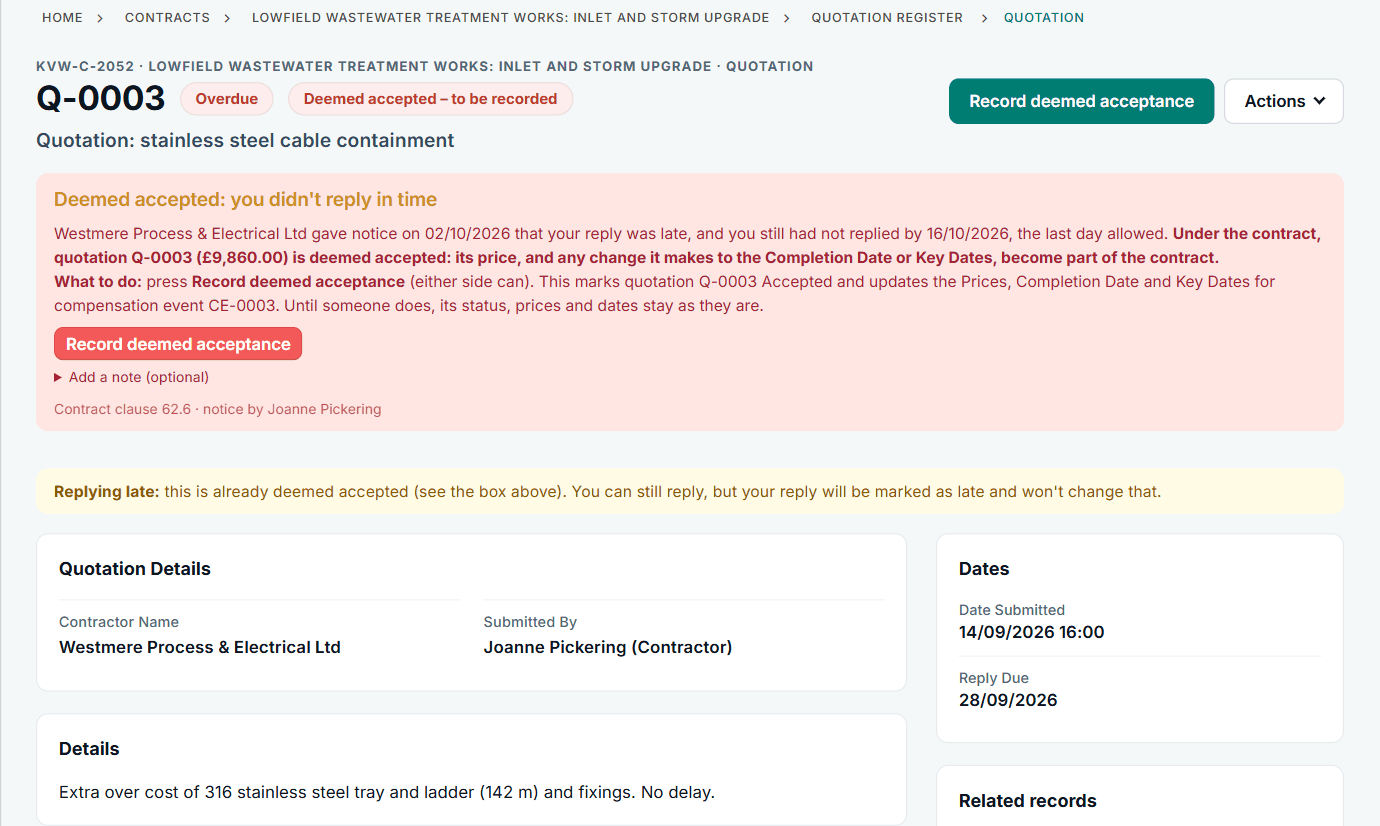
A quotation treated as accepted, as the Client side sees it. See the worked example.
See how this works in practice
Click through Contract Status with sample contracts: raise the notice, reply to it, and watch both sides of one record.
Take the guided tour Book a demo
Take the NEC4 ECC quiz, use the free NEC tools or download free NEC templates.
This guide is general information in our own words, not legal advice. Your contract and its Contract Data always govern. NEC, NEC3 and NEC4 are trade marks of Thomas Telford Ltd; Contract Status is not affiliated with or endorsed by NEC.