
Under clause 60.1(9), it's a compensation event when the Project Manager withholds an acceptance for a reason the contract doesn't give. The Project Manager keeps the freedom to say no, but saying no for a reason outside the contract moves the cost to the Client. Clause 13.8 confirms the other side: a reason stated in the contract isn't an event.
The rule is the same in NEC3 and NEC4 ECC, and there are two exceptions, both for quotations: acceleration and leaving a Defect uncorrected. The Project Manager can refuse those freely.
The stated reasons
These are the common submissions and the stated reasons for NEC4 ECC. Read your own contract, as Z clauses may add to them.
| Submission | Clause | Stated reasons for not accepting |
|---|---|---|
| Programme | 31.3 | Plans not practicable; required information missing; plans not realistically shown; doesn't comply with the Scope |
| Contractor's design | 21.2 | Doesn't comply with the Scope or the applicable law |
| Proposed Subcontractor | 26.2 | The appointment would stop the Contractor providing the works |
| Subcontract documents | 26.3 | Includes that they would stop the Contractor providing the works, and that they leave out a statement on working in mutual trust and co-operation |
| Anything submitted for acceptance (NEC4) | 13.4 | More information is needed to judge the submission fully |
What triggers it
- The contract gives the Project Manager something to accept.
- The Contractor submits it.
- The Project Manager replies with a reason that isn't one the contract gives for that submission.
The reason doesn't have to be stated badly, or in bad faith. A sensible commercial preference is still outside the list. That's the point of the clause. If the Client has a real need, the Project Manager can achieve it through a change to the Scope, as a 60.1(1) event.
The entry concerns the reason, not the timing. No reply at all is 60.1(6) instead. And an acceptance previously given and then withdrawn is 60.1(8).
How it is usually evidenced
- The submission, complete with what it was offered for.
- The reply, which is usually the whole case. Clause 13.4 requires reasons in enough detail for the Contractor to correct the matter.
- The clause that gives the reasons for that kind of submission.
- The cost and time effect of the alternative the Contractor then had to follow.
Worked example
A fictional highway drainage scheme on Option C, with illustrative figures. The Contractor proposes Firm A as its drainage Subcontractor. The firm is competent, available and has a sound record. The Project Manager replies that it won't accept Firm A, because the Client wants to use businesses from its own local area. Nothing in the Scope says so.
The reason isn't one given in 26.2. The Contractor can't appoint until the firm is accepted, so it proposes Firm B, which is accepted. Firm B's price is £38,000 higher and it can't begin for two weeks.
| Effect | Defined Cost |
|---|---|
| Price difference between Subcontractors | £38,000 |
| Site running costs for one week's delay to planned Completion | £8,500 |
| Total (the Fee is then added) | £46,500 |
The Contractor notifies under 60.1(9), and the Completion Date moves by a week. If the Client's local preference had been in the Scope at tender, there'd be no event, since the Contractor would have priced it and Firm A wouldn't have met the Scope in the first place.
How it is assessed
Notify promptly. Withholding acceptance is a reply rather than obviously an instruction or notification, so treat the time bar as applying rather than relying on an exemption. The effect is the difference between the work as it would have been with acceptance and the work as it now has to be done. Measure delay from the Accepted Programme in force on the dividing date.
A programme that isn't accepted
Where a programme is rejected for a reason not on the 31.3 list, the Contractor may have no cost effect at first. The harm appears when the next compensation event is assessed on an old programme. So don't ignore it because it seems harmless today. A note saying the reason isn't a listed one, and resubmitting, keeps the position clear. The guide to the Accepted Programme covers why that baseline matters.
What people get wrong
- Project Managers using a general "not acceptable". Tie every refusal to the listed reason, or be ready for the event. If there's a client preference behind it, instruct it as a change.
- Contractors assuming any refusal is an event. A design that doesn't meet the Scope can be refused all day. The test is whether the reason is on the contract's list.
- Thinking a rejected quotation fits here. Quotations have their own route under 62.3 and the Project Manager's assessment. Quotations for acceleration and for leaving a Defect are also expressly excluded.
- Accepting a "resubmit" loop. A list of comments outside the Scope, repeated for several rounds, can be a withheld acceptance. Ask which reason applies.
- Relying on memory of the list. The reasons vary with the clause, the edition and the Z clauses. Check them each time.
Related guides
- NEC Compensation Events: The Complete Guide
- Compensation Event: Tests and Searches Finding No Defect
- Compensation Event: Test or Inspection Causing Delay
- Compensation Event: Physical Conditions
- Compensation Event: Objects of Value or Interest Found
- Compensation Event: A Changed Decision
How this looks in Contract Status
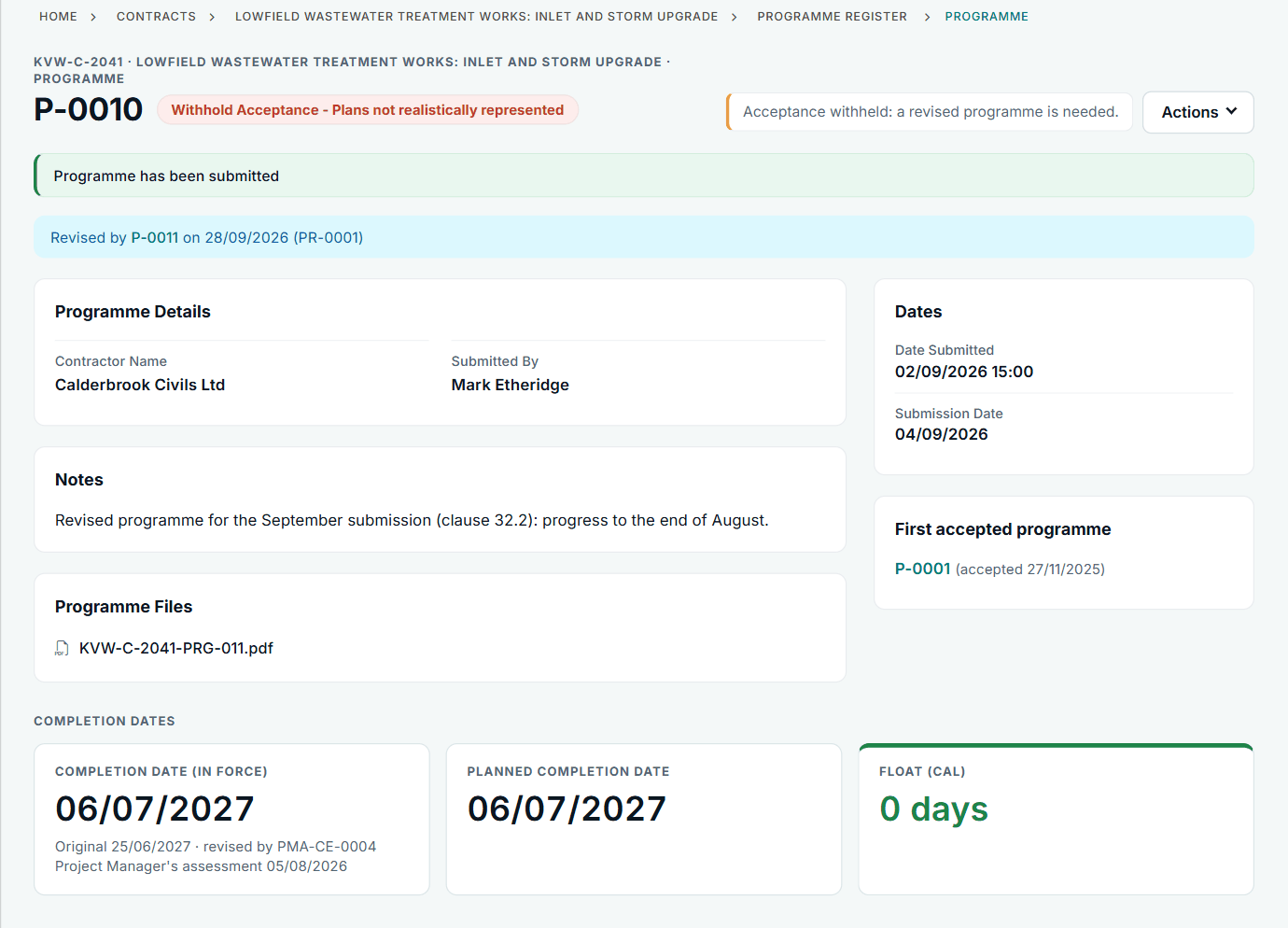
A programme not accepted, from the Contractor side, with the reason in its status. See the worked example.
See how this works in practice
Click through Contract Status with sample contracts: raise the notice, reply to it, and watch both sides of one record.
Take the guided tour Book a demo
Take the NEC4 ECC quiz, use the free NEC tools or download free NEC templates.
This guide is general information in our own words, not legal advice. Your contract and its Contract Data always govern. NEC, NEC3 and NEC4 are trade marks of Thomas Telford Ltd; Contract Status is not affiliated with or endorsed by NEC.