
An NEC revised quotation is what the Project Manager instructs when a Contractor's quotation needs another attempt. Clause 62.4 allows it only after the Project Manager has explained why, and the Contractor then has three weeks to resubmit. The rule is the same in NEC3 and NEC4 ECC.
It's one of three permitted replies to a quotation, alongside acceptance and the Project Manager's own assessment. Choosing the right one is a matter of judgement rather than a set rule, as the sections below show. See the compensation events guide for the whole process.
Revise or assess?
| Situation | Better reply | Why |
|---|---|---|
| A figure has been missed or a rate is wrong, and the Contractor can fix it quickly | Revised quotation | The Contractor keeps ownership of the assessment, with little effort |
| The two sides have different views of the facts, and more information would help | Revised quotation | Gives the Contractor the chance to supply evidence |
| The Project Manager wants a different method, and hasn't said so yet | Discussion first, then alternative quotations or a revised quotation | Clause 62.1 is written for this |
| Quotation has already been round twice with no movement | Own assessment | Another round only adds time |
| The dispute is about a point of principle | Own assessment | Settles the position; the Contractor can use the dispute route |
| No programme or a programme problem | Own assessment | Clause 64.1 lets the Project Manager do this anyway |
What the reasons should say
The contract asks only for an explanation. It doesn't say what makes a reason good enough. A useful one is specific enough for the Contractor to act on. Compare these two, from a fictional job:
- Weak: "The quotation is too high and doesn't reflect the Defined Cost."
- Useful: "The 14-week Equipment hire for the crane doesn't match the 9-week lift period shown in your programme. The allowance for a groundwater risk overlaps with the assumption stated in our instruction. Please reassess both and resubmit."
Reasons that often come up, and that are worth considering:
- The cost items fall outside the Schedule of Cost Components.
- Resources don't match the programme.
- The dividing date, the Fee percentage or a stated assumption has been wrongly applied.
- Risk allowances lack a basis or duplicate each other.
- The delay isn't shown on the programme.
- An early warning statement under clause 61.5 isn't reflected.
"We have only got budget for half of it" isn't a reason. Neither is a Client's instruction to bring the number down, since the Project Manager has to apply the contract.
Timing
- The Project Manager explains its reasons, then instructs, within the two-week reply period (clause 62.3). A conversation followed by a written instruction works well, as long as the instruction records what was said.
- The Contractor resubmits within three weeks.
- The Project Manager replies again. Treat the two-week reply period as running again from the new submission, and the treated acceptance route as available for a revised quotation just as for a first one.
Each full round adds up to five weeks, so a second round means the event has taken about ten weeks after the first reply. Costs may have moved on, and part of the forecast may have become fact, although the dividing date stays where it was.
The contract doesn't limit the number of rounds. However, it's a good discipline to allow one, and only rarely a second, before moving to an assessment. Repeated requests with no new reasons can look like avoiding a decision.
For the Contractor
- Read the reasons. Where they're right, change the quotation. Where they aren't, explain why in the resubmission and keep the original basis.
- Don't resubmit the same document unchanged with a new date. That hands the Project Manager the argument that the event wasn't correctly assessed, and that its own assessment is justified (64.1).
- If the reasons don't make sense, ask. A short meeting usually costs less than a three-week cycle.
- If you are worried about the outcome, set out in writing what you think the correct position is. See the guide to the Project Manager's assessment for what may follow.
Revised quotations also apply in NEC4 to a proposed instruction. There, the Project Manager gives its reasons with the instruction under 65.2.
Related guides
- NEC Compensation Events: The Complete Guide
- When the Project Manager Assesses a Compensation Event
- Assessing a Compensation Event: Clause 63
- Assessing Delay to Completion
- Clause 62.3: Time to Submit and Reply
- Failure to Reply: Treated Acceptance
How this looks in Contract Status
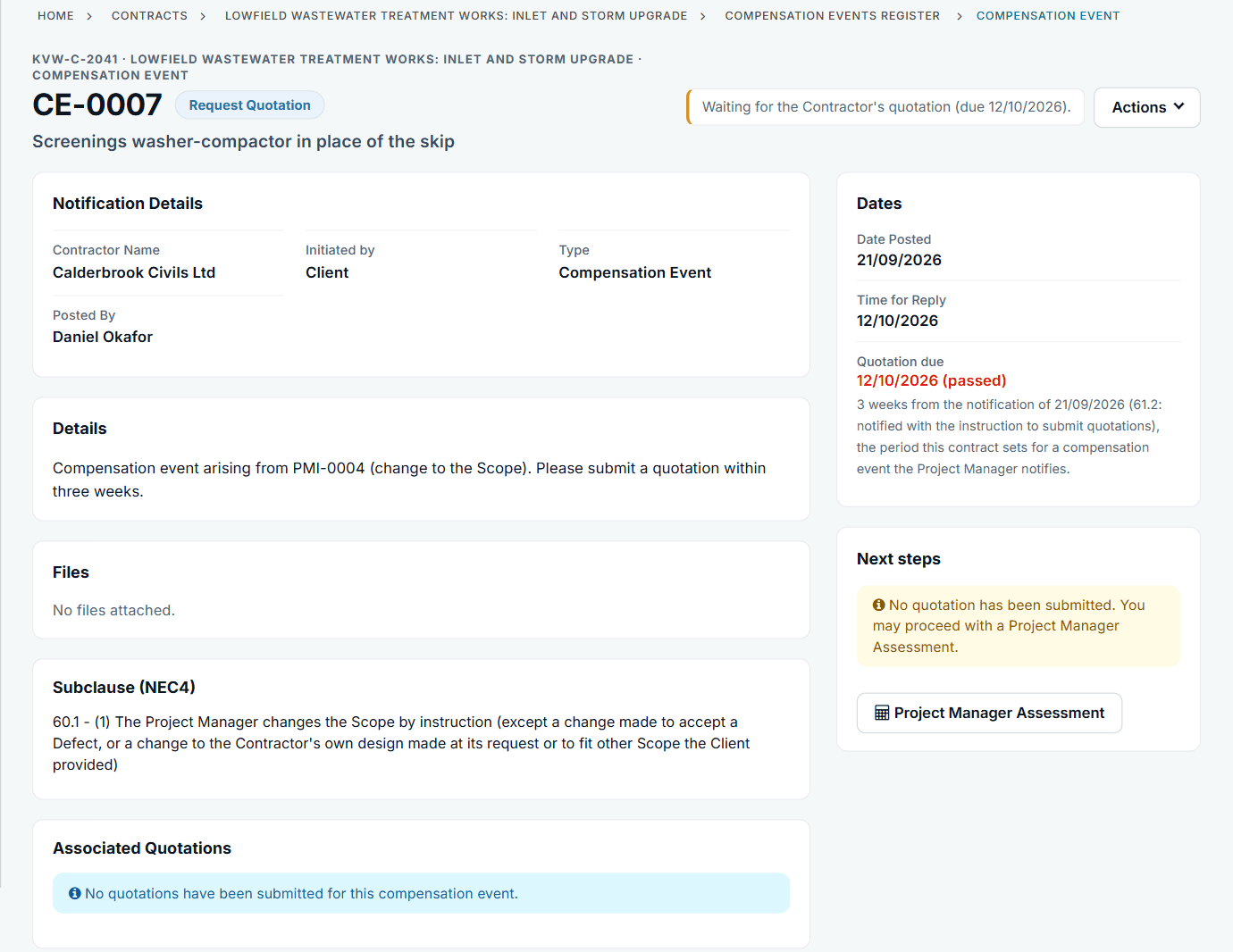
The quotation date has passed, and the record offers the Project Manager's assessment. See the worked example.
See how this works in practice
Click through Contract Status with sample contracts: raise the notice, reply to it, and watch both sides of one record.
Take the guided tour Book a demo
Take the NEC4 ECC quiz, use the free NEC tools or download free NEC templates.
This guide is general information in our own words, not legal advice. Your contract and its Contract Data always govern. NEC, NEC3 and NEC4 are trade marks of Thomas Telford Ltd; Contract Status is not affiliated with or endorsed by NEC.