
NEC clause 61.4 is where the Project Manager decides whether an event the Contractor has notified is a compensation event. It has one week, unless the Contractor agrees to longer, and there are only two possible answers: nothing changes, with reasons, or it qualifies and quotations are instructed.
Note what the decision isn't. It doesn't settle how much the event is worth, and it doesn't apply to events the Project Manager notified itself. For the overall picture, see the compensation events guide.
The tests
The Project Manager says the Prices and dates won't change if any of these applies. Otherwise, the event is a compensation event.
| Reason for no change | What it means in practice | NEC4 ECC | NEC3 ECC |
|---|---|---|---|
| The Contractor's fault | The Contractor's own failure caused it. A poor workmanship delay is the classic case | Yes | Yes |
| Not happened, not expected | The feared event isn't going to occur, or the facts don't show it | Yes | Yes |
| Notified too late | Outside the timescales in the conditions, usually the eight weeks at clause 61.3 | Yes | Not listed; the bar still applies via 61.3 |
| No effect | It doesn't touch Defined Cost, Completion or a Key Date | Yes | Yes |
| Not on the list | It isn't one of the compensation events in the contract | Yes | Yes |
Those reasons form a closed list. "We have no budget for it" and "it should have been in your tender" aren't on it, unless the second of those is really a way of saying the event doesn't meet the test in the sub-clause. In NEC4 the reply gives reasons; under NEC3 it's wise to give them even so.
Reading the tests properly
- Fault needs a causal link. Finding some Contractor error nearby doesn't defeat an event if the error isn't what caused it. If fault explains only part of the effect, that goes to the assessment, not the decision.
- "No effect" is a narrow test. It's about whether there is any effect at all on those three things, not how big it will be.
- Don't mix decision and price. A Project Manager who thinks the value is small should still say yes and deal with the value in the quotation.
What follows silence
A failure to reply within the period has two possible consequences:
- The Contractor can give notice of that failure. If there is still no answer two weeks later, the Project Manager is treated as having accepted that it is a compensation event, and as having instructed quotations. The guide to treated acceptance sets out the timings.
- A missed reply to a Contractor's communication can itself be a compensation event under 60.1(6). In practice, that is usually only worth raising if the silence had a real effect on cost or time.
The first route is the important one. It is automatic once the Contractor gives notice and two weeks pass, so a Project Manager who plans to refuse an event needs to do so in time. Being treated as accepting only confirms the event and the need for a quotation. It doesn't fix the amount.
A worked example
A fictional school extension. The Contractor notifies that the Client's furniture supplier is occupying a part of the Site that the Accepted Programme shows as free in week 18, citing 60.1(5). The Project Manager checks the programme and the supplier's dates.
| Finding | Result |
|---|---|
| Supplier was there from week 18 to week 20, outside the shown times | Test passed: it has happened and it's on the list |
| Contractor's own crew was delayed elsewhere and could not have used the area until week 19 | Not a fault that caused the event, but it limits the effect. Goes to the assessment |
| Notified nine days after the supplier arrived | In time |
The Project Manager replies within the week: it is a compensation event, quotations are instructed, and the reply points out the crew's own delay, for the Contractor to reflect in its quotation.
What a good reply includes
- The Contractor's notice reference and date.
- The decision, in one clear sentence.
- If no change: the reason, tied to the list above, and the facts behind it.
- If it qualifies: the instruction to submit quotations, plus anything under clause 61.5 on early warning and any assumptions under 61.6.
The one-week period can be extended, but only by the Contractor's agreement. Get it in writing, record it in your register, and agree a new date, not an open-ended "shortly". If the Contractor disagrees with a refusal, the route is the contract's dispute procedure: see the disputes overview.
Related guides
- NEC Compensation Events: The Complete Guide
- Clause 61.5: Failure to Give an Early Warning
- Quotations for Compensation Events
- Clause 62.3: Time to Submit and Reply
- Clause 61.1: Project Manager Notification
- Clause 61.3: The Eight-Week Time Bar
How this looks in Contract Status
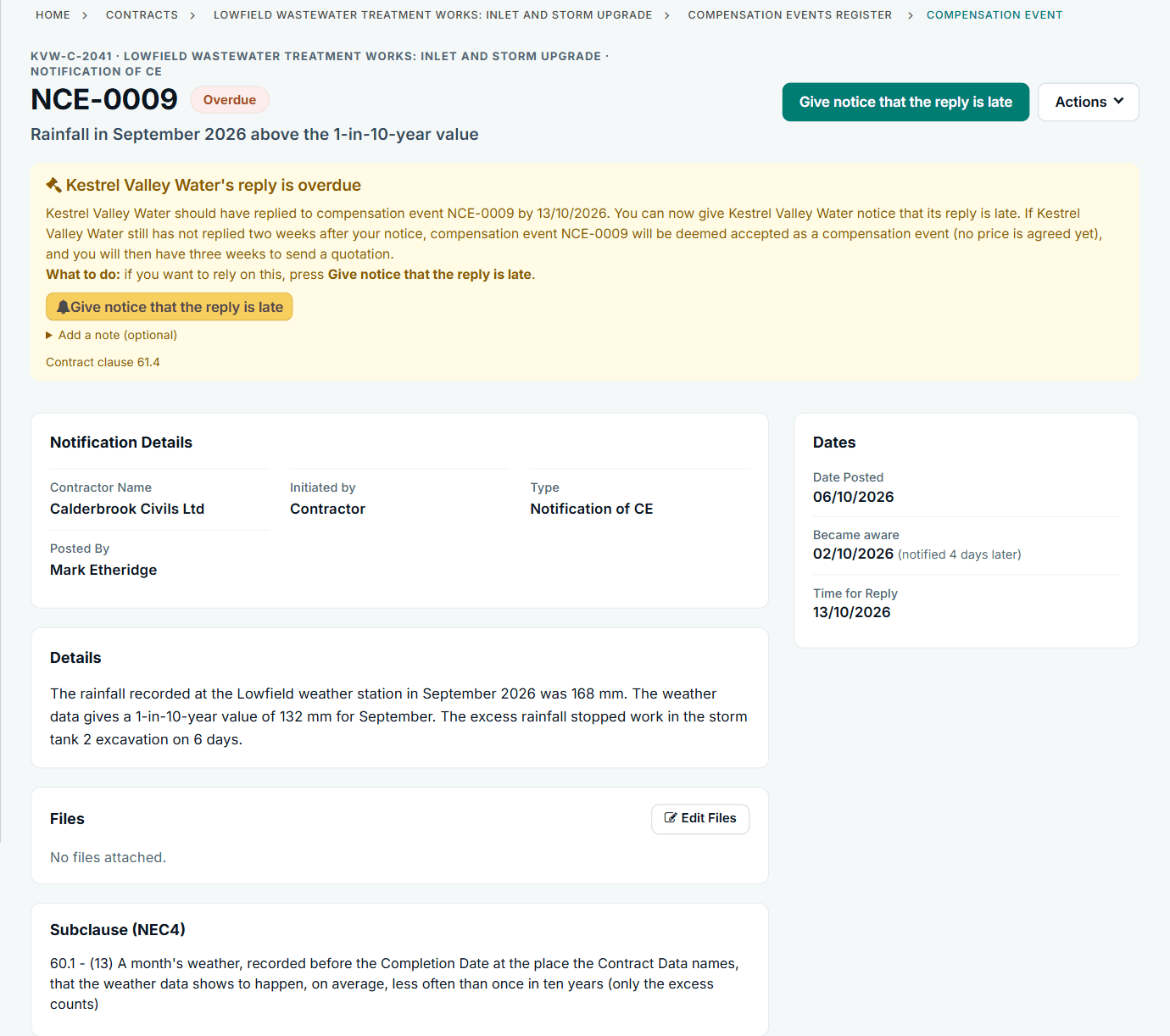
A late reply in Contract Status: the banner, the clause and the button for the notice. See the worked example.
See how this works in practice
Click through Contract Status with sample contracts: raise the notice, reply to it, and watch both sides of one record.
Take the guided tour Book a demo
Take the NEC4 ECC quiz, use the free NEC tools or download free NEC templates.
This guide is general information in our own words, not legal advice. Your contract and its Contract Data always govern. NEC, NEC3 and NEC4 are trade marks of Thomas Telford Ltd; Contract Status is not affiliated with or endorsed by NEC.