
Clause 60.1(11) makes it a compensation event when one of the Supervisor's tests or inspections holds the work up unnecessarily. A properly timed inspection isn't an event, even when it holds up work; a Supervisor who doesn't turn up to a hold point on the agreed day may well be one.
The linked duty is that the Supervisor doesn't hold up the work, or a payment that depends on a pass, more than it has to. That's clause 41.5 in NEC4 ECC and 40.5 in NEC3. The entry number 60.1(11) is the same in both.
What triggers it
- The test or inspection is the Supervisor's. The Contractor's own tests don't count, and neither do those by a third party acting for itself. Check who the Scope says does each test (41.1).
- Delay. To the work, although not necessarily to Completion. Cost alone can be an effect.
- The delay is unnecessary. The contract gives no definition, so this is a matter of fact.
What "unnecessary" looks like
| More likely unnecessary | More likely necessary |
|---|---|
| Supervisor misses an arranged inspection with proper notice given | Inspection takes the time the Scope's procedure actually needs |
| Results held for a week when the lab issued them on day one | A required curing period before a test can be done |
| Work held for an inspection the Scope doesn't require | Test repeated because the first one showed a Defect |
| A short test scheduled for a time that forces a whole gang to stand down for days | Contractor's late notice leaves the Supervisor no time to attend |
The Contractor's side of the bargain is clause 41.3: tell the Supervisor in time for the test or inspection to be arranged. A case for this event falls away quickly if the notice was late or wrong.
How it is usually evidenced
- The Scope or inspection and test plan showing the test, who does it, and any hold point.
- The Contractor's 41.3 notice, and any acknowledgment.
- A record of who attended and when, plus when results were communicated.
- Records of the gang and plant kept waiting, and any work the delay pushed into a later window.
A hold-point log kept during the job will settle most of these on its own. Trying to rebuild the record from emails months later usually won't.
Worked example
A fictional underpass on Option C, with illustrative figures. The inspection plan has a Supervisor hold point on reinforcement before each pour, needing 48 hours' notice. On Monday, the Contractor gives notice for an inspection on Wednesday at 8am, with a concrete delivery booked for 2pm.
The Supervisor doesn't attend on Wednesday and the pour is cancelled. The inspection takes place on Friday afternoon, passes and the pour moves to the following Tuesday, as the batching plant is booked up.
| Effect | Defined Cost |
|---|---|
| Concrete cancellation charge | £850 |
| Pour gang stood down for 2 days, partly redeployed | £2,900 |
| Pump hire extended and rebooked | £1,150 |
| Time-related cost for 3 days' delay to planned Completion | £8,100 |
| Total (the Fee is then added) | £13,000 |
The hold-up lasts six days, but the critical path had three days of float there, so planned Completion moves three days. The later Tuesday date may be challenged, so a note from the batching plant showing it had no earlier slot would be useful.
How it is assessed
The Contractor generally notifies this event, since a failure to attend isn't an instruction or a notification. Treat the time bar as applying, and consider logging each incident at once. The dividing date is the date of notification. Under 63.9, the Contractor is expected to react competently, so showing the gang was redeployed where possible helps. The rest follows the normal assessment and delay rules.
What people get wrong
- Calling any wait an event. Inspections naturally take time. The event is about delay beyond what was needed.
- Confusing it with a search. Opening up work to look for a Defect is 60.1(10). A failed test leading to a repeat is at the Contractor's cost.
- Blaming the Supervisor for the Client's missing materials. If the test can't go ahead because the Client didn't provide what the Scope said, the entry is 60.1(16).
- Pouring anyway. Covering work to avoid delay gives away the event. It also sets up the exception to 60.1(10) if a search follows, and it may mean you have to pay for uncovering.
- Ignoring small repeated delays. A half-day lost on each of twenty hold points adds up, but only if each one was recorded. If the pattern is a resourcing problem, raise it as an early warning and talk to the Supervisor early.
Related guides
- NEC Compensation Events: The Complete Guide
- Compensation Event: Physical Conditions
- Compensation Event: Weather
- Compensation Event: A Client Liability Event
- Compensation Event: Withholding Acceptance for Other Reasons
- Compensation Event: Tests and Searches Finding No Defect
How this looks in Contract Status
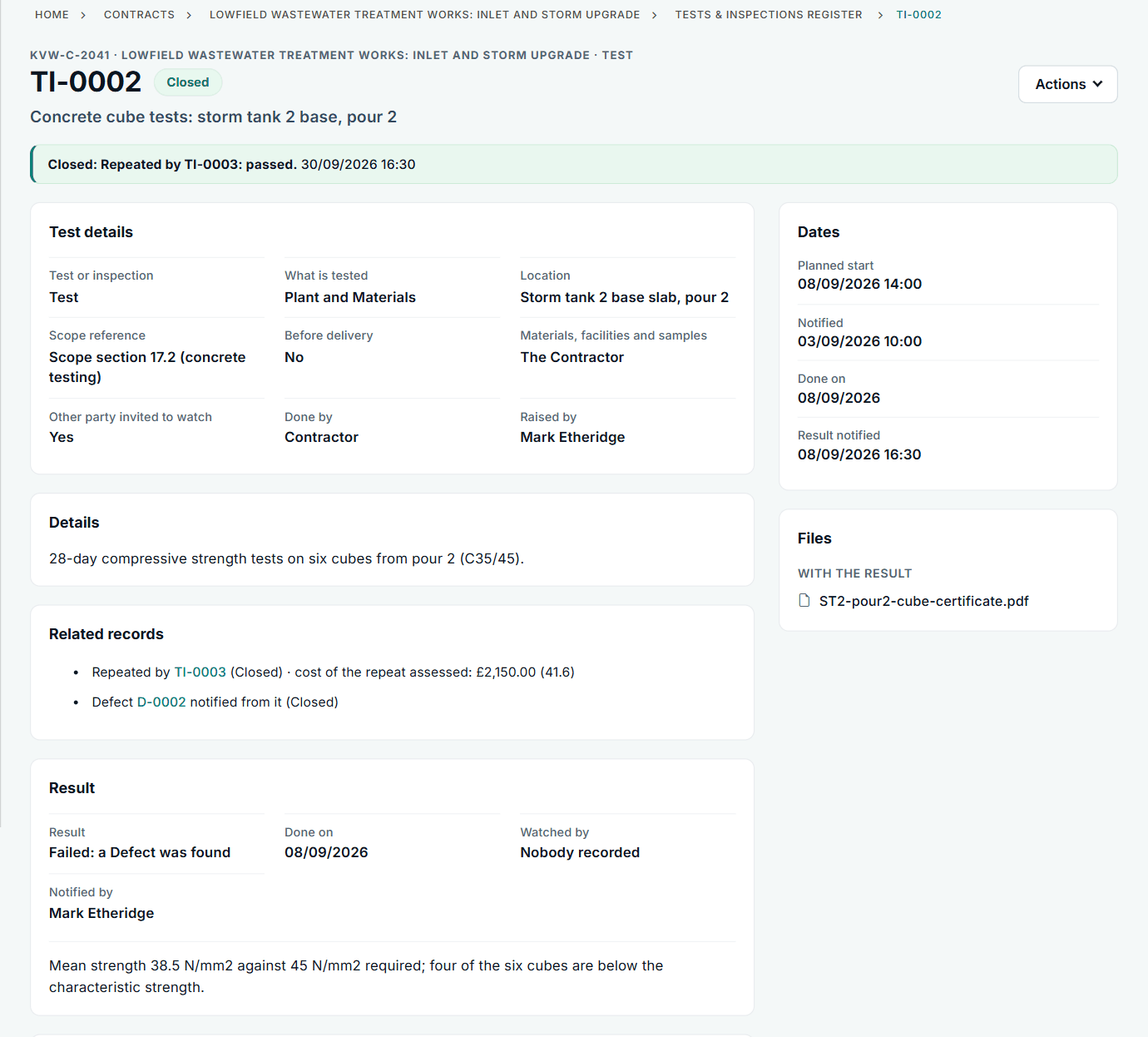
A failed test linked to its Defect and its repeat, with the cost of the repeat. See the worked example.
See how this works in practice
Click through Contract Status with sample contracts: raise the notice, reply to it, and watch both sides of one record.
Take the guided tour Book a demo
Take the NEC4 ECC quiz, use the free NEC tools or download free NEC templates.
This guide is general information in our own words, not legal advice. Your contract and its Contract Data always govern. NEC, NEC3 and NEC4 are trade marks of Thomas Telford Ltd; Contract Status is not affiliated with or endorsed by NEC.