
The NEC compensation event process has five stages: notify, decide, quote, reply, implement. Under NEC4 ECC the whole route from a Contractor's notice to an accepted quotation can take six weeks if every period is used in full and nothing goes round again.
The steps below follow NEC4 ECC. The periods are the same in NEC3 ECC, although some clause numbers aren't. Your Contract Data and Z clauses can change either. The compensation events guide gives the background.
The steps
- The event is notified. If it arises from an instruction, notification, certificate or changed decision, the Project Manager notifies it at that moment (61.1). Otherwise the Contractor notifies it, within eight weeks of becoming aware that it has happened (61.3). The Contractor can also notify something it expects to happen.
- The Project Manager decides, for a Contractor's notice. It has one week, or longer if the Contractor agrees, to say either that the event doesn't change anything, with reasons, or that it is a compensation event (61.4). This step doesn't apply where the Project Manager made the notification.
- Quotations are instructed. The instruction comes with the notification or the decision (61.2, 61.4). It is also where the Project Manager says if an early warning should have been given (61.5) and states any assumptions, if the effects are too uncertain to forecast (61.6). It can ask for alternatives too (62.1).
- The Contractor quotes. Within three weeks of the instruction, it submits the change to the Prices, any delay to the Completion Date or a Key Date, its details, and any changes needed to the Accepted Programme (62.2, 62.3).
- The Project Manager replies. It has two weeks from submission to accept, to instruct a revised quotation or to say it will make its own assessment (62.3). A revised quotation is due three weeks after the instruction (62.4).
- If needed, the Project Manager assesses. It has the same length of time the Contractor would have had to quote, counted from when the need became apparent (64.3).
- The event is implemented. That is when the quotation is accepted, the assessment is notified or a quotation is treated as accepted (66.1). The Prices and dates change at that point (66.2).
Who holds the pen at each stage
| Stage | Project Manager | Contractor |
|---|---|---|
| Notify | Events it or the Supervisor caused | All others it believes qualify |
| Decide | Applies the 61.4 tests | Can chase, and notify a failure to reply |
| Quote | Answers questions; discusses ways of dealing with the event | Prepares the assessment and the programme changes |
| Reply | Accepts, asks again or assesses | Can notify a failure to reply |
| Implement | Notifies the acceptance or assessment | Reflects the change in the next application and programme |
A timeline on a fictional job
Take a fictional highway scheme where a utility company is late moving a main, and the Contractor believes 60.1(5) applies. These are illustrative weeks.
| Week | What happens |
|---|---|
| 0 | Contractor's foreman reports that the utility crew hasn't turned up on the date shown in the Accepted Programme |
| 1 | Contractor notifies the compensation event. Dividing date is set by this notice |
| 2 | Project Manager confirms it is a compensation event and instructs quotations |
| 5 | Contractor quotes: an illustrative £64,000 and two weeks, with its programme changes |
| 7 | Project Manager accepts. The event is implemented; Completion Date moves two weeks, and the Prices rise by £64,000 |
The utility work may not be finished at week 7. That's fine: any work not done by the dividing date is priced as a forecast, and the process doesn't wait for the outcome.
Where the process breaks down
- The clock wasn't started. An email or minute mentions the problem, but no notification under the contract goes in. Clause 13 asks for a separate notification, so don't rely on a passing reference. See how to notify a compensation event.
- Quotations are held until the work is done. That turns a forward-looking process into a retrospective one and usually makes it harder to agree.
- The reply slips. A busy Project Manager passes the deadline, then discovers that treated acceptance has started.
- Revised quotation loops. Repeated rounds without clear reasons waste everyone's time. At some point the Project Manager should make its own assessment instead.
- No Accepted Programme. The Contractor then gets a less favourable position on time. Keep a current one in place: see the NEC programme guide.
The periods above are the ones that matter most. Other time limits are collected in the NEC time periods guide.
Related guides
- NEC Compensation Events: The Complete Guide
- How to Notify a Compensation Event
- Clause 61.1: Project Manager Notification
- Clause 61.3: The Eight-Week Time Bar
- The Full List of NEC4 ECC Compensation Events
- The Full List of NEC3 ECC Compensation Events
How this looks in Contract Status
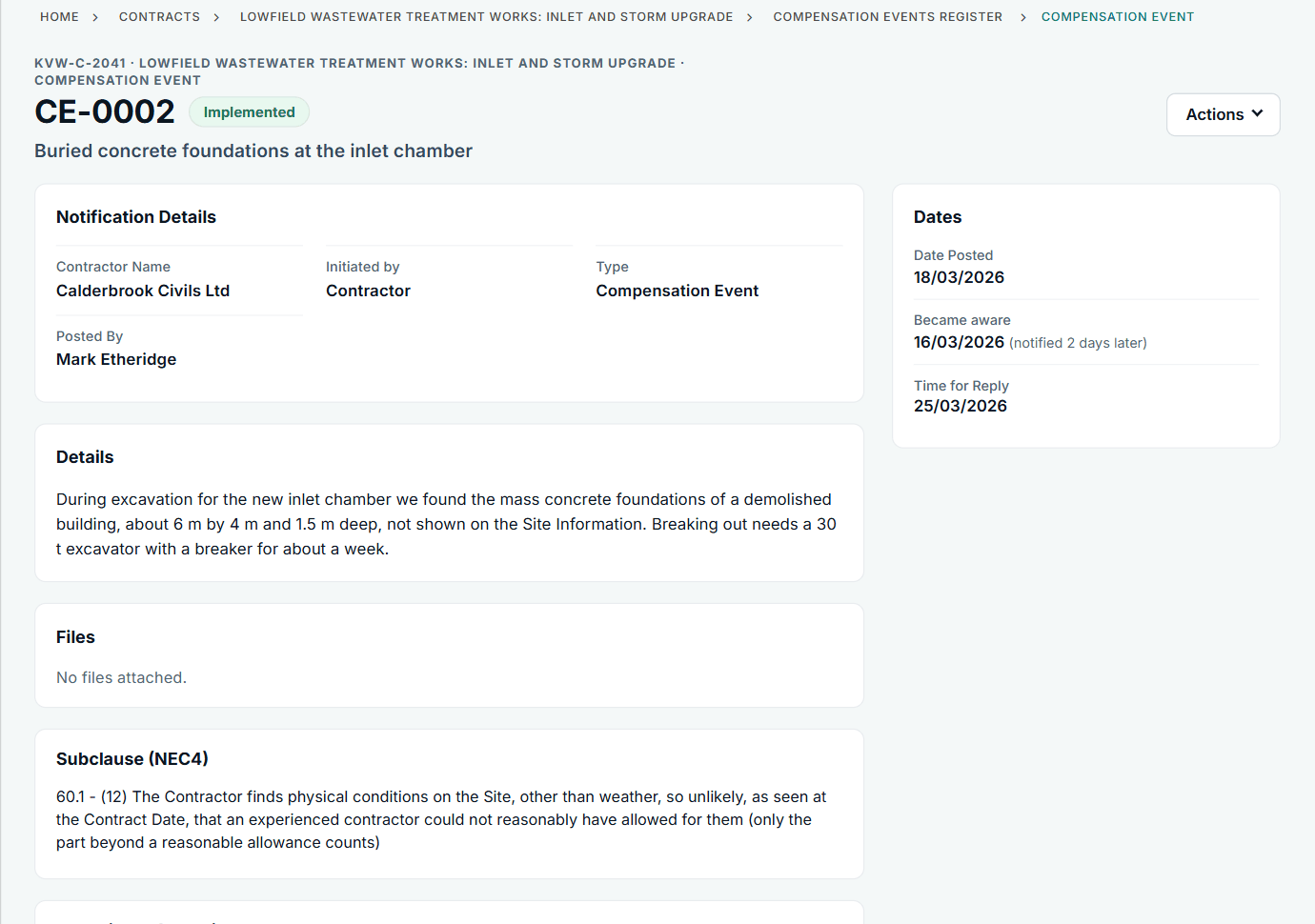
The record shows the date you became aware and how long you took to notify. See the worked example.
See how this works in practice
Click through Contract Status with sample contracts: raise the notice, reply to it, and watch both sides of one record.
Take the guided tour Book a demo
Take the NEC4 ECC quiz, use the free NEC tools or download free NEC templates.
This guide is general information in our own words, not legal advice. Your contract and its Contract Data always govern. NEC, NEC3 and NEC4 are trade marks of Thomas Telford Ltd; Contract Status is not affiliated with or endorsed by NEC.