
NEC clause 64 says when the Project Manager, rather than the Contractor, assesses a compensation event. It applies in four situations, gives the Project Manager the same time the Contractor would have had to quote, and treats the Contractor's quotation as accepted if the Project Manager still doesn't act. The clause numbers are the same in NEC3 and NEC4 ECC.
It's easy to read this as a punishment for the Contractor. It's better seen as a way of making sure every event reaches a result, however the quotation stage went. For the wider context, see the compensation events guide.
The four triggers in 64.1
| Trigger | Example from a fictional job |
|---|---|
| The Contractor hasn't submitted its quotation and details in time | The instruction was issued in week 10, and nothing has arrived by week 13 |
| The Project Manager decides the quotation wasn't assessed correctly, and doesn't instruct a revised one | A quotation prices bill rates instead of Defined Cost, and the Project Manager has already been through one round |
| When quoting, the Contractor hasn't submitted a programme or alterations it was required to submit | No revised programme has been sent since the last one fell due |
| When quoting, the Project Manager has not accepted the latest programme, for a reason the contract gives | The programme was rejected because it doesn't show how the Contractor will meet the Key Dates |
The reply to a quotation under clause 62.3 has to say the Project Manager will make the assessment. If it is the second trigger, it's a matter of judgement against a revised quotation.
Which programme it uses
Clause 64.2 deals with the programme. The Project Manager uses its own view of how the remaining work will run if there's no Accepted Programme, or if the Contractor hasn't submitted a required programme or alteration. The NEC4 subcontract adds the case where the latest programme has not been accepted for a stated reason; check the matching wording in your NEC4 ECC.
That can be uncomfortable for a Contractor, because the time assessment then depends on someone else's view of how the job will run. It's one of the strongest practical reasons to keep the programme accepted and current. See also assessing delay to Completion.
Timing
Clause 64.3 ties the Project Manager's period to the quotation period, so it's three weeks under standard ECC terms. It runs from when the need for the assessment became apparent. That start date is less precise than the others in this process, so it helps if the Project Manager states when the need arose:
- For a late quotation, the need arises when the quotation period ends.
- For a quotation that's been rejected, it's normally the date of the reply saying the Project Manager will assess.
If the Project Manager doesn't assess in time, the Contractor may notify the failure under 64.4. If there's no assessment within a further two weeks, the Contractor's quotation counts as accepted. If several quotations were sent, the notice says which one the Contractor proposes. See treated acceptance for how this works.
That raises an awkward point for a Contractor who never quoted at all. There's then no quotation to be treated as accepted. The practical answer is to submit one late, rather than rely on the failure route.
What a good assessment contains
- The same rules as a quotation: clause 63 applies, whoever is doing the assessment.
- Details, because 64.3 requires them. Give the Contractor the Defined Cost breakdown, Fee, risk allowances and delay with the programme basis.
- The information relied on and any record the Contractor hasn't seen.
- Any early warning statement that has been made.
The assessment is made fairly and on the contract's own terms. It shouldn't be used as a bargaining position, and it shouldn't be the lowest conceivable number. A clear assessment is also the document an adjudicator is likely to read first if it's disputed.
Once it's notified
The Project Manager's notification of the assessment implements the event (66.1, NEC3 65.1). The Prices, the Completion Date and Key Dates change at that point. The Contractor doesn't have to agree for that to happen. If it disagrees, it uses the dispute procedure in the contract, and there are time limits for doing that, set out in the guide to dispute time limits.
Related guides
- NEC Compensation Events: The Complete Guide
- Assessing a Compensation Event: Clause 63
- Assessing Delay to Completion
- Implementing a Compensation Event
- Failure to Reply: Treated Acceptance
- Revised Quotations: When and Why
How this looks in Contract Status
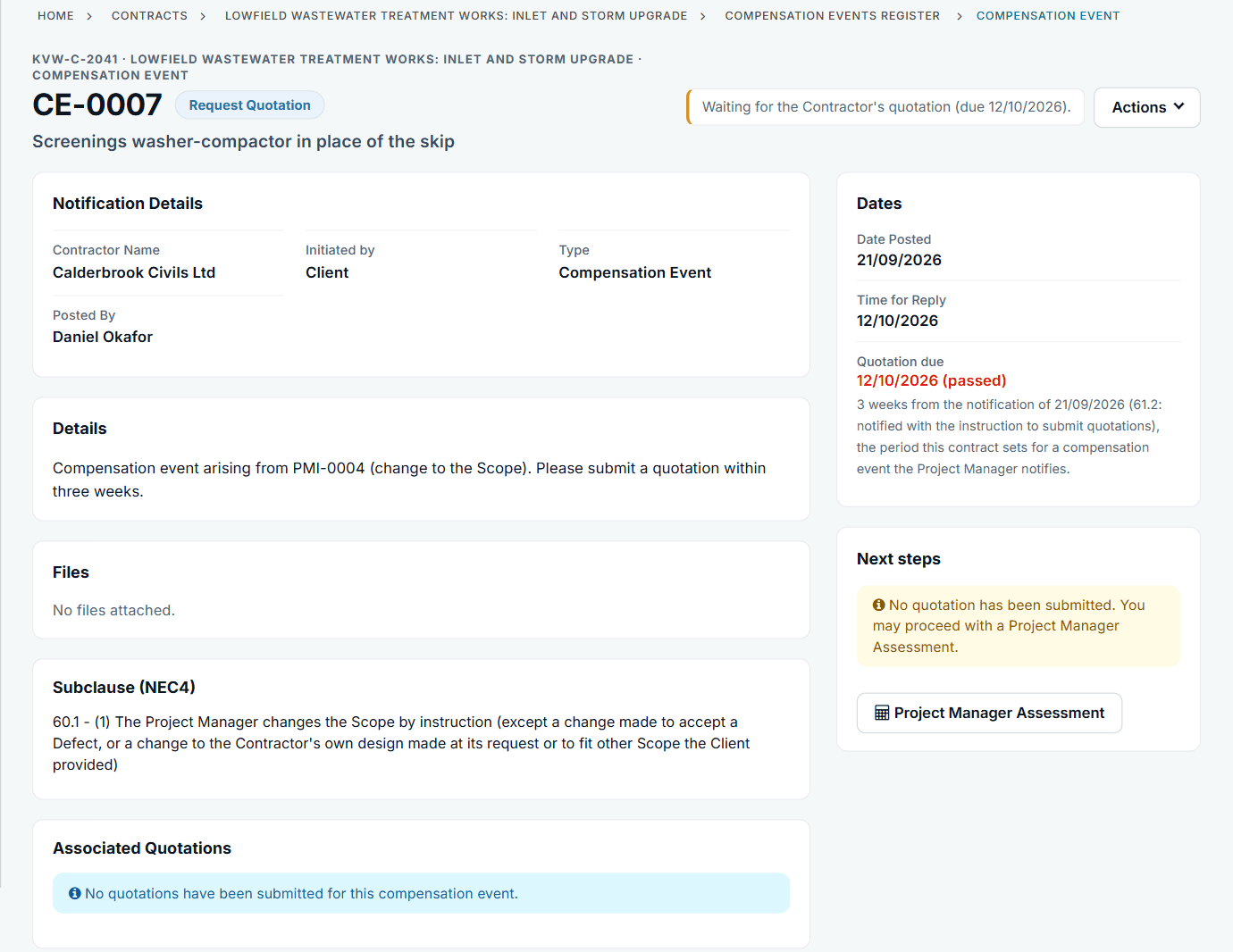
The quotation date has passed, and the record offers the Project Manager's assessment. See the worked example.
See how this works in practice
Click through Contract Status with sample contracts: raise the notice, reply to it, and watch both sides of one record.
Take the guided tour Book a demo
Take the NEC4 ECC quiz, use the free NEC tools or download free NEC templates.
This guide is general information in our own words, not legal advice. Your contract and its Contract Data always govern. NEC, NEC3 and NEC4 are trade marks of Thomas Telford Ltd; Contract Status is not affiliated with or endorsed by NEC.