
Clause 60.1(12) makes it a compensation event when the Contractor meets physical conditions within the Site, other than weather, that had such a small chance at the Contract Date that an experienced contractor could not reasonably have allowed for them. The assessment covers just the gap between what was found and what it was reasonable to allow for.
It's the most argued-over entry on the compensation event list, and the only one that turns on a judgement about risk. Numbering and substance match in NEC3 and NEC4 ECC. Z clauses often amend it or remove it, so read those first.
How it is judged
The test is forward-looking and objective. Don't ask whether the ground was a surprise to this Contractor. Ask what a competent contractor, with the right information, would have thought at the Contract Date.
| Question | Where it comes from | Practical point |
|---|---|---|
| Is it within the Site? | 60.1(12) | Check the Site boundary. A collapsed road outside it needs another route. |
| Is it a weather condition? | 60.1(12) | Weather has its own test under 60.1(13). Ground flooded by a storm is often caught by this. |
| What is the Contractor taken to have considered? | 60.2 | The Site Information, public information it refers to, what a visual inspection would show, and what an experienced contractor could reasonably expect to have or obtain. |
| What if the Site Information conflicts? | 60.3 | The Contractor is taken to have assumed the more favourable conditions for doing the work. |
| How unlikely was it? | 60.1(12) | So unlikely that allowing for it would have been unreasonable. Being merely unusual isn't enough. |
| How much counts? | 60.1(12) | Only the excess over a reasonable allowance. |
Clause 60.2 is where most claims are won and lost. An old map referred to in the Site Information counts as knowledge, as does a sign on the fence saying "Buried services". A geological memoir, or a neighbour's records, may count depending on what an experienced contractor would reasonably obtain.
How it is usually evidenced
- A record of the condition as found, made at the time: photos with location and date, logs, surveys, test results, and quantities measured jointly where possible.
- The Site Information and everything it refers to.
- The tender allowance: method statement, programme and assumptions at the Contract Date. It doesn't decide the test, but it shows how the risk was seen.
- An explanation from a geotechnical engineer or similar specialist on what those documents would have suggested.
Tell the Project Manager as soon as you find the condition, so they can see it before it's dug out. An uninspected, disposed-of obstruction is hard to prove.
Worked example
A fictional pumping station on Option C, with illustrative figures. The Site Information includes three boreholes. Two show rock at about 4 metres, and one at 3 metres; the deep excavation goes down to 5 metres. The Contractor allowed for about 400m³ of rock, which experts later agree was a reasonable reading.
In fact, rock is found at about 2 metres across the eastern half, giving 1,100m³ of rock. A desk study shows nothing of this kind, and a visual inspection wouldn't have shown it.
| Item | Rock volume |
|---|---|
| Encountered | 1,100m³ |
| Reasonable to have allowed for | 400m³ |
| Difference assessed | 700m³ |
At an illustrative additional Defined Cost of £65/m³ over normal digging, the difference costs £45,500 before the Fee, with delay assessed on the extra breaking-out time. The first 400m³ stays with the Contractor, even though it's also rock.
Suppose one of the boreholes had shown rock at 2 metres, conflicting with the other two. Clause 60.3 would favour the Contractor on the conflict, rather than treating the worst borehole as a warning. If all three had shown rock at 2 metres, there would be no event.
How it is assessed
This is Contractor-notified, so the time bar applies. Notify as soon as the condition appears. The dividing date is the date of notification. If the extent is unknown when the quotation is due, the Project Manager can state an assumption, such as a rock volume, and correct it later under 60.1(17). Since the effect on time is often the biggest part, tie it to the effect on planned Completion.
What people get wrong
- Using hindsight. "Nobody expected this" isn't the test, and neither is "you should have known, now we've seen it". Go back to what the documents said on the Contract Date.
- Claiming everything. Pricing the entire excavation as rock ignores the difference rule.
- Relying only on the boreholes. The contract also expects a visual inspection and reasonable enquiries. Buried services on a utility search, or a former use shown on historic maps, can sink a claim.
- Treating no Site Information as a win. Thin information doesn't make every condition unlikely. An experienced contractor would still bring knowledge of the area.
- Stating that only the ground counts. The entry isn't limited to natural ground. A buried tank or an unexpected structure can qualify, and the same test applies. See objects of interest if the find has historic value.
- Project Managers replying too quickly. A reply under 61.4 needs a stated ground, so a short rejection before the facts are known can come back to haunt you. The contract asks for a reply within the period, so ask for the facts straight away.
Related guides
- NEC Compensation Events: The Complete Guide
- Compensation Event: Weather
- Compensation Event: A Client Liability Event
- Compensation Event: Client Taking Over Early
- Compensation Event: Tests and Searches Finding No Defect
- Compensation Event: Test or Inspection Causing Delay
How this looks in Contract Status
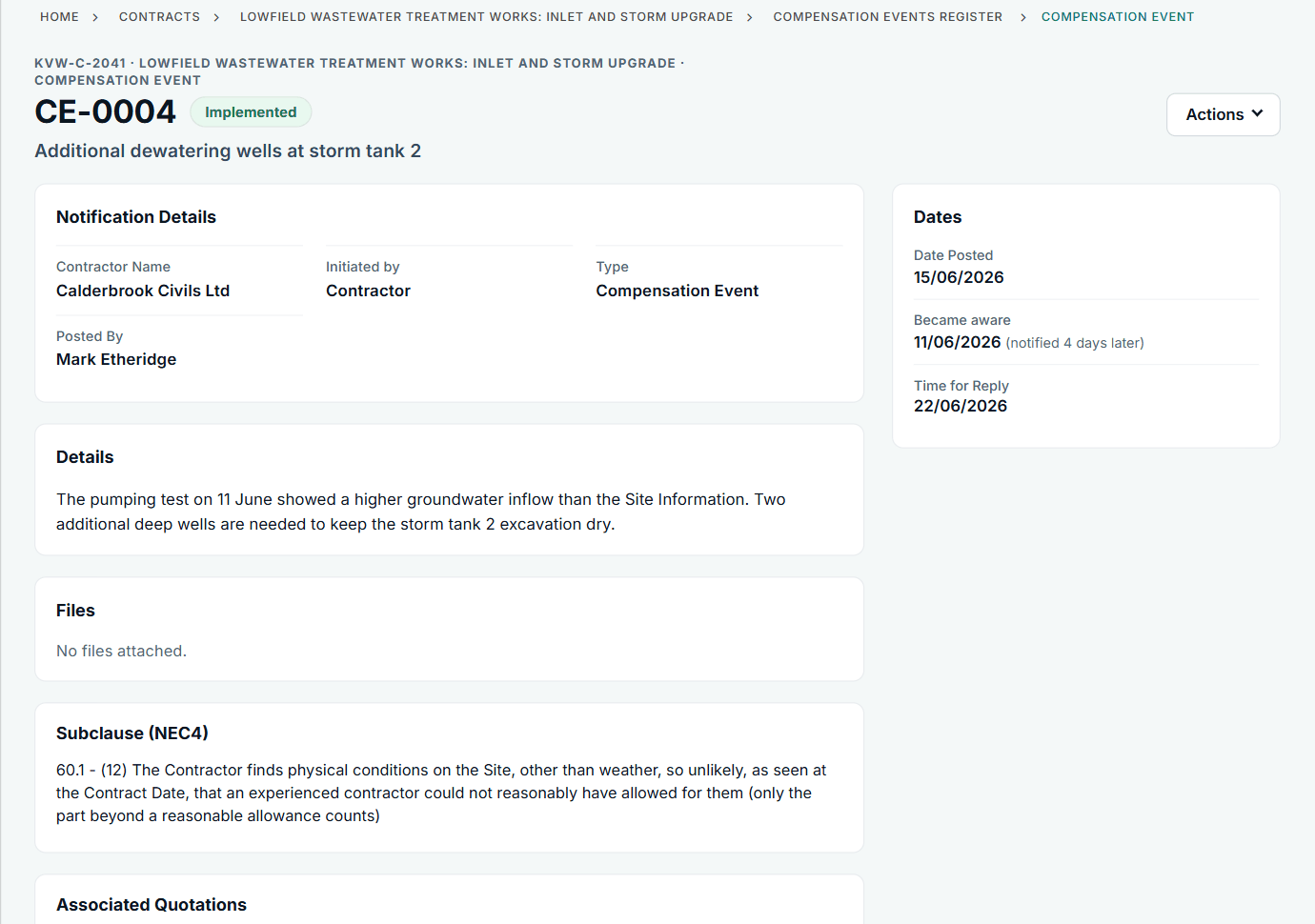
A 60.1(12) event, notified four days after the test that showed the inflow. See the worked example.
See how this works in practice
Click through Contract Status with sample contracts: raise the notice, reply to it, and watch both sides of one record.
Take the guided tour Book a demo
Take the NEC4 ECC quiz, use the free NEC tools or download free NEC templates.
This guide is general information in our own words, not legal advice. Your contract and its Contract Data always govern. NEC, NEC3 and NEC4 are trade marks of Thomas Telford Ltd; Contract Status is not affiliated with or endorsed by NEC.