
Clause 60.1(4) makes it a compensation event when the Project Manager instructs that work stops or doesn't begin, or changes a Key Date. Because the event arises from an instruction, the Project Manager notifies it at the same time, and the Contractor doesn't face the usual time bar that applies to other compensation events.
The power to stop or hold back work is in clause 34.1. The power to change a Key Date is in clause 14.3. Both are the same in NEC3 and NEC4 ECC, so this entry works the same way in each.
What triggers it
The entry covers three kinds of instruction:
- Stop: work under way is to cease, in whole or part.
- Do not start: planned work is held back, even if nothing has begun.
- Key Date change: a Key Date is moved by instruction. Changes can suit the Client, such as bringing a Key Date forward, but the Contractor is still entitled to have the effect assessed.
A stop instruction isn't the end of the matter. Under 34.1 the Project Manager later has to tell the Contractor to restart or start the work, or take it out of the Scope. Removing it is a change to the Scope, which brings 60.1(1) into play as well.
When the Contractor caused the stoppage
The list entry doesn't mention fault, but the process does. If the event comes from the Contractor's own fault, clause 61.2 means no quotations are asked for, and clause 61.4 treats fault as a reason for leaving the Prices and dates alone. So a stop instruction after unsafe scaffolding was found on the Contractor's watch doesn't help the Contractor, while one due to a Client funding review does.
Project Managers should state the reason in the instruction, because that's what everyone will come back to. If you think it's the Contractor's fault, say why and keep the evidence.
How it is usually evidenced
- The instruction itself, including its scope, its date and the reason given.
- A record of resources on Site at that moment and what happened to them.
- Off-hire, demobilisation and remobilisation records, and subcontractor notices.
- The later instruction to restart or to remove the work.
Watch out for a phone call from the Client's team saying "hold off for now". That is not a Project Manager's instruction. Ask for it in writing, because otherwise you have stopped on your own account.
Worked example
A fictional road bridge on Option C, with illustrative figures. In week 12 the Project Manager instructs the Contractor to stop piling on the east abutment while the Client settles a dispute with a neighbouring landowner. No one knows how long it'll take, so the Project Manager states an assumption in the instruction to quote (61.6): a restart at the end of week 16.
| Effect, based on the assumption | Defined Cost |
|---|---|
| Piling rig demobilise and remobilise | £18,000 |
| Standing and redeployed gang costs, first week | £6,500 |
| Time-related site costs for 4 weeks' delay to planned Completion | £34,000 |
| Extra winter working protection, now forecast | £5,500 |
| Total (the Fee is then added) | £64,000 |
The restart actually comes at the end of week 19. Three weeks more than assumed. The Project Manager notifies a correction, which is a 60.1(17) event assessed for those extra weeks. Without the assumption, the Contractor would have had to forecast it and carry the risk of guessing wrong.
How it is assessed
The dividing date is the day of the instruction (63.1). Costs after that are forecast, which is hard when nobody knows the restart date; that's why assumptions suit this event. Time is assessed on planned Completion from the Accepted Programme at the dividing date, as set out in the guide to compensation event delay. A Key Date change is assessed on its own terms, and may have cost but no effect on Completion.
Long stoppages and termination
A stoppage that isn't lifted can lead to termination rights. Clause 91.6 sets out who may terminate after a long stop, depending on whose default it was (reasons R18 to R20). The period is 13 weeks in the NEC4 ECC and NEC3 ECC, and 14 in the NEC4 subcontract. Amended contracts may differ. See termination reasons.
What people get wrong
- Treating it as a suspension right. The instruction comes from the Project Manager. The Contractor can't stop under this clause on its own initiative.
- Keeping everything on Site "just in case". The assessment assumes a competent, prompt reaction, so plan demobilisation decisions and record why you made them.
- Stopping more than the instruction says. If only one abutment is stopped, costs from stopping the other are yours to justify.
- Issuing a stop and forgetting it. The follow-up instruction is a duty, and silence adds cost to the Client. Put it on the tracker.
Related guides
- NEC Compensation Events: The Complete Guide
- Compensation Event: Client or Others Not Working as Stated
- Compensation Event: Late Reply to a Communication
- Compensation Event: Objects of Value or Interest Found
- Compensation Event: Access Not Provided
- Compensation Event: Something the Client Should Provide
How this looks in Contract Status
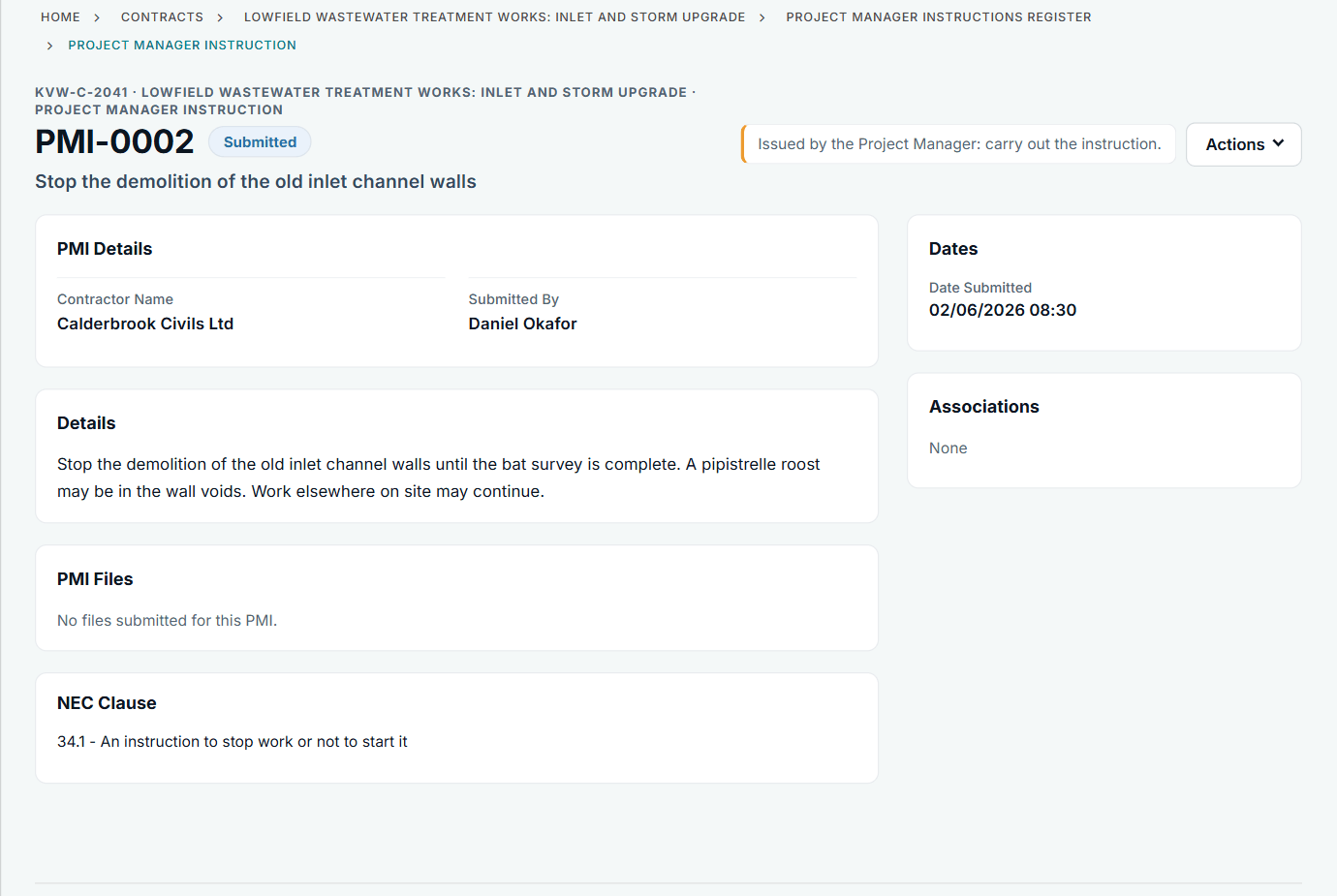
A stop instruction under 34.1, from the Contractor side. See the worked example.
See how this works in practice
Click through Contract Status with sample contracts: raise the notice, reply to it, and watch both sides of one record.
Take the guided tour Book a demo
Take the NEC4 ECC quiz, use the free NEC tools or download free NEC templates.
This guide is general information in our own words, not legal advice. Your contract and its Contract Data always govern. NEC, NEC3 and NEC4 are trade marks of Thomas Telford Ltd; Contract Status is not affiliated with or endorsed by NEC.