
NEC clause 63 sets the rules for assessing a compensation event. The Prices change by the event's effect on three things: what work up to the dividing date actually cost (Defined Cost), the forecast Defined Cost of what remains, and the Fee that follows from both. It's about the event's effect, not about what the same work would have been priced at in the tender.
Those rules apply whoever does the assessment, so both quotations and the Project Manager's assessments follow them. The clause numbers below are for NEC4 ECC, with NEC3 ECC shown alongside. See the compensation events guide for the wider process.
The rules, clause by clause
| Rule | NEC4 ECC | NEC3 ECC |
|---|---|---|
| Effect on actual and forecast Defined Cost and Fee, split at the dividing date | 63.1 | 63.1 |
| Agreed rates or lump sums may be used | 63.2 | Option clauses, 63.14 |
| A reduction in Defined Cost doesn't reduce the Prices, unless stated | 63.3 | 63.2 |
| Certain changes do reduce the Prices | 63.4 | Option clauses, such as 63.10 and 63.11 |
| Delay: how far the Completion Date and Key Dates move | 63.5 | 63.3 |
| These are the parties' only rights for the event | 63.6 | 63.4 |
| Assessed as if an early warning had been given, where stated | 63.7 | 63.5 |
| Risk allowances | 63.8 | 63.6 |
| Assumes a competent, prompt reaction and reasonable cost | 63.9 | 63.7 |
| Ambiguity in the Scope: read in favour of the Party that didn't provide it | 63.10 | 63.8 |
| A Key Date Condition made wrong by a change is corrected | 63.11 | 63.9 |
The dividing date
For an event from an instruction, notification, certificate or changed decision, it's the date of that communication. For anything else, it's the date the event was notified. Work done by that date is priced at actual Defined Cost, so records matter. Work after that date is priced as a forecast, even if the assessment is prepared later and some of the work has since been done.
That's why a late notice can change the shape of the assessment. Notifying later moves more of the cost onto actuals, and it can also change which Accepted Programme applies.
A worked calculation
A fictional sewer scheme with illustrative figures. The Project Manager instructs an extra manhole on 10 June, so that's the dividing date. The Contractor had already ordered materials for the original design before then, and they're now redundant.
| Item | Basis | £ |
|---|---|---|
| Redundant order, cancellation charge | Actual Defined Cost, by the dividing date | 2,400 |
| People for the manhole | Forecast | 11,000 |
| Equipment | Forecast | 6,500 |
| Plant and Materials | Forecast | 9,100 |
| Risk allowance: 30% chance of a further pump for 2 weeks | Forecast | 1,000 |
| Effect on Defined Cost | 30,000 | |
| Fee at an illustrative 10% | Fee percentage from the Contract Data | 3,000 |
| Change to the Prices | 33,000 |
If the forecast later proves too low or too high, the assessment normally stays as it is. That's the deal: the Contractor takes the risk on a forecast in return for a quick answer. See implementing a compensation event.
Risk allowances
The assessment includes allowances for matters with a significant chance of occurring. In NEC4 the test is that the matter isn't itself a compensation event; in NEC3 it's that the matter is at the Contractor's risk. More on this in risk allowances under NEC. If the effects are too uncertain to forecast fairly, the Project Manager states assumptions instead (61.6), and a later correction is a new event, 60.1(17).
Reductions
The default is that a saving doesn't reduce the Prices. The exceptions are specific: an instruction changing the Scope that saves money, unless the change is one the Contractor proposed and the Project Manager accepted, in which case the Options deal with it; and a corrected assumption. In NEC4 the Options A and B treatment uses a value engineering percentage, while the target Options leave the Prices unchanged, so the saving goes through the share. Check the wording for your main Option.
Common arguments
- "Use the bill rates." Not unless both agree. The standard basis is Defined Cost and Fee. See what Defined Cost is.
- "You could have done it cheaper." Clause 63.9 assumes the Contractor reacts competently and promptly and that costs are reasonably incurred. That's a fair challenge, but it should identify what a competent reaction would have been.
- "That cost is Disallowed." Disallowed Cost is a payment concept in the cost-based Options. It's not the same test as this assessment, and the two shouldn't be mixed.
- "The Fee shouldn't apply." It does. The fee percentage is applied to the effect on Defined Cost. See the Fee.
Related guides
- NEC Compensation Events: The Complete Guide
- Assessing Delay to Completion
- Implementing a Compensation Event
- Compensation Events Under Option A
- Revised Quotations: When and Why
- When the Project Manager Assesses a Compensation Event
How this looks in Contract Status
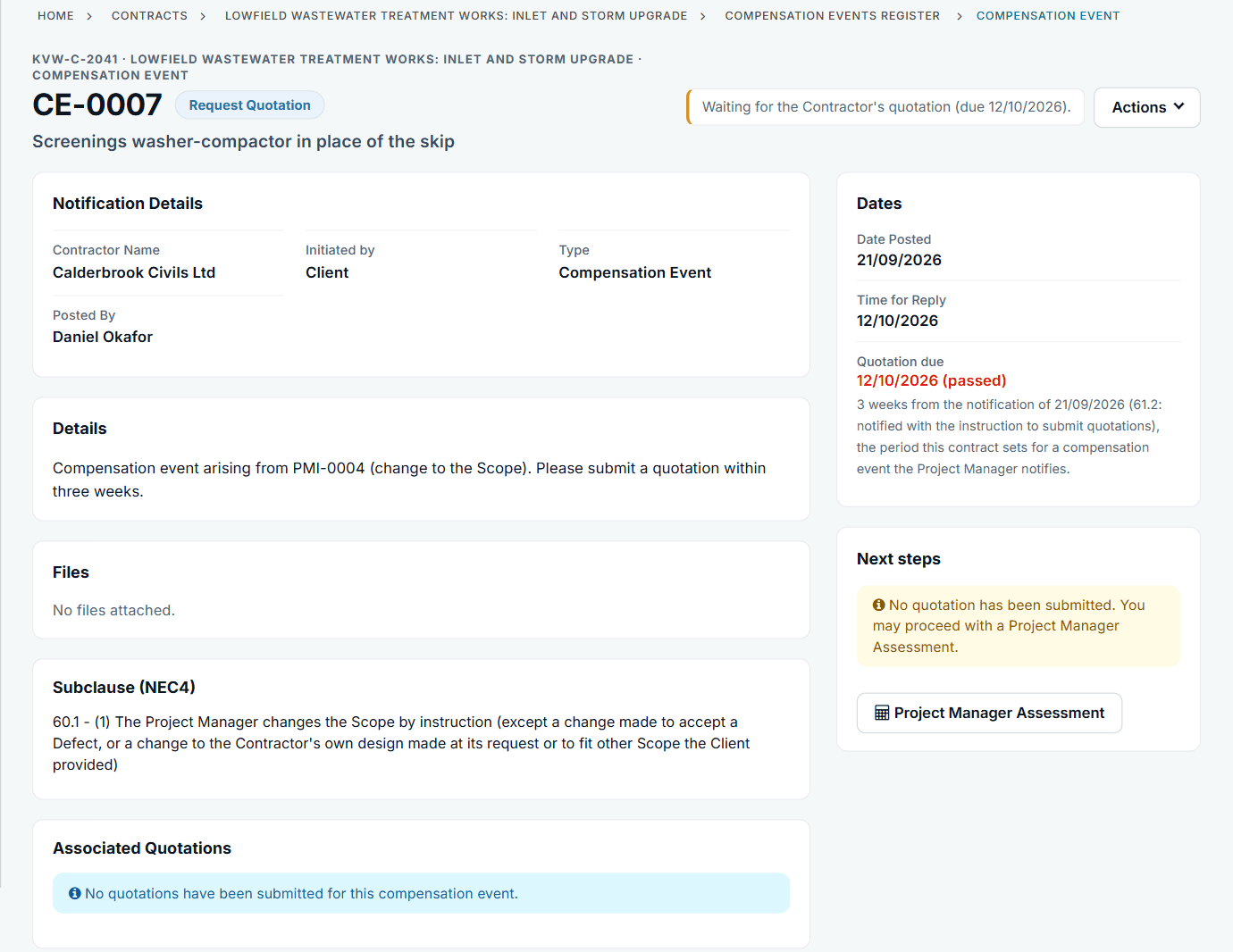
The quotation date has passed, and the record offers the Project Manager's assessment. See the worked example.
See how this works in practice
Click through Contract Status with sample contracts: raise the notice, reply to it, and watch both sides of one record.
Take the guided tour Book a demo
Take the NEC4 ECC quiz, use the free NEC tools or download free NEC templates.
This guide is general information in our own words, not legal advice. Your contract and its Contract Data always govern. NEC, NEC3 and NEC4 are trade marks of Thomas Telford Ltd; Contract Status is not affiliated with or endorsed by NEC.