
Under clause 60.1(13), weather is a compensation event only if a measurement for a calendar month, recorded at the place named in the Contract Data before the Completion Date, is shown by the weather data to occur on average less often than once in ten years. Only the excess over that one-in-ten level is assessed.
Unlike most compensation events, this is a numbers test, with no judgement about whether the weather felt bad. It's the same in NEC3 and NEC4 ECC. Everything else is left at the Contractor's risk, apart from prevention in very rare cases.
Setting up the data
Look in Contract Data part one before you have an event. The standard form asks for:
- The measurements for each calendar month: cumulative rainfall (mm), days with rainfall over 5mm, days with minimum air temperature below 0°C, and days with snow lying at a stated time. Other measurements can be added, such as wind.
- Who supplies the measurements.
- The weather data: past records for each calendar month, the place they were recorded, and where they can be obtained.
- Assumed values: where no recorded data exist, the ten-year return values to use instead.
The place can be a weather station miles from the Site. That station decides the test, not a rain gauge on your cabin, however much closer it is. A site gauge is still useful for showing what happened on the job, but it can't establish the event.
If you can, get the one-in-ten figure for each month and measurement at the start of the job, and keep it in a table. Past records don't always state this value directly, so agree how you'll calculate it. For example, with 30 years of January figures, a level reached in only two of those years happens less than once in ten years, while a level reached in three happens about once in ten.
Worked example: reading the numbers
A fictional road widening on Option A, with illustrative figures. The Completion Date is in July. The February figures are:
| February measurement | Recorded | One-in-ten level | Result | Excess |
|---|---|---|---|---|
| Cumulative rainfall | 148mm | 120mm | Passes | 28mm |
| Days with over 5mm rain | 13 | 11 | Passes | 2 days |
| Days below 0°C | 9 | 14 | Fails | None |
| Days with snow lying | 1 | 4 | Fails | None |
Each measurement is tested on its own, and the two that pass overlap. Earthworks stop on days with over 5mm of rain, so the natural measure of the effect is the two excess days. The Contractor needs to show what was lost because of those two days rather than the whole 13.
The Contractor assesses that two days of earthworks are lost, planned Completion moves by two days and the running cost and standing plant cost £7,200 a day. The Prices rise by £14,400 plus the Fee, and the Completion Date moves two days. The other 11 wet days stay with the Contractor, as they were a risk it priced.
How to use the data in practice
- At the start, put the one-in-ten table in the project file.
- During each month, check the cumulative figure as it builds up. Rainfall can cross the line part way through the month, so you may become aware of it before the month ends. Give an early warning when that looks likely.
- At the end of the month, get the official figures from the named supplier.
- Notify promptly. The eight-week time bar runs from becoming aware the event has happened. Allow for the time it takes for the supplier to publish, but don't use that as a reason to wait.
- Record daily what was working, what was stopped and why. Diaries should mention rain, ground state and resources.
- Work out the effect of the excess only, using the Accepted Programme in force on the dividing date.
How it is assessed
The dividing date is the day of notification. The difficult part is separating the excess from the rest. Rain doesn't arrive in neat layers, so the assessment has to be reasoned: what would have been achieved in a one-in-ten month compared with this one? Sometimes, a wet start to a month does more damage than the same rain at the end. In those cases, set out your method and be open about it. A sensible method that's explained usually wins out over a precise-looking number with no reasoning behind it. See how delay is measured.
What people get wrong
- Comparing with the wrong year. The test compares that calendar month with the same calendar month in past records, not with the average for the year.
- Counting a bad week. Measurements are monthly, so a terrible week in a dry month probably won't pass. That's the risk the contract gives to the Contractor.
- Claiming the whole month. Only the excess counts. See how the compensation event examples treat this.
- Going after the Completion Date. A measurement recorded once the Completion Date has passed doesn't qualify. A Contractor in delay loses this protection.
- Using weather as a physical condition. 60.1(12) excludes weather conditions, and using 60.1(19) for weather that fails this test rarely works.
- Leaving the Contract Data blank or vague. No place, or no data source, is an argument waiting to happen. Fill it in with care; the Contract Data guide covers the rest.
Related guides
- NEC Compensation Events: The Complete Guide
- Compensation Event: A Client Liability Event
- Compensation Event: Client Taking Over Early
- Compensation Event: Materials or Facilities for Tests
- Compensation Event: Test or Inspection Causing Delay
- Compensation Event: Physical Conditions
How this looks in Contract Status
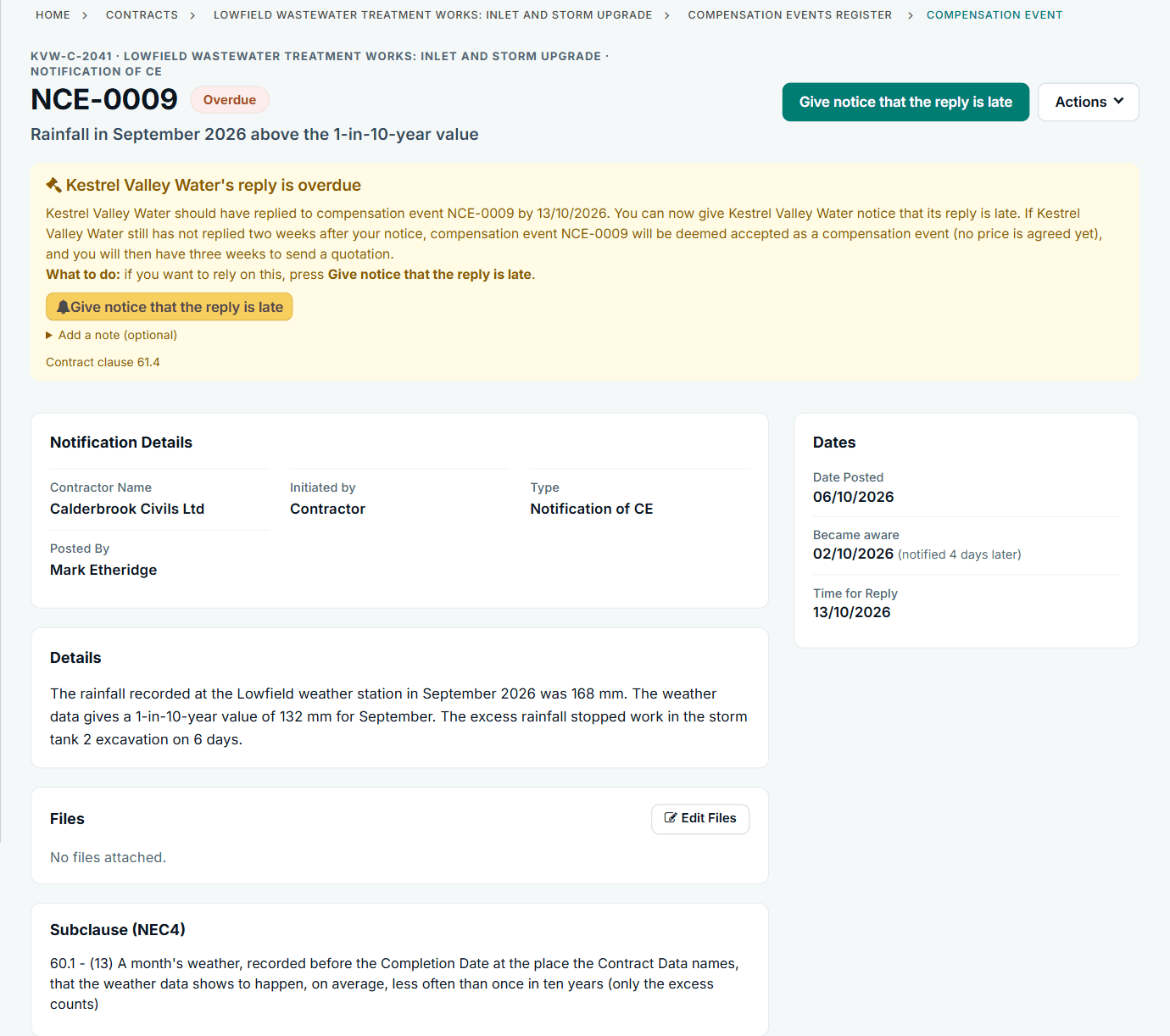
A weather event notified with the recorded figure against the one-in-ten value. See the worked example.
See how this works in practice
Click through Contract Status with sample contracts: raise the notice, reply to it, and watch both sides of one record.
Take the guided tour Book a demo
Take the NEC4 ECC quiz, use the free NEC tools or download free NEC templates.
This guide is general information in our own words, not legal advice. Your contract and its Contract Data always govern. NEC, NEC3 and NEC4 are trade marks of Thomas Telford Ltd; Contract Status is not affiliated with or endorsed by NEC.