
Early warn anything you become aware of that could increase the Prices, delay Completion, put a Key Date at risk or harm how the finished works perform. These NEC early warning examples show how that test applies on real kinds of work, since the difficulty is rarely the rule itself but recognising a matter while it is still only a possibility.
All the examples below are illustrative, and the clause references are to the NEC4 Engineering and Construction Contract (ECC). The rules are explained in the main early warnings guide.
A quick test for borderline cases
- Could it plausibly have one of the listed effects? It need not be likely. If yes, go on.
- Do I actually know about it? The duty starts with awareness, so a vague worry can wait for a quick check, but only a quick one.
- Would the other side want the chance to act? If you would be embarrassed that you hadn't mentioned it, warn.
- Has it already been notified as a compensation event? If so, no warning is required.
Examples by sector
| Sector | Matter | Possible effect | Typically raised by |
|---|---|---|---|
| Highways | Traffic management permit may be refused for planned night working | Completion; Prices | Contractor |
| Highways | Utility company's diversion is running behind its stated date | Key Date; Completion | Either |
| Highways | Council is considering a change to the junction layout | Prices; Completion | Project Manager |
| Rail | A possession needed for a lift looks likely to be cancelled or shortened | Key Date; Completion | Either |
| Rail | Delay in product approval for a proposed component | Completion; performance | Contractor |
| Water | The network operator may not release a planned outage window | Key Date; Prices | Project Manager |
| Water | Substitute valve may give lower flow than the design assumed | Performance in use | Contractor |
| Buildings | Planning condition for facade samples hasn't been discharged | Completion | Either |
| Buildings | Tenant's fit-out team wants access earlier than the Accepted Programme allows | Key Date; Prices | Project Manager |
| Buildings | Long-lead lift manufacturer warns of a factory shutdown | Completion | Contractor |
| Energy | Grid connection date may move | Completion; Key Date | Either |
| Maintenance | Site user plans a shutdown that reduces working access | Prices; Completion | Project Manager |
For how each sector tends to use NEC, see the guides on highways, rail and water.
Things people forget to warn about
- Problems of your own making. Your own late resources or a supplier failure can still delay Completion, so the duty applies even if the cost will be yours. The other side may be able to help, for instance by changing the sequence of their work.
- Performance in use. This limb is the most overlooked. A cheaper substitute could meet the installation date but cost the operator more over time, or it may not achieve what the operator needs.
- Things the Project Manager or Client knows first. Budget reviews, changes of end user, neighbouring projects and likely design changes all count. The duty isn't one-way.
- Interfaces. Another contractor's programme may affect yours, even when nothing has gone wrong on your own works yet.
The optional limb: the Contractor's own cost
Under 15.1 the Contractor may warn about any other matter that could raise its own total cost. Think of a supplier's price rise on Option A. Unless a secondary Option such as price adjustment applies, it wouldn't change the Prices, so the mandatory limb isn't engaged, though it may still hurt the Contractor. Warning gives the Project Manager the chance to suggest a change of specification or timing that helps. It costs little and shows co-operation, but the contract does not require it.
What doesn't need a warning
- A matter already notified as a compensation event. The clause expressly says no further warning is required.
- Something with no possible effect on the listed items. A rearranged site cabin, say, or a routine staff holiday covered within the team.
- General, ever-present risks without any specific trigger. "It might rain" adds nothing. "The forecast shows flooding of the haul road next week" does. Listing every conceivable hazard buries the ones that matter, a point covered in common early warning mistakes.
Worth raising early: possible compensation events
A warning is often the first step before an event becomes a compensation event. Suppose the Client's free-issue pumps look likely to arrive after the date on the Accepted Programme. The Contractor should warn straight away, since the delivery can perhaps still be saved. If the date is then missed, that is a separate matter under 60.1(3), which needs its own notice. See things the Client provides for that event.
Related guides
- NEC Early Warnings: The Complete Guide
- Who Gives an Early Warning?
- What Happens If No Early Warning Is Given?
- Common Early Warning Mistakes
- Early Warning Register Template
- Running an Early Warning Meeting
How this looks in Contract Status
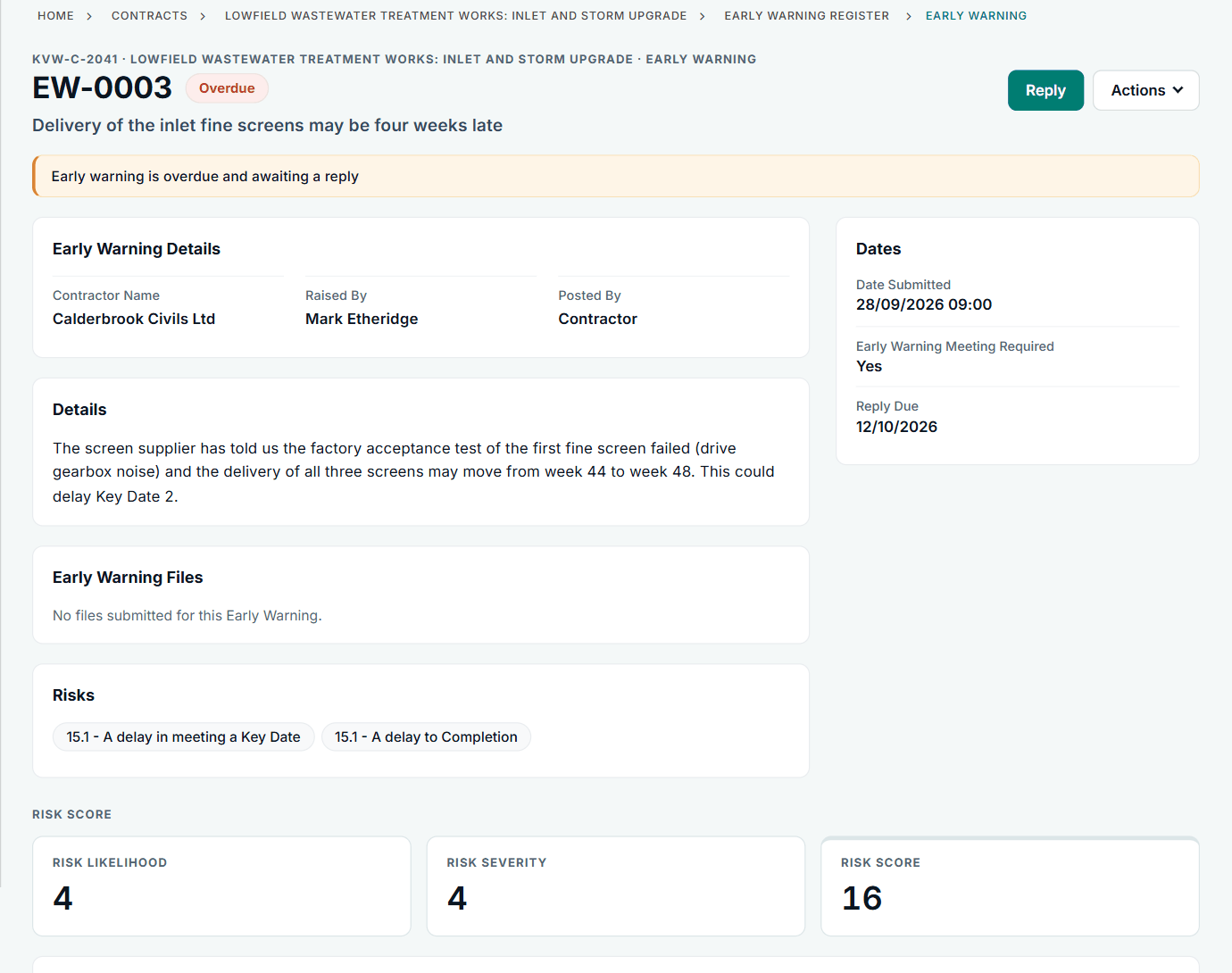
An early warning in Contract Status, with its risks, reply date and score. See the worked example.
See how this works in practice
Click through Contract Status with sample contracts: raise the notice, reply to it, and watch both sides of one record.
Take the guided tour Book a demo
Try the Project Manager role-play, use the free NEC tools or download free NEC templates.
This guide is general information in our own words, not legal advice. Your contract and its Contract Data always govern. NEC, NEC3 and NEC4 are trade marks of Thomas Telford Ltd; Contract Status is not affiliated with or endorsed by NEC.