
The most common early warning mistakes on NEC contracts come in two opposite kinds: teams either warn too little, usually for fear of how it looks, or they warn about everything to protect themselves. Both defeat the purpose, because in each case the real risks don't get dealt with in time.
This page sets out the patterns to look for, on both sides of the contract, and what to do instead. For the rules themselves, see the early warnings guide. Clause numbers are NEC4 ECC.
Under-use: warning too little or too late
| What happens | Why it hurts | Fix |
|---|---|---|
| Waiting until the cost and delay are known | By then, the cheap options are gone, and the 61.5 risk has started to build | Warn on "could". Say "not yet known" for anything you can't size |
| Not warning because it looks like an admission | A warning says nothing about fault; staying silent on your own problem can cost more | Keep the notice factual and leave out liability |
| Staying quiet in case it damages the relationship | The surprise later does far more damage | Phone first, then send the notice the same day |
| Project Manager not warning at all | Contractor loses time it could have used, and later events cost the Client more | Add "anything we know that they don't?" to your weekly routine |
| Knowledge stuck on site | The people who send notices don't hear about it in time | Give foremen and engineers a simple way to pass concerns on |
Over-use: warning about everything
Over-warning feels safe, but it can do its own harm. When a contract has a very long list of warnings, people stop reading them, meetings run out of time and the matters that really need a decision get lost.
- Blanket or "just in case" notices. A letter listing every possible hazard on the job isn't a warning about anything. Keep to specific matters you have actually become aware of.
- Using warnings to build a claim file. The other side can tell, and the meeting then turns into a negotiation. Compensation events have their own route.
- Warning about trivial items. Ask whether the matter could genuinely have a listed effect. If it couldn't, a conversation is all it needs.
- Several matters in one notice. Split them. Otherwise one can't be closed while the others stay open.
Our guide to what should be early warned includes a quick test for borderline cases.
Treating a warning as something it isn't
- Treating it as a compensation event notice. This is the costly one. A warning doesn't stop the 61.3 period for notifying the event from running. Check each live warning against the list of NEC4 compensation events and notify separately where needed.
- Rejecting a warning. The contract gives the Project Manager no such response. It enters the matter and deals with it at a meeting. A reply saying "rejected, no entitlement" confuses a warning with a claim, and it discourages the next warning.
- Assuming entry in the register means entitlement. It shows the matter is being managed, not that the Client will pay.
- Waiting for a reply before acting. NEC sets no reply period for a warning, so don't plan around one. If the matter is urgent, instruct a meeting.
Paperwork errors that undermine the process
- Mentioning it only in a progress report or minutes. A notification goes separately (13.7). Keep reports for reporting.
- Quoting the wrong clause. Clause 16 is right for NEC3 early warnings, but in NEC4 it deals with the Contractor's proposals. Check your templates when moving between editions.
- Letting the register slip. NEC4 requires the revised register within a week of each meeting (15.4). When that slips, decisions are forgotten and actions go unowned.
- Vague actions. "Monitor" isn't an action. Name a person, a task and a date.
- Removing items too soon. A matter comes off once a meeting decides it can. Keep a record of when and why.
Meeting mistakes
- Letting the first meeting slip. NEC4 puts it within two weeks of the starting date (15.2). Often it's the first thing dropped during mobilisation, as covered in the kick-off meeting guide.
- Agreeing a Scope change with no instruction. A decision needing a change has to be followed by the Project Manager's instruction (15.4). Doing the work on the strength of a minute puts payment for it at risk.
- Debating who pays. Move that conversation out of the room. Ask "what's the best way to deal with this?" and let the contract's other clauses settle the money.
- Sending too many people or the wrong ones. If no one present can commit resources, decisions wait for another week.
Related guides
- NEC Early Warnings: The Complete Guide
- Early Warnings for Subcontractors
- Who Gives an Early Warning?
- What Happens If No Early Warning Is Given?
How this looks in Contract Status
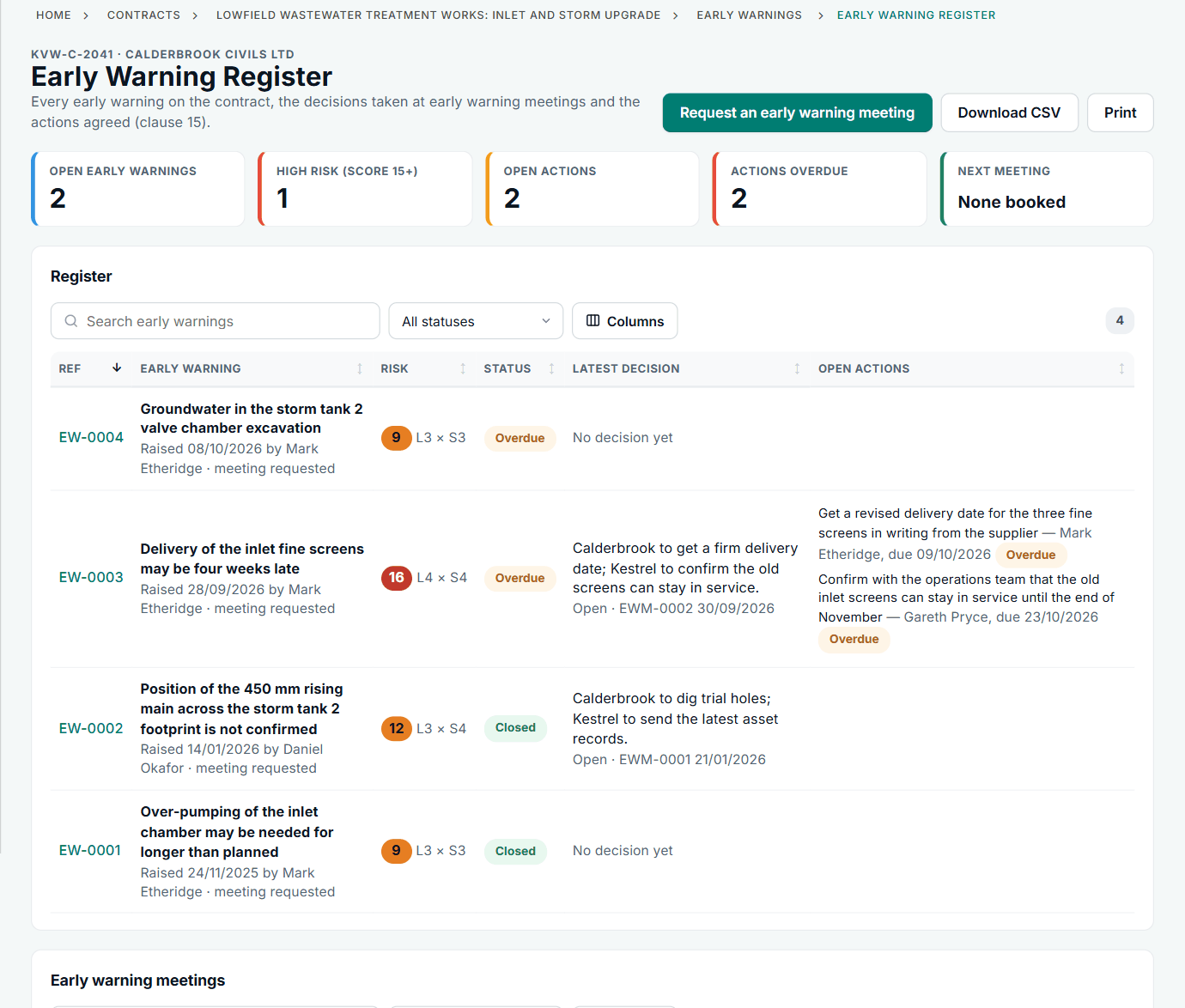
The Early Warning Register page, with risk scores, decisions and open actions. See the worked example.
See how this works in practice
Click through Contract Status with sample contracts: raise the notice, reply to it, and watch both sides of one record.
Take the guided tour Book a demo
Try the Project Manager role-play, use the free NEC tools or download free NEC templates.
This guide is general information in our own words, not legal advice. Your contract and its Contract Data always govern. NEC, NEC3 and NEC4 are trade marks of Thomas Telford Ltd; Contract Status is not affiliated with or endorsed by NEC.