
An early warning under NEC is a notice from the Project Manager to the Contractor, or from the Contractor to the Project Manager, about something that might harm cost, time or the quality of the finished works. It is a contractual duty, not a courtesy, and it applies as soon as either of them becomes aware of the matter.
The idea is simple: the earlier a problem is shared, the more options there are for dealing with it. This page covers the purpose of the duty. The wider process is in the complete guide to NEC early warnings.
What the duty requires
In the NEC4 Engineering and Construction Contract (ECC), clause 15.1 asks each side to tell the other when it learns of a matter that could:
- increase the total of the Prices,
- make Completion later,
- make it late in meeting a Key Date, or
- impair how the works perform once in use.
The Contractor may also warn of anything else that could add to its own total cost. That limb is a choice, whereas the four above are not. NEC3 sets out the same duty at clause 16.1.
Three words do most of the work here. Could sets a low bar, since the risk need not be probable. Aware means the duty starts with knowledge, not with a finished investigation. And the duty runs both ways, which surprises people who assume warnings only come from contractors.
What an early warning is not
Most confusion comes from treating a warning as something it isn't. The table shows the difference.
| Early warning | Compensation event notice | |
|---|---|---|
| What it says | This might cause a problem; let's deal with it | This listed event has happened or is expected |
| Who can give it | Project Manager or Contractor | Project Manager or Contractor |
| Formal response | Entered in the register and discussed; never accepted or rejected | Decision on whether it is a compensation event, then quotations |
| Changes Prices or dates? | No, not by itself | Yes, if it qualifies and is assessed |
| Who carries the risk? | Says nothing about that | Decided by the contract's list of events |
| Main clauses (NEC4 ECC) | 15 | 60 to 66 |
A warning is not an admission either. Saying "our supplier may deliver late" does not concede liability for the delay, and saying "the Client's consent may be late" does not make it a claim. The warning simply puts the matter on the table. To see how the two processes interact, read early warnings and compensation events.
Why the contract asks for it
NEC is written around managing problems as they emerge rather than arguing about them afterwards. The early warning process is where that shows most clearly, for three practical reasons.
- Options narrow quickly. A clash found on paper can be redesigned. The same clash found on site may mean rework and delay.
- Each side sees different things. The Contractor knows its supply chain and resources; the Project Manager knows the Client's plans and neighbouring projects. Neither has the whole picture.
- Solutions may suit both sides. The meeting that follows is meant to find answers that benefit everyone affected, not to allocate blame.
A short example
This fictional example shows the duty working in both directions on a school extension. The figures would vary; the sequence is the point.
- The Contractor's site manager learns that the roofing supplier has lost a key fabricator. Delivery could slip by weeks, which could delay Completion. She issues an early warning that day.
- The Project Manager enters it in the register and, in the same week, gives a warning of its own: the school may ask to move the summer holiday handover of one classroom block, which could affect a Key Date.
- At the early warning meeting, the two matters are looked at together. The team agrees that the Contractor will price a second supplier and that the Project Manager will confirm the handover date with the school by Friday.
- The Project Manager records the decisions in the revised register. The contract's normal rules then decide who pays for anything that follows.
Neither warning cost anything to give, and neither decided who was responsible. Both widened the range of options while there was still time to use them.
What happens if nobody warns?
The main consequence falls on the Contractor. If an experienced contractor could have warned of an event and did not, the compensation event can be assessed as though the warning had been given (NEC4 ECC 61.5 and 63.7; NEC3 ECC 61.5 and 63.5). See what happens if no early warning is given for how that works in practice. The duty sits alongside the clause on mutual trust and co-operation at 10.2 of NEC4, which you can read about in the clause 10 guide.
Related guides
- NEC Early Warnings: The Complete Guide
- NEC Clause 15 Explained
- How to Write an Early Warning Notice
- Early Warning Notice Template
How this looks in Contract Status
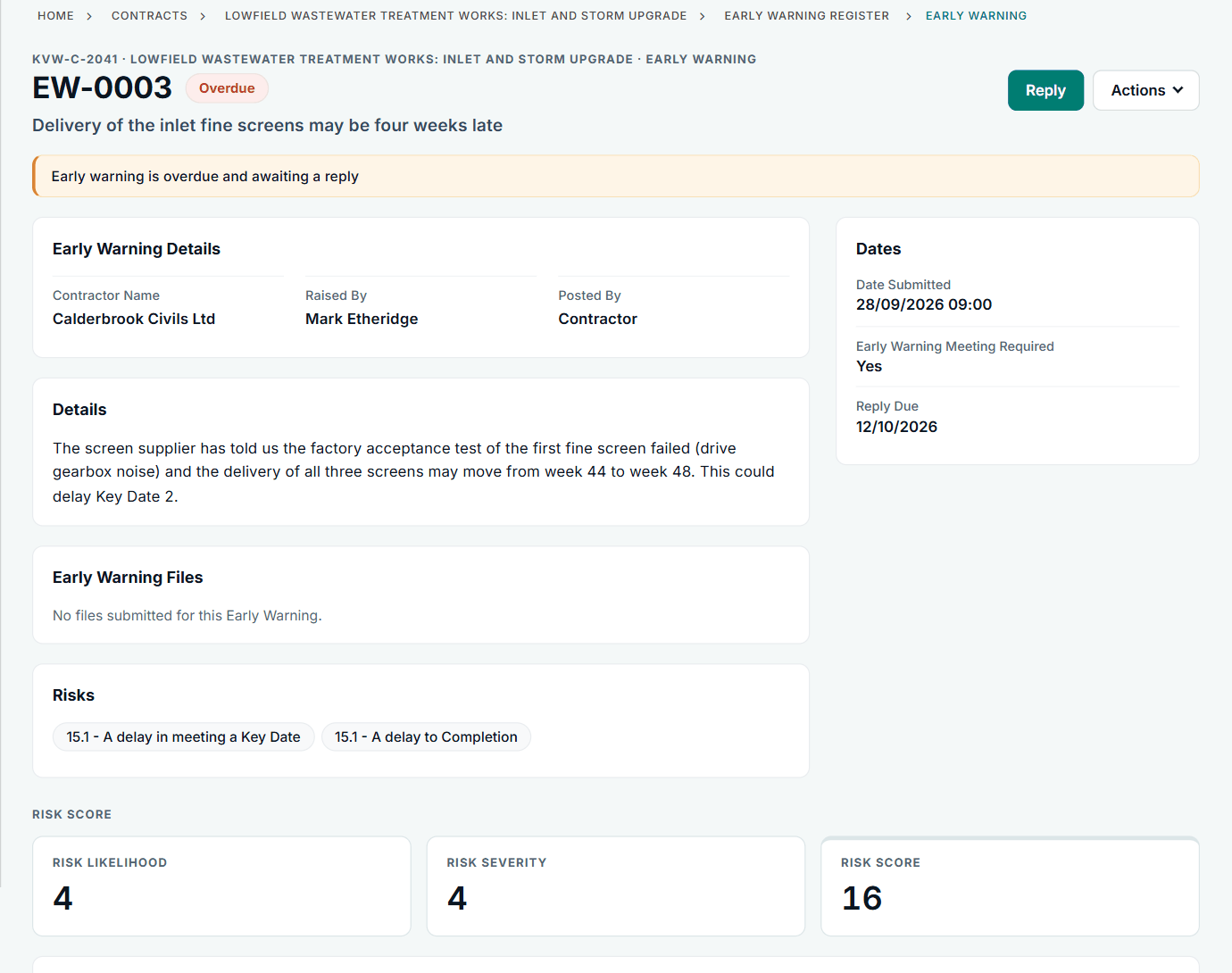
An early warning in Contract Status, with its risks, reply date and score. See the worked example.
See how this works in practice
Click through Contract Status with sample contracts: raise the notice, reply to it, and watch both sides of one record.
Take the guided tour Book a demo
Try the Project Manager role-play, use the free NEC tools or download free NEC templates.
This guide is general information in our own words, not legal advice. Your contract and its Contract Data always govern. NEC, NEC3 and NEC4 are trade marks of Thomas Telford Ltd; Contract Status is not affiliated with or endorsed by NEC.