
An early warning register template needs only two things to satisfy the contract: a description of each matter, and how its effects will be avoided or reduced. The extra columns below make it workable, because they show who is doing what by when and what has already been decided.
You can build this in a spreadsheet in a few minutes. It suits the NEC4 Early Warning Register and the NEC3 Risk Register alike. Just change the title and the clause references.
The columns
| Column | What to enter | Status |
|---|---|---|
| Reference | A unique number that matches the notice, such as EW-017. Use "CD" for matters from the Contract Data | Good practice |
| Date entered | The date the matter was notified or added | Good practice |
| Raised by | Project Manager, Contractor or Contract Data | Good practice |
| Description of the matter | One or two plain sentences that someone new to the job could follow | Required |
| Possible effect | Mark each that applies: Prices, Completion, Key Date (name it), performance, Contractor's cost | Good practice |
| Rough scale | A range or "not yet known". Leave out private pricing | Optional |
| How effects will be avoided or reduced | The agreed response, updated after each meeting | Required |
| Action owner | A named person, not a company or team | Good practice |
| Action date | A real date, not "ongoing" | Good practice |
| Latest decision and meeting date | What the last meeting decided, with its date | Good practice |
| Instruction reference | Any Scope change instructed with the revised register | Good practice |
| Linked compensation event | The event reference, if the matter became or led to one | Good practice |
| Status | Open, or Removed, with the date and meeting that removed it | Good practice |
Sample entries
These entries come from a fictional rail depot project. They show a level of detail that is enough without being a report.
| Ref | Matter | Effect | How avoided or reduced | Owner and date | Status |
|---|---|---|---|---|---|
| CD-01 | Track access for crane lifts depends on the operator's possession plan | Completion; Key Date 1 | Contractor to share lift sequence; Project Manager to confirm possessions with the operator | J. Patel, 14 March | Open |
| EW-006 | Switchgear supplier reports factory delay of up to four weeks | Completion | Second factory slot being priced; temporary supply considered at last meeting | R. Owen, 21 March | Open |
| EW-009 | Client's IT team may change the door access system specification | Prices; performance | Project Manager to confirm decision. If it changes, an instruction will follow | S. Hughes, 7 March | Open |
| EW-003 | Possible bat roost in the old store | Completion | Survey found none. Removed by meeting 4 | Closed | Removed |
Three choices to make before you start
- Who controls the master? The Project Manager revises and issues the register under 15.4 (NEC3: 16.4). Contractors can keep a working copy but shouldn't circulate a rival version.
- Do you need scoring? Likelihood and impact scores are not a contract requirement. They can help sort a long list, but arguments over a score waste meeting time. A simple high, medium or low, or sorting by the date a decision is needed, is often enough.
- Will you keep private notes elsewhere? Both sides see this document. Keep your contingency, margin and commercial strategy in your own internal register.
Common faults with templates
- An effects column that only says "cost" and "time". The contract separates Prices from the Contractor's own cost and Completion from each Key Date. The distinction often matters later.
- No link to compensation events. Without it, nobody can see if a live matter has moved into the compensation event register, or if it needs to.
- Deleted rows. Mark items as removed instead. The record of what was known and when can matter if 61.5 is raised later.
- No issue date or revision number. Since NEC4 expects reissue within a week of each meeting, the header needs to show the revision and date of the meeting it reflects.
If you use it for several contracts, consider how you will see across them, as explained in the guide to tracking NEC contracts in spreadsheets. The wider picture is in the NEC early warnings guide.
Related guides
- NEC Early Warnings: The Complete Guide
- Running an Early Warning Meeting
- What Should Be Early Warned?
- Who Gives an Early Warning?
- Early Warning Notice Template
- The Early Warning Register
How this looks in Contract Status
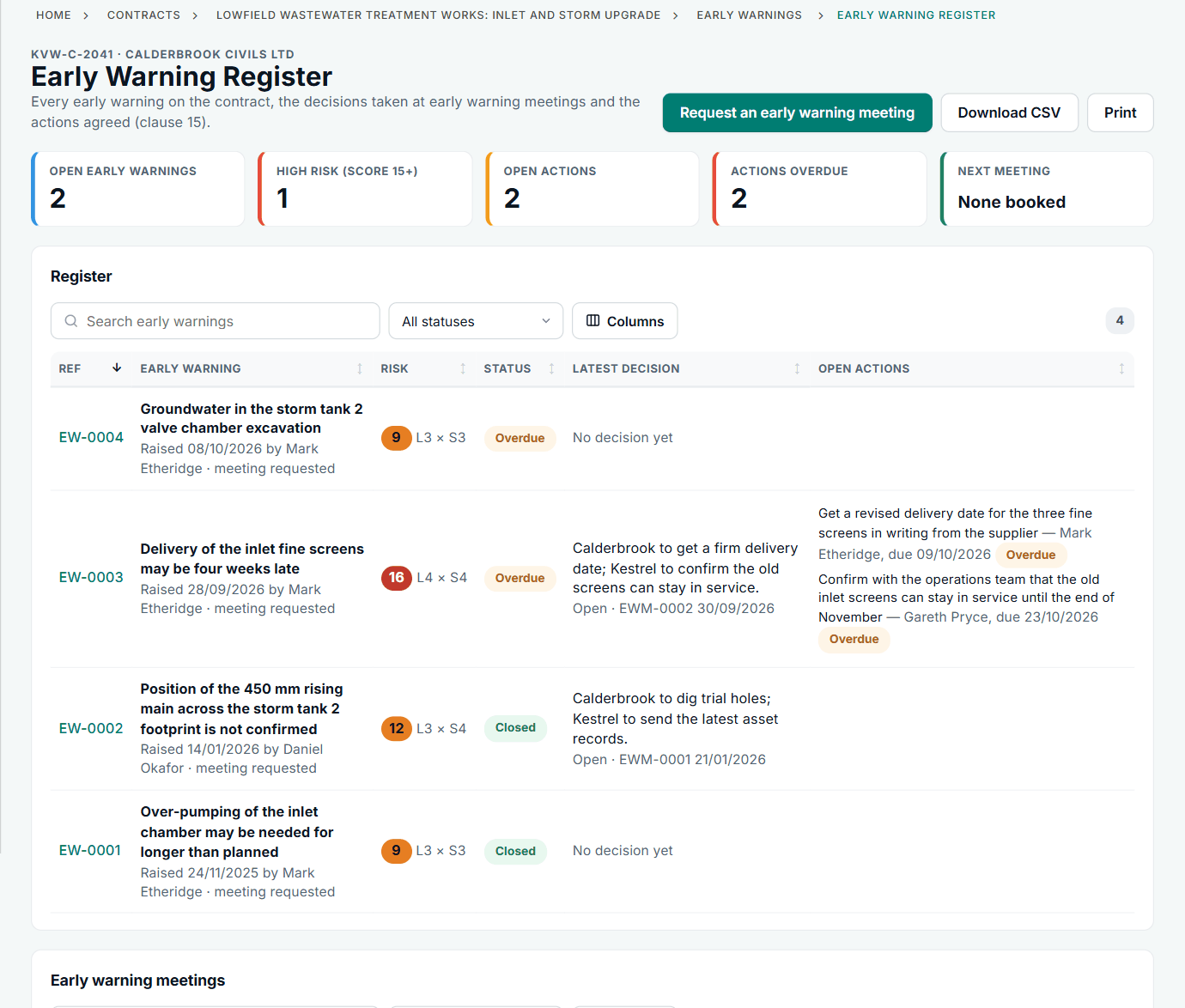
The Early Warning Register page, with risk scores, decisions and open actions. See the worked example.
See how this works in practice
Click through Contract Status with sample contracts: raise the notice, reply to it, and watch both sides of one record.
Take the guided tour Book a demo
Try the Project Manager role-play, use the free NEC tools or download free NEC templates.
This guide is general information in our own words, not legal advice. Your contract and its Contract Data always govern. NEC, NEC3 and NEC4 are trade marks of Thomas Telford Ltd; Contract Status is not affiliated with or endorsed by NEC.