
Under an NEC subcontract, early warning runs between the Subcontractor and the Contractor, with the Contractor taking the role the Project Manager has in the main contract. A Subcontractor's warning doesn't reach the Project Manager on its own, so each link in the chain has to pass it on.
The rules are in clause 15 of the NEC4 Engineering and Construction Subcontract (ECS) and clause 16 of the NEC3 version. The main contract process is in the NEC early warnings guide; this page covers what changes further down. More on the form itself is in the Engineering and Construction Subcontract guide.
How the subcontract clause differs
| Point | NEC4 main contract (ECC) | NEC4 subcontract (ECS) |
|---|---|---|
| Who warns whom | Project Manager and Contractor | Contractor and Subcontractor |
| Who keeps the register | Project Manager | Contractor |
| First register | One week from the starting date | One week from the subcontract starting date |
| First meeting | Two weeks from the starting date | Two weeks from the subcontract starting date |
| Later meetings | Contract Data interval at most | Subcontract Data interval at most |
| Optional cost warning | Contractor may warn about its own cost | Either party may warn about the Subcontractor's cost |
| Joining the upper-tier meeting | Not applicable | Contractor may instruct the Subcontractor to attend its meeting with the Project Manager if the matter also affects the subcontract |
That last row is a useful NEC4 addition at 15.2 of the ECS. The NEC3 subcontract has no direct equivalent, so there the Subcontractor attends a main contract risk reduction meeting by agreement between the Project Manager and the Contractor.
How a warning moves through the chain
Upwards: a Subcontractor finds the problem
- The Subcontractor notifies the Contractor as a separate notice under the subcontract.
- The Contractor enters it in the subcontract register.
- The Contractor asks itself whether it could also affect the main contract. If so, it gives its own warning to the Project Manager.
- If a joint discussion would help, the Contractor proposes bringing the Subcontractor to the main contract meeting. The Project Manager's agreement is needed for that under 15.2 of the ECC.
- Decisions come back down through the revised registers and any instructions, each under its own contract.
Downwards: the Project Manager or Client raises something
- The Project Manager warns the Contractor under the main contract.
- The Contractor checks which subcontracts are touched and warns each affected Subcontractor.
- Under the ECS, the Contractor may instruct those Subcontractors to attend the main contract meeting.
What a Contractor needs to watch
A missing link has consequences at both levels. If an experienced subcontractor could have warned and did not, the Contractor can state this under 61.5 of the subcontract, so the subcontract event is assessed as if the warning had been given (ECS 63.7). In the main contract, however, the Contractor's own position depends on what an experienced contractor could have warned of. A failure by a Subcontractor doesn't by itself excuse the Contractor against the Client.
So the Contractor benefits from a real flow of information, not just from the paperwork. Make warnings a topic at subcontractor reviews, and check them against the main contract register regularly.
Time limits are different too
The early warning periods match across the tiers, but the related compensation event periods do not. The table compares them. These figures are for the unamended forms; check yours.
| Step | NEC4 ECC | NEC4 ECS |
|---|---|---|
| Notify a compensation event (61.3) | Eight weeks | Seven weeks |
| Reply to that notification (61.4) | One week | Two weeks |
| Submit a quotation (62.3) | Three weeks | Two weeks |
| Reply to a quotation (62.3) | Two weeks | Four weeks |
The pattern gives the Contractor room to pass information on. A Subcontractor can't assume it has the ECC's periods: a warning in hand doesn't stop the shorter subcontract clock. See back-to-back subcontracts for how to align a chain.
Other subcontract types
- NEC3 Short Subcontract (ECSS). Clause 16 has the warning duty and the duty to co-operate on a response, but no register or formal meetings. Missing warnings can still reduce an assessment under 61.3 and 63.5 of that form. For the NEC4 version, check the number in your own copy.
- Professional Service Subcontract (NEC4 PSS). Follows the same structure at clause 15, with its own list of effects.
- Non-NEC subcontracts. A bespoke or JCT-based subcontract won't include this duty unless it has been written in. A Contractor under an NEC main contract should consider adding it, since its own main contract exposure remains. The Subcontractor should read the actual terms.
Practical tips for Subcontractors
- Send your notice to the Contractor, not the Project Manager. Your contract is with the Contractor, even if you talk to the Project Manager's team on site.
- Tell the Contractor if you think the main contract is affected. It may not spot the link without your help.
- Warn about your own subcontract's Key Dates too. They can differ from those in the main contract.
- Pass the duty down to your subsubcontractors and suppliers, or you may hear about the problem too late to warn in time.
Our guide to NEC for subcontractors covers the rest of the subcontract routine.
Related guides
- NEC Early Warnings: The Complete Guide
- What Happens If No Early Warning Is Given?
- Common Early Warning Mistakes
How this looks in Contract Status
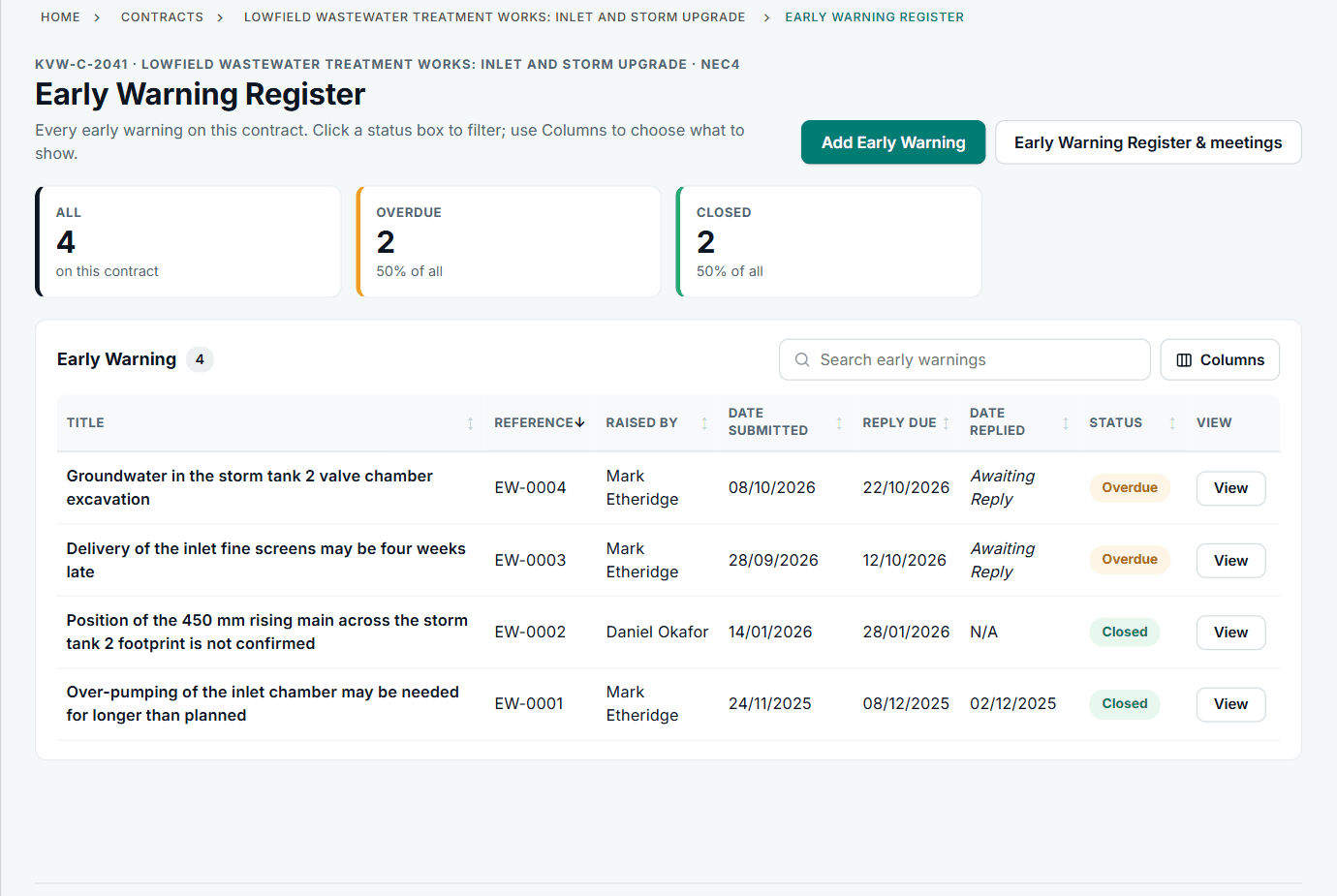
An early warning register. A subcontract account uses its own words for the two sides. See the worked example.
See how this works in practice
Click through Contract Status with sample contracts: raise the notice, reply to it, and watch both sides of one record.
Take the guided tour Book a demo
Try the Project Manager role-play, use the free NEC tools or download free NEC templates.
This guide is general information in our own words, not legal advice. Your contract and its Contract Data always govern. NEC, NEC3 and NEC4 are trade marks of Thomas Telford Ltd; Contract Status is not affiliated with or endorsed by NEC.