
NEC for subcontractors means working to tighter clocks than the main contract, with the Contractor doing the jobs a Project Manager and Supervisor do above you. Under the NEC4 subcontract (ECS), you have seven weeks to notify a compensation event, not eight, and two weeks to quote, not three.
The first question is which subcontract you actually have. This page is written for the unamended ECS. The short subcontract is a simpler form with its own rules, and if yours is a bespoke form that only refers to NEC, read that form first, because the terms could be very different. For the wider routine, see managing NEC contracts.
Your periods under the NEC4 subcontract
| Your action | ECS period | Clause |
|---|---|---|
| Notify a compensation event you believe has happened | 7 weeks after becoming aware | 61.3 |
| Submit a quotation | 2 weeks after being instructed | 62.3 |
| Submit a revised quotation | 2 weeks after being instructed | 62.4 |
| Submit a first programme | As the Subcontract Data says | 31.1 |
| Warn of a problem | As soon as you become aware | 15.1 |
| Apply for payment | Before each assessment date | 50.2 |
The Contractor has longer on its side: two weeks to reply to a notified event, four to reply to a quotation and three on a programme. That gap is by design, so that the Contractor can hear from the Project Manager and pass it on. See the table of NEC time periods for the full list.
What's different about the Contractor's role
There is no Project Manager or Supervisor in the ECS. The Contractor instructs, tests, accepts and certifies, while also being your commercial counterparty. That has some practical effects:
- Keep the roles apart in your head. A site agent's comment isn't an instruction unless the person giving it has authority. Ask who is acting and under which clause.
- Know that your Contractor is also on a clock. If a change comes from the Project Manager, your Contractor needs your quotation in order to quote upwards. Be early where you can, and you'll usually get a better conversation.
- The 60.1 list is similar, but the cause matters. Events caused by the Contractor are your compensation events, even when they aren't anyone's event higher up. Don't assume an event fails because the main contract wouldn't cover it.
Getting paid
- Apply before every assessment date, with details of how you've worked it out (50.2). If you don't, the amount due falls back on a less favourable basis (50.4).
- Check for a first programme. If none is identified in the Subcontract Data, assessments hold back 25% from the Price for Work Done to Date until you submit one (50.5).
- Under the ECS, the certificate is due within two weeks of the assessment date, and payment within four, unless the Subcontract Data says otherwise (51.1, 51.2).
- Where the UK Construction Act applies, look at Option Y(UK)2. A Contractor planning to pay under the notified sum gives notice no later than seven days before the final date for payment (Y2.3). If you suspend performance as the Act allows, that is a compensation event. The NEC4 ECS numbers it Y2.4, using that number twice; it is Y2.5 in the NEC4 ECC and PSS.
- Be alert to pay-when-paid wording in a bespoke form. See payment for subcontractors.
Before you sign: a checklist
- Which form and edition, and have the periods been changed?
- Does the subcontract's programme line up with the Contractor's Accepted Programme? Ask to see the part that affects you.
- What are your access dates, and what do they depend on?
- Have you seen the main contract terms that are said to apply to you? Ask for any Z clauses that flow down.
- Are delay damages under Option X7 set at a level that bears any relation to your package?
- Have you got the Site Information that relates to your work?
- Is there a Fee that actually reflects your overheads?
- Are there any terms that make notice harder, such as extra content a notification has to include?
What gets subcontractors into trouble
- Doing the extra on a site agent's word, and no instruction ever comes. Ask for one, and confirm what you've been told in writing the same day.
- Waiting for the main contract answer. Your seven weeks run regardless of what the Project Manager has told the Contractor.
- Warning only by phone. Use a written notice, or your warning may not count when it matters. See early warnings for subcontractors.
- Thinking a target contract above you means you share its gain. Check your own subcontract. Your Option is what counts.
- Leaving your records with the main team. Keep your own diary, allocation sheets and photographs.
For the Contractor's side of this relationship, see managing NEC subcontracts. The form itself is covered under the Engineering and Construction Subcontract. NEC3's subcontract uses a similar shape, but check its own periods.
Related guides
- Managing NEC Contracts: A Practical Guide
- An NEC Guide for Consultants
- NEC on Highways Projects
- NEC on Rail Projects
- An NEC Guide for Contractors
- An NEC Guide for Clients
How this looks in Contract Status
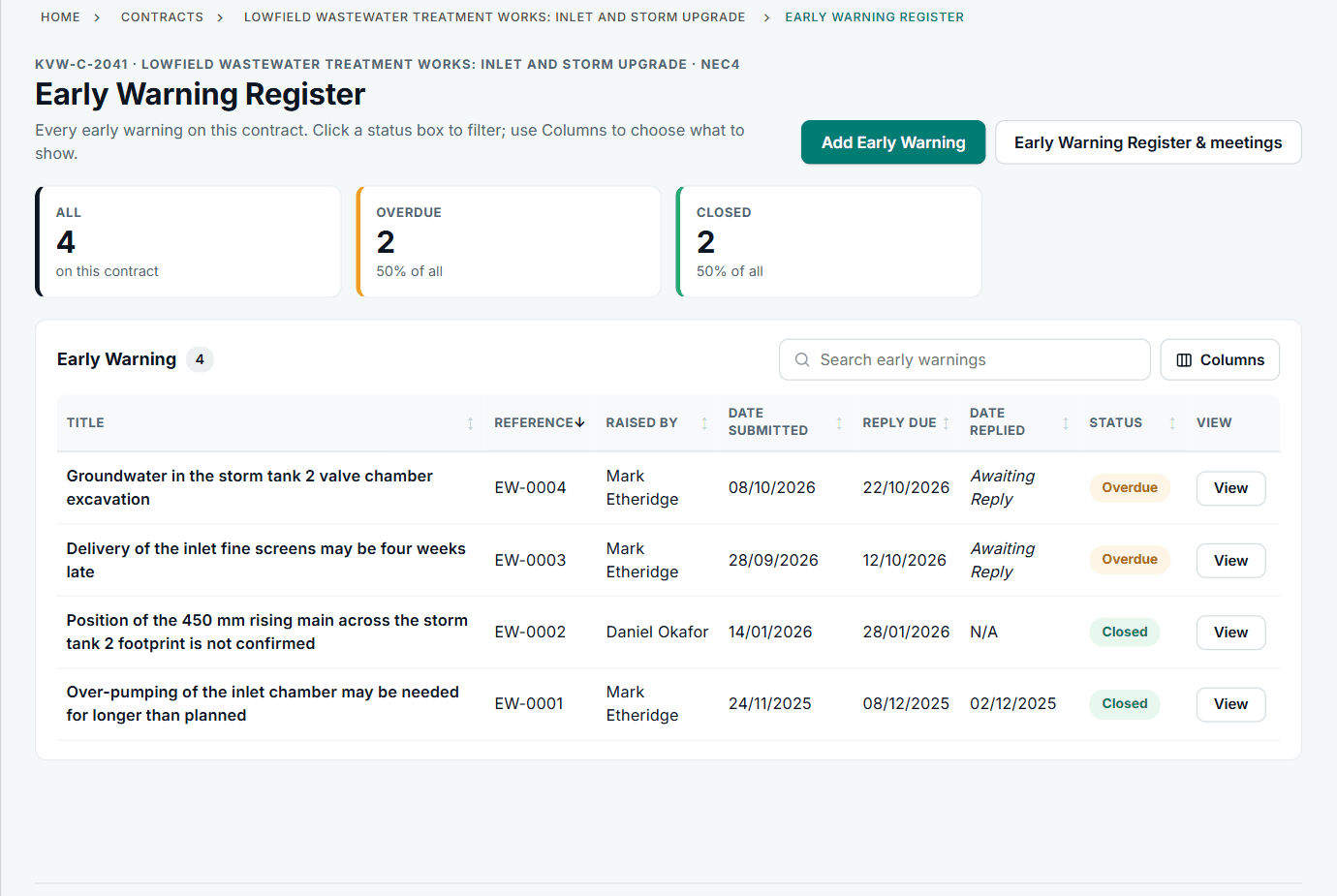
An early warning register. A subcontract account uses its own words for the two sides. See the worked example.
See how this works in practice
Click through Contract Status with sample contracts: raise the notice, reply to it, and watch both sides of one record.
Take the guided tour Book a demo
Get free NEC templates, use the free NEC tools or download free NEC templates.
This guide is general information in our own words, not legal advice. Your contract and its Contract Data always govern. NEC, NEC3 and NEC4 are trade marks of Thomas Telford Ltd; Contract Status is not affiliated with or endorsed by NEC.