
NEC contract mobilisation has a few fixed deadlines and a lot of set-up that nobody will force you to do, and both need attention in the first 30 days. Under the NEC4 Engineering and Construction Contract (ECC), the Early Warning Register is due within one week of the starting date and the first early warning meeting has to take place inside two weeks.
The dates below assume an unamended NEC4 ECC. Periods marked "Contract Data" are specific to your job, so look them up on day one and enter them in your diary. For how this fits into the overall routine, see managing NEC contracts.
Before the starting date
- Read the Contract Data, both parts, and every Z clause. Write a one-page summary of the periods and anything unusual.
- Confirm the names and addresses for communications, and whether the Scope specifies a communication system (13.2).
- Check what security and insurance documents are required, such as any bond or guarantee under the secondary Options. See insurance under NEC.
- Find out who is actually doing the Project Manager's and Supervisor's actions. If anything is delegated, the Project Manager notifies the Contractor (14.2).
- Book the kick-off meeting.
The checklist by week
| When | Who | Task | Source |
|---|---|---|---|
| Day 1 | Both | Open the registers and agree numbering | Good practice |
| Week 1 | Project Manager | Issue the first Early Warning Register, seeded from the Contract Data matters and any others you know of | 15.2 |
| Week 1 | Project Manager | Instruct the Contractor to attend the first early warning meeting | 15.2 |
| Week 2 | Both | Hold the first early warning meeting (no later than two weeks after the starting date) | 15.2, 15.3 |
| Week 2 or 3 | Project Manager | Send out the updated register within a week of that meeting | 15.4 |
| Contract Data | Contractor | Submit the first programme, unless one is already identified | 31.1 |
| Two weeks later | Project Manager | Accept the programme or give reasons | 31.3 |
| Contract Data | Contractor | Provide the quality policy statement and quality plan for acceptance | 40.2 |
| Within one assessment interval of the starting date | Project Manager | Set the first assessment date to suit both parties' procedures | 50.1 |
| Before appointing | Contractor | Submit proposed subcontractors, and subcontract documents where needed, for acceptance | 26.2, 26.3 |
| Before doing the work | Contractor | Submit any Contractor's design for acceptance | 21.2 |
The money reason to get the programme in
If the Contract Data identifies no programme, each assessment takes the Price for Work Done to Date and holds back 25% of it until a first programme showing what the contract requires has gone in (50.5). That is a large sum for any business during mobilisation, so aim to get the first programme right the first time.
The Project Manager has an interest too. Until a programme is accepted, it is much harder to assess compensation events, since 64.2 leaves the assessment resting on the Project Manager's own view of the programme. Spend time with the planner before submission so that a non-acceptance is unlikely. A programme review checklist helps both sides.
Set-up decisions that are hard to change later
- The compensation event process. Decide how to record the date of awareness, because 61.3 depends on it. Ask site teams to report anything unusual on the day it happens.
- Records of Defined Cost. On Options C, D and E, agree how timesheets, plant records and invoices will be collected and checked before the first cost arrives. Retrofitting this is painful. See open book under NEC.
- Baseline photographs and surveys. Record access routes, existing structures and neighbours' property before work starts.
- A meeting calendar. Fix the early warning meetings, commercial meetings and programme reviews for the next few months while diaries are still free.
A day-30 health check
By the end of the first month, a well-mobilised job can answer yes to each of these:
- Has the first early warning meeting been held, and is the updated register out?
- Is a programme accepted, or is one submitted with a known reply date?
- Does everyone know the period for reply and the eight-week compensation event limit?
- Is the assessment date known, with the first application prepared?
- Does each register have a named owner?
- Has anything already been noticed on site that should be a warning or a compensation event?
That last one is often overlooked. New sites surface surprises quickly, and the eight weeks start running whether or not the team has settled in. Under NEC3 ECC, the fixed periods for the first register and meeting don't apply, though the Risk Register and first programme still need setting up, so agree early dates anyway.
Related guides
- Managing NEC Contracts: A Practical Guide
- Running an NEC Kick-off Meeting
- A Weekly NEC Routine
- Managing NEC Communications
- NEC Contract Administration
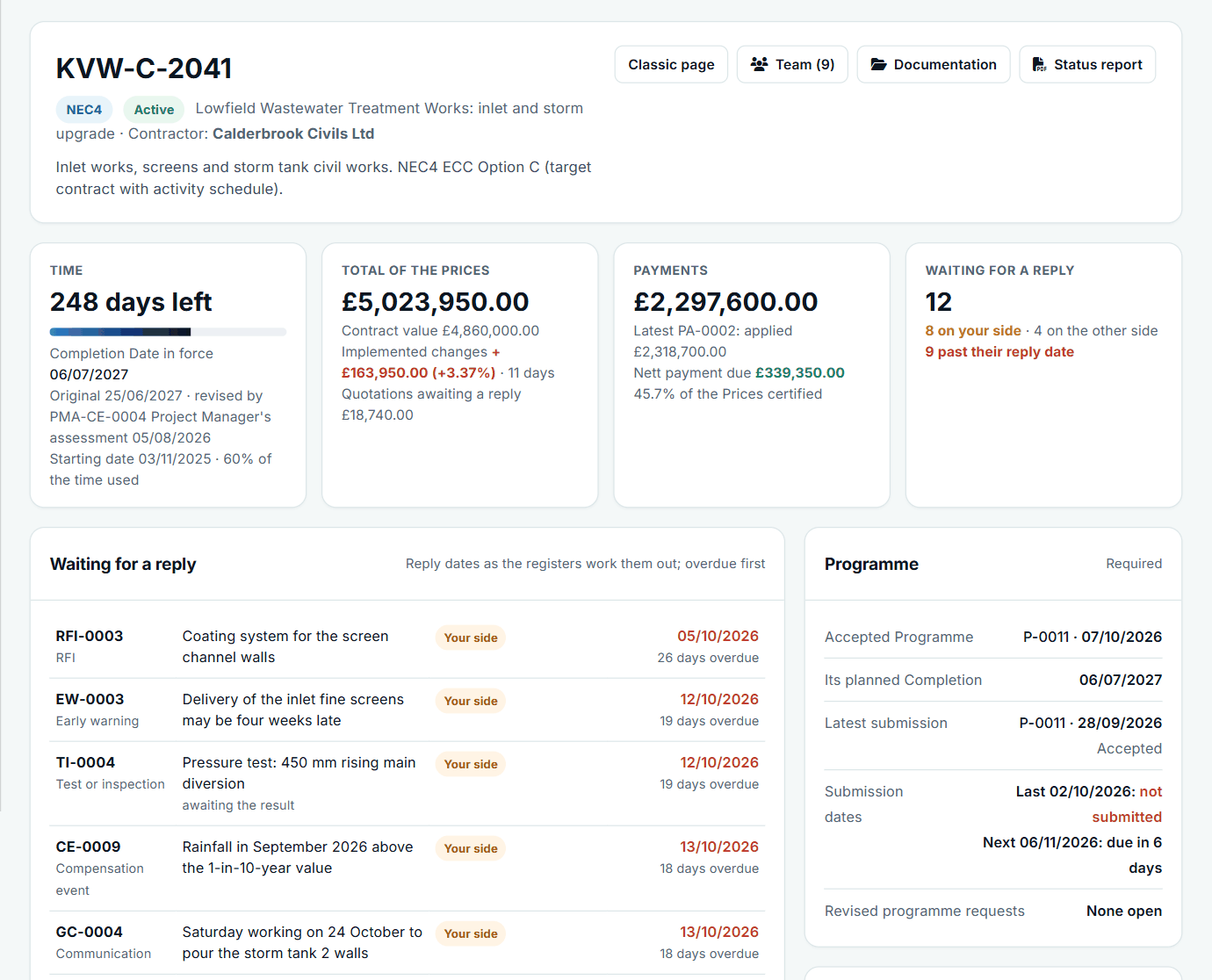
See how this works in practice
Click through Contract Status with sample contracts: raise the notice, reply to it, and watch both sides of one record.
Take the guided tour Book a demo
Get free NEC templates, use the free NEC tools or download free NEC templates.
This guide is general information in our own words, not legal advice. Your contract and its Contract Data always govern. NEC, NEC3 and NEC4 are trade marks of Thomas Telford Ltd; Contract Status is not affiliated with or endorsed by NEC.