
NEC subcontract management is mainly about timing the chain: a notice from a Subcontractor has to reach the Project Manager in time, and a decision from the Project Manager has to reach the Subcontractor in time. The NEC4 subcontract (ECS) sets its periods to help with this, but only if the Contractor moves things on promptly.
This page is written from the Contractor's side. Subcontractors should read the NEC guide for subcontractors. For the form, see the Engineering and Construction Subcontract. It is part of the wider guide to managing NEC contracts.
Before letting the package
| Check | Why | Clause (NEC4 ECC) |
|---|---|---|
| Submit the subcontractor's name for acceptance | You can't appoint before this is resolved | 26.2 |
| Submit the documents, leaving out pricing | Not needed for an unamended NEC subcontract (other than additional conditions) or if the Project Manager agrees | 26.3 |
| Include mutual trust wording | A reason for not accepting non-NEC documents is if they don't include it | 26.3 |
| On Options C, D and E, provide pricing information unless agreed otherwise | Check your own Option; it is in the Option clauses | 26.4 |
| Match the Subcontract Data to your main programme | Dates, Key Dates, access, interval | 31, 32 |
The Contractor remains responsible for Providing the Works as if it hadn't subcontracted (26.1). A subcontractor's failure is no excuse with the Project Manager.
How the periods fit together
| Step | Main contract | Subcontract | What that gives you |
|---|---|---|---|
| Notify an event | 8 weeks | 7 weeks | One week after the Subcontractor's limit to notify upwards, if they share the same awareness date |
| Reply to a notified event | 1 week | 2 weeks | One week to pass the answer down |
| Quote | 3 weeks | 2 weeks | One week to review and add your own |
| Reply to a quotation | 2 weeks | 4 weeks | Room to hear from the Project Manager and pass that down |
| Reply to a programme | 2 weeks | 3 weeks | One week to pass the answer down |
| Certificate after the assessment date | 1 week | 2 weeks | One week after your own certificate |
| Payment after the assessment date | 3 weeks | 4 weeks | One week after your receipt, assuming assessment dates match |
These are unamended forms. Bespoke subcontracts and amended ECS often change them, and that's where gaps open up. For a full walk-through, see back-to-back subcontracts.
A worked example
A fictional steelwork package. In week 1, on Monday, the Project Manager instructs a change affecting steelwork and tells the Contractor to quote within three weeks.
- Monday, week 1: Contractor instructs its Subcontractor to quote, under the subcontract's two weeks. If the Contractor waits until Friday, the margin has shrunk to two days.
- Monday, week 3: Subcontractor quotes.
- Monday, week 4: Contractor sends its own quotation with the subcontract price and its effect on other trades.
- Monday, week 6: Project Manager accepts.
- By Monday, week 7: Contractor replies to the Subcontractor. Four weeks from the subcontract quotation runs to the Monday of week 7.
The Contractor's week-1 action is what makes it work. Set your procedure so a main contract instruction triggers a subcontract instruction on the same day.
What goes wrong
- Misaligned event wording. Something can be a compensation event under the subcontract, because the Contractor caused it, without being one under the main contract. If you caused it, that cost stays with you.
- Passing through without thought. The Contractor's job is to manage, not to forward. A subcontract quotation that's wrong will only cost you once it's been accepted upstream.
- Different weather or physical condition tests. The subcontract may have different Site Information, a different Contract Date or different weather data. That can leave the Contractor in the middle.
- Warnings that stop at the Contractor. A Subcontractor's warning doesn't reach the Project Manager by itself, as covered in early warnings for subcontractors.
- Assuming pay-when-paid. Conditional payment is generally restricted under the UK Construction Act, except in insolvency cases, so check with your advisers before making payment depend on what you receive.
- Disputes moving separately. Without thought, you can have two inconsistent decisions on the same facts. Option W wording and any joinder arrangements are worth reading before they're needed. See ending subcontracts for the other end of the relationship.
A simple subcontract routine
- Keep main and subcontract registers linked, so one event shows both sets of clocks.
- Give each package manager their reply dates weekly.
- Invite critical subcontractors to early warning meetings for the relevant items, as 15.2 allows others to attend by agreement.
- Include subcontractor programme updates in your own revised programme.
Related guides
- Managing NEC Contracts: A Practical Guide
- Making Clause 10 Work in Practice
- An NEC Guide for Contractors
- An NEC Guide for Clients
- Tracking NEC Contracts in Spreadsheets
- Keeping a Clear NEC Audit Trail
How this looks in Contract Status
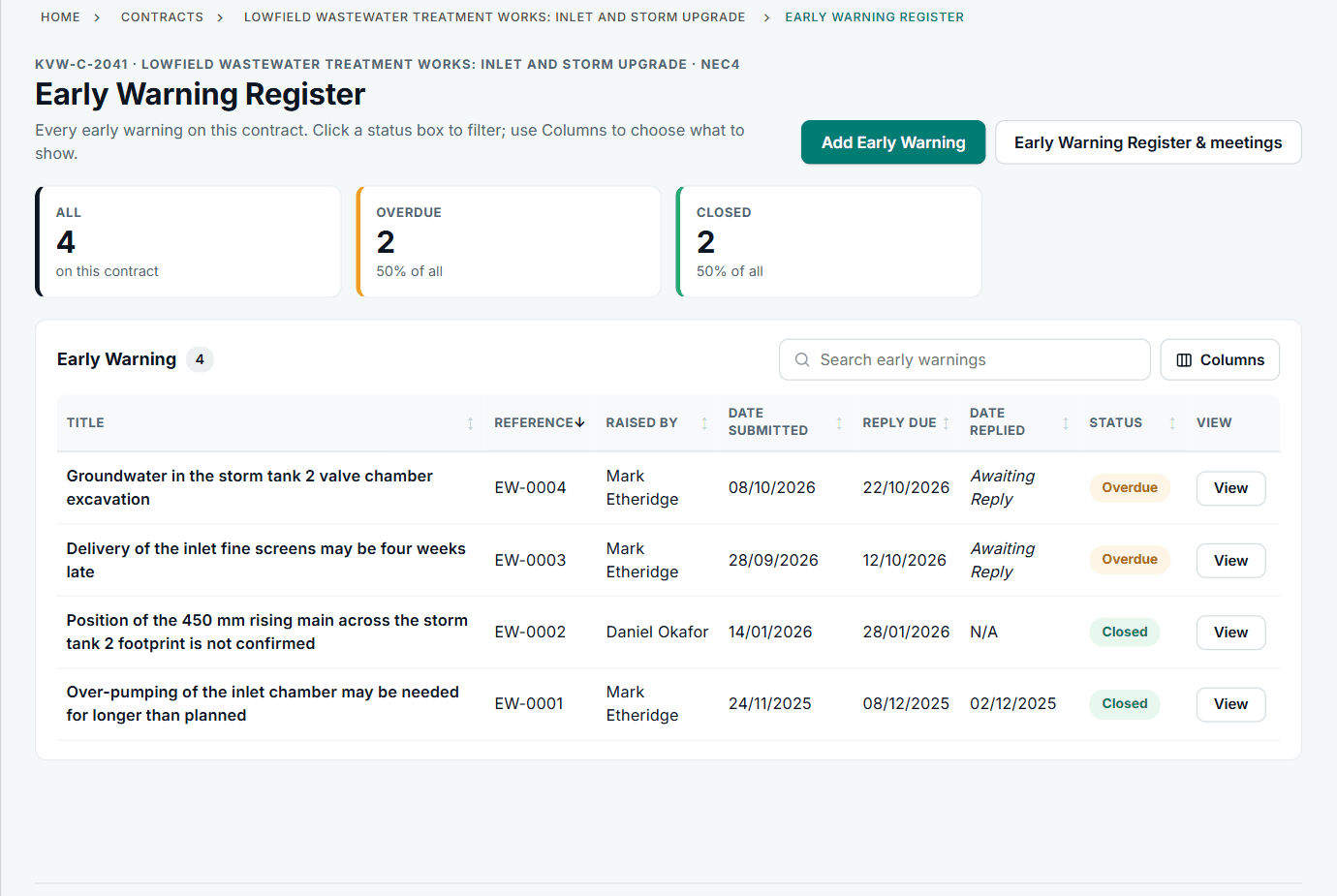
An early warning register. A subcontract account uses its own words for the two sides. See the worked example.
See how this works in practice
Click through Contract Status with sample contracts: raise the notice, reply to it, and watch both sides of one record.
Take the guided tour Book a demo
Get free NEC templates, use the free NEC tools or download free NEC templates.
This guide is general information in our own words, not legal advice. Your contract and its Contract Data always govern. NEC, NEC3 and NEC4 are trade marks of Thomas Telford Ltd; Contract Status is not affiliated with or endorsed by NEC.