
Every NEC contract needs a small set of registers: early warnings, compensation events, instructions, programmes, submissions, Defects, tests and payments. Only the Early Warning Register is a defined term that the conditions require; the others are practical necessities that let you show what happened and when.
Fields below are for an NEC4 Engineering and Construction Contract (ECC). Under NEC3, the first one is the Risk Register. For how they fit into the routine, see managing NEC contracts, and for what each one proves, see keeping a clear audit trail.
The registers and their fields
| Register | Fields worth keeping |
|---|---|
| Early warnings | Number, who raised it and when, description, possible effect on cost, time and quality, proposals considered, decisions, action owner, action date, status, linked compensation event |
| Compensation events | Number, description, 60.1 category, date of awareness, date notified, who notified, 61.4 reply date and result, quotation due, submitted, reply due, result, value, time effect, date implemented, linked warning |
| Instructions | Number, date, from, clause (14.3, 34.1 and so on), summary, whether a compensation event was notified with it, its reference |
| Programmes | Revision, submission date, reply due, accepted or not, reasons, date accepted, planned Completion, terminal float, Key Date forecasts |
| Submissions | Type (design, subcontractor, subcontract documents, quality plan, Equipment design), reference, date submitted, reply due, result, reasons, resubmission |
| Defects | Number, who notified it, date, location, description, defect correction period, date due, date corrected, date certified, cost if uncorrected |
| Tests and inspections | Test, who does it, notice given, date, result, repeat needed, cost if repeated |
| Payments | Assessment date, application value, certified value, certificate date, final date for payment, pay less notice, amount paid, date paid |
Where each is grounded in the contract
| Register | Contract basis |
|---|---|
| Early warnings | Required and maintained by the Project Manager (15.2, 15.4) |
| Compensation events | Not required. It tracks 61 to 66 |
| Instructions | Not required. It tracks 14.3 and others |
| Programmes | Not required. It tracks 31 and 32 |
| Defects | Not required. It tracks 43 to 46. Your Scope may require one |
| Payments | Not required. It tracks 50 and 51 |
A Scope can add requirements of its own, so check what yours asks for. Also check for Defined Cost records under Options C, D and E, as clause 52 lists what the Contractor has to keep.
Keeping them in step
The biggest failure isn't a missing register but several versions of one. The Project Manager's team has a list of events, the Contractor has another, and the two drift apart over months. Three habits prevent this.
- Agree a single numbering series. A compensation event gets one reference, used by both sides, from notification to implementation.
- Link across registers. A warning that becomes an event should point to it, and vice versa. So should an instruction, a programme revision or a Defect that gives rise to an event.
- Reconcile monthly. Compare both sides' lists line by line. Disagreements on status and value should be settled or recorded while people still remember what happened.
A worked illustration
A single fictional event, showing how the registers connect.
| Register | Entry |
|---|---|
| Early warnings | EW-022: Client's switchgear delivery may slip two weeks. Raised 4 May. |
| Compensation events | CE-047: Late switchgear, 60.1(3). Aware 18 May, notified 19 May, linked to EW-022. |
| Instructions | None. The event wasn't caused by an instruction. |
| Programmes | Rev 8: shows revised install date, submitted with the CE-047 quotation. |
| Payments | Application 11: includes the change to the Prices once CE-047 is implemented. |
Anyone picking this up later can follow it in minutes.
Common mistakes
- Recording only the headline status. "Closed" tells you little. Note whether a warning was closed because the risk passed or because it became an event.
- No date of awareness. This is the most important field for a Contractor in the compensation event register.
- Letting the Early Warning Register go stale. Under NEC4, the Project Manager reissues it within a week of each meeting (15.4).
- Too many fields. If nobody fills them in, delete them. A short register that is complete beats a long one that isn't.
Templates for the first two registers are at the early warning register template and the list of NEC templates.
Related guides
- Managing NEC Contracts: A Practical Guide
- NEC Letter Templates: What to Include
- Compensation Event Notice Template
- Compensation Event Quotation Template
- A Table of Key NEC Time Periods
- NEC Contract Reporting
How this looks in Contract Status
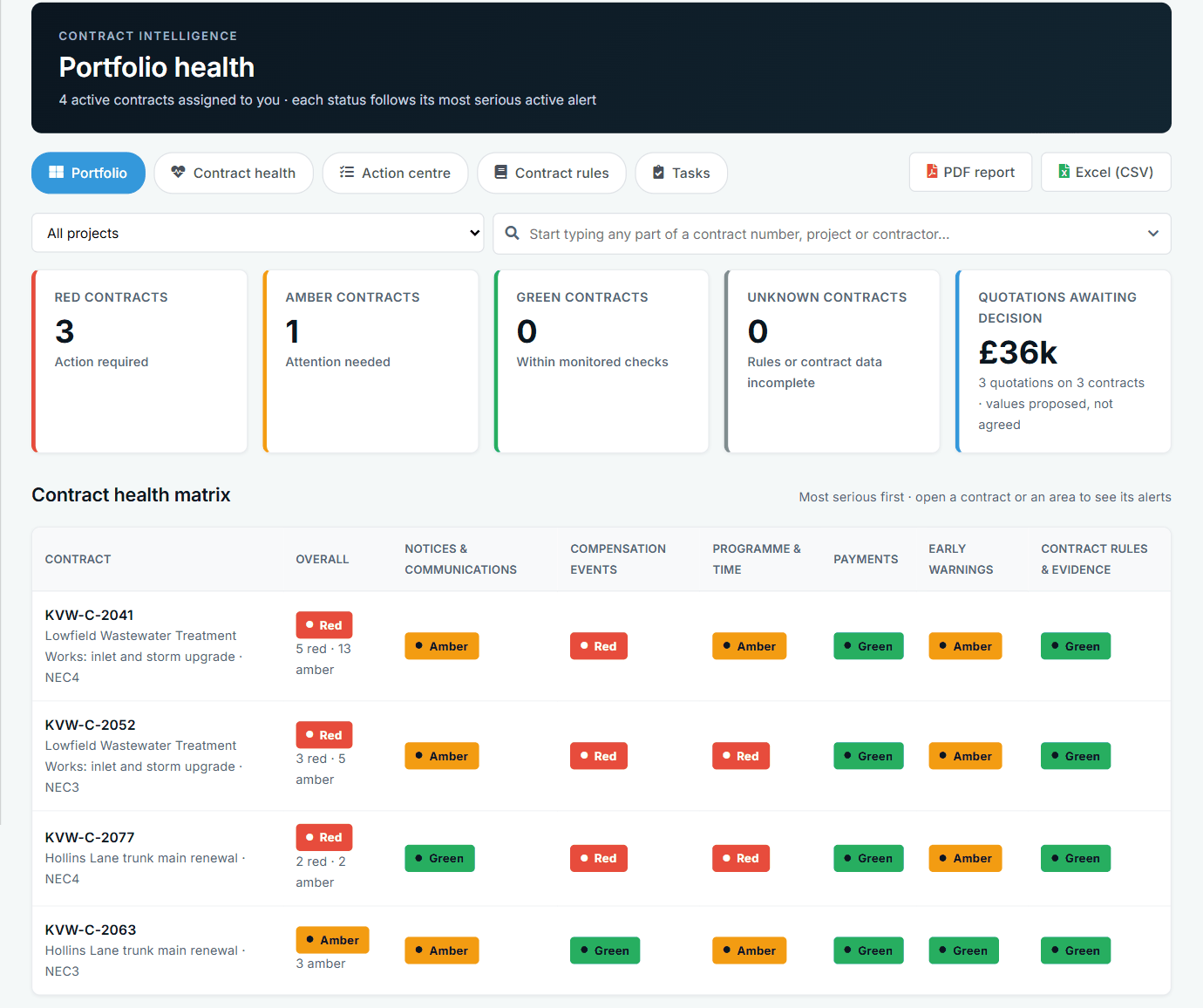
Portfolio health across contracts, by area. See the worked example.
See how this works in practice
Click through Contract Status with sample contracts: raise the notice, reply to it, and watch both sides of one record.
Take the guided tour Book a demo
Get free NEC templates, use the free NEC tools or download free NEC templates.
This guide is general information in our own words, not legal advice. Your contract and its Contract Data always govern. NEC, NEC3 and NEC4 are trade marks of Thomas Telford Ltd; Contract Status is not affiliated with or endorsed by NEC.