
Tracking NEC time periods comes down to three things: record the event that starts each clock, work out the reply date on the day it starts, and act on any miss straight away. Clause 13.3 sets the default period for reply in the Contract Data, while the compensation event, programme and payment clauses set their own.
A list of periods is useful, but on a live job it is the tracking that fails. Our table of key NEC time periods lists the figures. This page covers how to run them, using the NEC4 Engineering and Construction Contract (ECC), and is part of the guide to managing NEC contracts.
What a tracker needs to hold
| Field | Why it matters |
|---|---|
| The communication's reference | Links the clock to the document |
| The start date | Usually when the communication was submitted or instructed, but not always, so read the clause |
| Clause and period | Shows why the date is what it is |
| Reply date | The number everyone acts on |
| Extension agreed | Date agreed, new date, and where it is recorded (13.5, 62.5) |
| Owner and deputy | Named people, so leave doesn't break it |
| Consequence if late | Tells you how hard to chase |
The last field is the one most trackers leave out, yet it shows that the clocks aren't equal. Missing the reply to a routine query is bad practice, whereas missing a quotation reply can start the route to a treated acceptance.
Consequences differ by clock
| Who missed what | What can follow (NEC4 ECC) |
|---|---|
| Project Manager: notified event not answered | The Contractor may notify the failure; a further two weeks' silence is treated as accepting the event as a compensation event (61.4) |
| Project Manager: quotation not answered | The Contractor may notify the failure; a further two weeks' silence is treated as accepting the quotation (62.6) |
| Project Manager: own assessment not issued | The Contractor may notify the failure; a further two weeks' silence is treated as accepting the quotation (64.4) |
| Project Manager: programme not answered | The Contractor may notify the failure; a further one week's silence is treated as acceptance (31.3) |
| Project Manager or Supervisor: a required reply is late | Possibly a compensation event, if it causes an effect (60.1(6)) |
| Contractor: late quotation | The Project Manager can make its own assessment (64.1) |
| Contractor: late notification of an event | The Prices and dates may not change (61.3) |
Note that a late Project Manager doesn't lead to automatic acceptance. The Contractor has to give the second notification first. If you're on the Contractor side, put that step in your procedure. The route is mapped in more detail on the clause 62.6 page and for programmes in programme deemed acceptance.
A worked example
A fictional job using unamended ECC periods, with illustrative dates.
- Monday 2 March: the Project Manager notifies a compensation event and instructs quotations. A quotation is due within three weeks, so the tracker shows Monday 23 March.
- Friday 20 March: the Contractor submits. The reply is due within two weeks: Friday 3 April.
- Friday 3 April: no reply arrives. The Project Manager is on leave and nobody is covering.
- Tuesday 7 April: the Contractor's weekly check picks it up, and it notifies the failure. Two further weeks gives Tuesday 21 April.
- Before 21 April: the deputy replies by accepting, asking for a revision or saying the Project Manager will assess. If nothing comes, the quotation is treated as accepted, and the event is implemented on that basis.
Had the Project Manager asked the Contractor for a two-week extension before 3 April and got agreement, none of this would have started.
Traps when counting
- Weeks are the usual unit. Under Option Y(UK)2, a count in days leaves out bank holidays, Good Friday and Christmas Day (Y2.1). Don't assume that a period in weeks does the same.
- Agree the counting convention. The day the clock starts should be counted in the same way by both sides. Set it out at the kick-off, and when in doubt, act a day early.
- Different forms, different figures. In the NEC4 subcontract, the reply to a quotation takes four weeks instead of two, for example. A combined tracker needs the contract identified on every line. See back-to-back subcontracts.
- Extensions agreed too late. Under 13.5 and 62.5, the agreement has to come before the reply is due.
- Amended periods. A Z clause or a Contract Data entry might change a figure. Enter the actual ones from your own contract, not the ones you remember.
Under NEC3 ECC, the same deemed acceptance mechanism exists for 61.4, 62.6 and 64.4, but not for programmes. NEC3's further period for those three is also two weeks.
Related guides
- Managing NEC Contracts: A Practical Guide
- NEC Time Bars Explained
- A Table of Key NEC Time Periods
- NEC Contract Reporting
- A Weekly NEC Routine
- Managing NEC Communications
How this looks in Contract Status
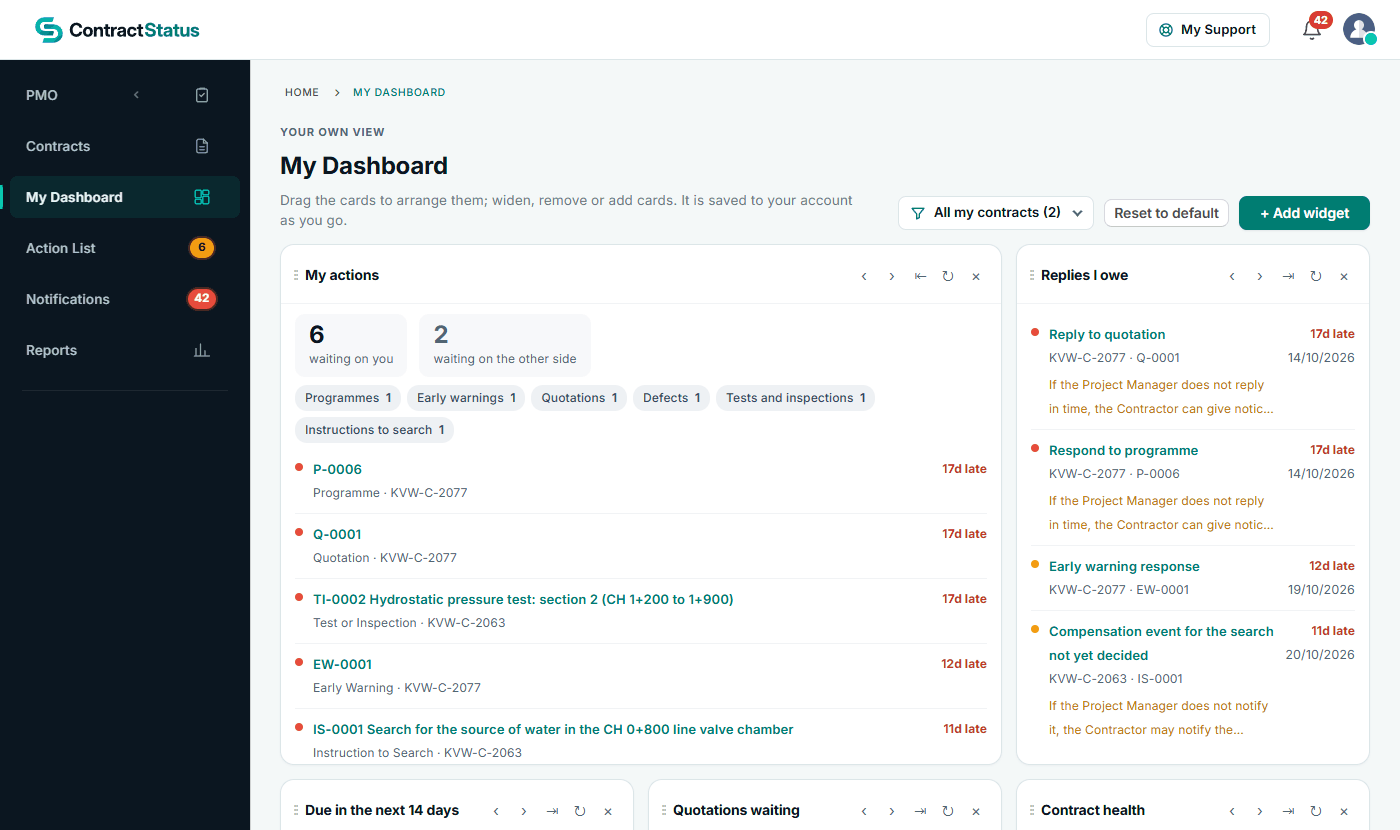
My Dashboard: what is waiting on you and which replies you owe. See the worked example.
See how this works in practice
Click through Contract Status with sample contracts: raise the notice, reply to it, and watch both sides of one record.
Take the guided tour Book a demo
Get free NEC templates, use the free NEC tools or download free NEC templates.
This guide is general information in our own words, not legal advice. Your contract and its Contract Data always govern. NEC, NEC3 and NEC4 are trade marks of Thomas Telford Ltd; Contract Status is not affiliated with or endorsed by NEC.