
NEC4 deemed acceptance of a programme happens in two stages. The Project Manager misses the two-week reply under clause 31.3, and the Contractor notifies that failure. If there is still no answer one week later, the programme is treated as accepted.
The contract's phrase is "treated as acceptance"; "deemed acceptance" is what people call it in practice. This rule is new in NEC4: NEC3 ECC has no equivalent, so silence there never gives a programme accepted status. This page explains the mechanism; for the wider rules, see the NEC programme guide.
The timeline
- Day 0. The Contractor submits a programme for acceptance.
- Week 2. The Project Manager's two weeks end with neither acceptance nor reasons.
- Any time after that. The Contractor can choose to tell the Project Manager about the failure. This is a choice, not a duty, and the clock doesn't start without it.
- One week after the notification. If the failure is continuing, the programme is treated as accepted.
So the earliest it can happen is around three weeks after submission. A Contractor that waits a month to send the notification simply gets acceptance a month later.
| Form | Reply period | Further period after notification |
|---|---|---|
| NEC4 ECC | Two weeks | One week |
| NEC4 ECS (between Contractor and Subcontractor) | Three weeks | Two weeks |
| NEC3 ECC | Two weeks | No treated acceptance |
Other forms and Z clauses can vary these, so check yours.
Practical steps for the Contractor
- Send the notification as its own communication, not as a line in a progress report. A notification is communicated separately from other communications under clause 13.7.
- Name the programme revision and the submission date, so nobody can later argue about which programme it refers to.
- Diarise the further week, then record the date the programme took on its status, along with the fact there was no reply.
- Decide whether it is worth using. If you know a programme has real faults, you may prefer to fix them than to rely on treated acceptance. The status helps you only if the programme is good.
Practical steps for the Project Manager
- Treat a failure notification as urgent. One week is short, and it may come when you are on leave, so make sure a delegate can act. Delegation is available under clause 14.
- Reply within the week with acceptance or a listed reason. That ends the failure, and the programme goes down the ordinary route.
- Once treated acceptance has happened, deal with what follows. The programme is the baseline; your concerns can go into discussions about the next revision or be recorded in reasons when you respond to it.
Example: the effect on a later compensation event
A fictional depot refurbishment has an illustrative timeline. Revision 6 shows the Client delivering its switchgear in week 18, where revision 5 showed week 22. The Project Manager doesn't answer. The Contractor notifies the failure, and a week later revision 6 is treated as accepted.
The switchgear arrives in week 22, as the Client always assumed. Under 60.1(3), that lateness is now measured from week 18 and may be a compensation event. Without the treated acceptance, revision 5 would have remained the baseline and the same delivery would have been on time. Reviewing the dates would have taken an hour.
Open questions
The text says the programme is treated as accepted. It doesn't specifically say what happens if the programme lacks information the contract requires, or doesn't comply with the Scope. So some will argue a non-compliant programme can't gain the status, and others that the Project Manager had the chance to object and didn't. We don't know of a definitive answer, so don't plan around either view. Contractors should send complete programmes, and Project Managers should reply.
Treated acceptance doesn't change the Completion Date or Key Dates, and it leaves the Contractor's responsibilities under clause 14.1 as they were. The programme acceptance guide covers what a timely reply looks like, and the NEC4 programme changes page places the rule among the other edition changes.
Related guides
- The NEC Programme: A Complete Guide
- NEC Clause 32: Revising the Programme
- Submitting the First Programme
- How Often to Revise the Programme
- What an NEC Programme Must Show
- Programme Acceptance and Reasons for Not Accepting
How this looks in Contract Status
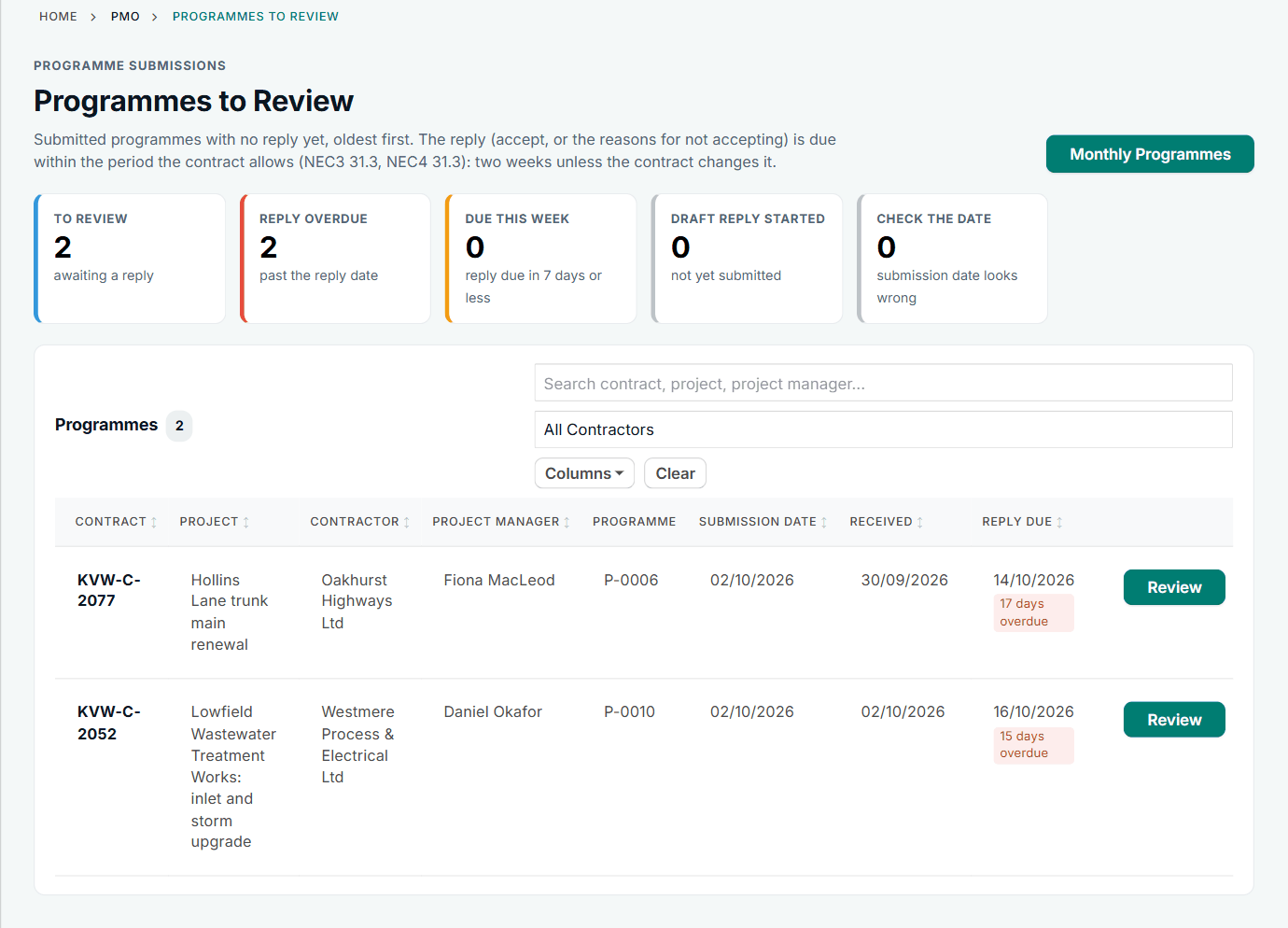
Programmes to Review, with the reply date for each. See the worked example.
See how this works in practice
Click through Contract Status with sample contracts: raise the notice, reply to it, and watch both sides of one record.
Take the guided tour Book a demo
Try the planner role-play, use the free NEC tools or download free NEC templates.
This guide is general information in our own words, not legal advice. Your contract and its Contract Data always govern. NEC, NEC3 and NEC4 are trade marks of Thomas Telford Ltd; Contract Status is not affiliated with or endorsed by NEC.