
An NEC programme revision is due at least as often as the interval in the Contract Data, whatever that interval is. The contract sets no standard number. Clause 32.2 also requires a revision when the Project Manager instructs it, and lets the Contractor submit whenever it chooses.
This is the same in NEC3 and NEC4 ECC, and the duty lasts from the starting date to Completion of the whole works. This page helps you pick and manage an interval; for what a revision contains, see NEC clause 32, and for the full picture, the NEC programme guide.
Choosing the interval
The interval is filled in by the Client in the Contract Data. A short interval gives a current baseline, but it costs planner and reviewer time. A long one is cheaper, but leaves an old baseline in place when events happen. These are the questions we would ask:
| Factor | Points towards shorter | Points towards longer |
|---|---|---|
| Pace of the work | Fast fit-out, short possessions | Steady, linear work over years |
| Likely change | Many interfaces, expected compensation events | Well-defined, little interface risk |
| Contract value and duration | A complex or high-risk contract | A small, simple contract |
| Review capacity | A resourced planning team on both sides | A Project Manager covering several jobs |
Do the sums on the review cycle before you fill in the box. The Project Manager gets up to two weeks to reply to each revision (three for the Contractor under NEC4 ECS). If the interval is about the same as the review time, the next revision will arrive just as the last one is accepted, and the team may never get ahead of it. Whichever figure you choose, the same period needs to be workable for the people doing the reviews.
How the interval interacts with acceptance
An illustration for a fictional contract. Compare two intervals, assuming the Project Manager takes the full two weeks and accepts each one first time:
| Interval | Age of Accepted Programme just before the next acceptance | Revisions in a 52-week job |
|---|---|---|
| 4 weeks | About 4 to 6 weeks, depending on the status date | 13 |
| 8 weeks | About 8 to 10 weeks, depending on the status date | 6 or 7 |
That isn't the whole story, because a rejection adds a further cycle. With a long interval, a rejected revision can mean the Accepted Programme gets very old. NEC4's assessment rule copes with this better than you might expect, since it allows for events between the programme's date and the dividing date, but the further back you go, the more of the assessment rests on reconstructing what happened.
When to revise early
- A major compensation event has changed the sequence, and more events are likely to follow.
- Delay or recovery measures mean the Accepted Programme no longer reflects how the job will be built.
- A Key Date is in doubt, and others are relying on it.
- A long gap would otherwise run through a critical period.
If the Contractor doesn't act, the Project Manager can use 32.2 to instruct a revision within the period for reply. Use it for genuine reasons, such as a stale baseline, as frequent instructions add cost for the Contractor and have to be reviewed in turn.
Running the cycle
- Fix a status date for each period, so each revision shows progress to a known day.
- Agree a submission date tied to it, leaving enough time to update logic.
- Keep a register: revision, status date, submission date, reply due, reply, status.
- Don't let the interval slip because the last one is still under review. The duty isn't suspended while you wait for an answer.
The obvious pitfall is thinking that sending a revision resets the interval even when it is rejected. The contract doesn't say this directly either way: it refers to submission, not acceptance, so a submission counts on its face, but a rejected one still leaves you needing an accepted programme. Agree how you will count the cycle at the start, and record it. For the review stage, use the programme review checklist.
Related guides
- The NEC Programme: A Complete Guide
- Terminal Float in NEC
- Time Risk Allowance in NEC
- Who Owns Float in NEC?
- NEC Clause 32: Revising the Programme
- Submitting the First Programme
How this looks in Contract Status
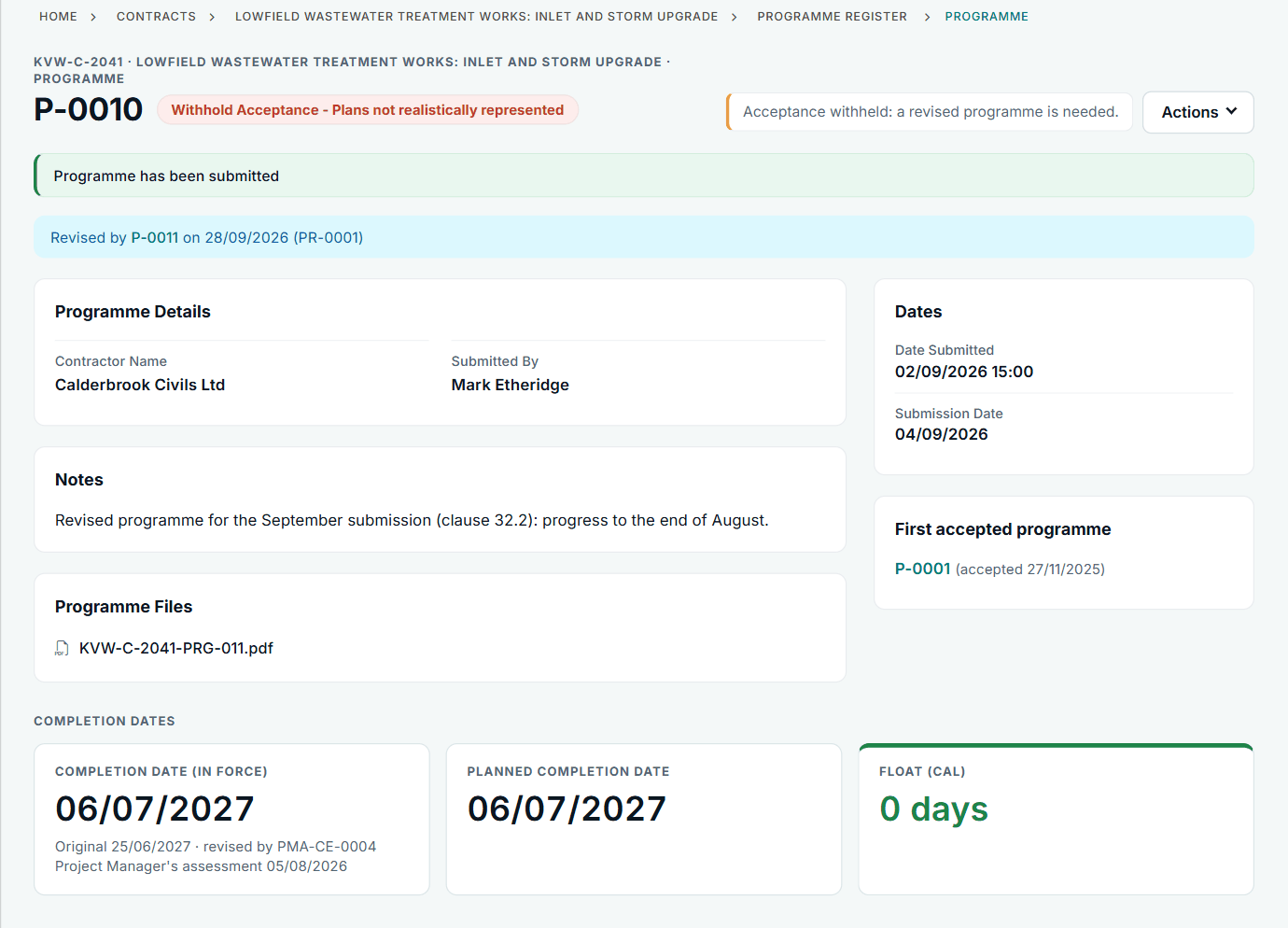
A programme not accepted, from the Contractor side, with the reason in its status. See the worked example.
See how this works in practice
Click through Contract Status with sample contracts: raise the notice, reply to it, and watch both sides of one record.
Take the guided tour Book a demo
Try the planner role-play, use the free NEC tools or download free NEC templates.
This guide is general information in our own words, not legal advice. Your contract and its Contract Data always govern. NEC, NEC3 and NEC4 are trade marks of Thomas Telford Ltd; Contract Status is not affiliated with or endorsed by NEC.