
NEC programme acceptance is governed by clause 31.3: the Project Manager has two weeks from submission to accept the programme or say why not, and only four reasons are listed. Giving any other reason risks a compensation event under 60.1(9).
The period and the four reasons are the same in NEC3 ECC and NEC4 ECC. NEC4 also deals with silence, which has its own page on deemed acceptance. For the overall picture, see the NEC programme guide.
The four reasons, in practice
| Reason (our summary) | Good example | Doesn't fit |
|---|---|---|
| The plans it shows can't practicably be carried out | Two gangs in a confined chamber at once; concrete poured before the falsework is complete | "I'd sequence this differently" |
| Required information is missing | No time risk allowances identified; no dates for Client-supplied items | Information you'd like, but neither the contract nor the Scope requires |
| It doesn't realistically represent the Contractor's plans | Six weeks of groundworks shown when only half the gang has been ordered | "It looks optimistic," with no evidence |
| It doesn't comply with the Scope (NEC3: Works Information) | Work in a closed section during a restricted period; the wrong software format under NEC4's form requirement | A preference nobody wrote into the Scope |
What isn't a reason
A planned Completion later than the Completion Date is not, in itself, on the list. If the Contractor is genuinely running late and the programme honestly shows it, that is a realistic programme. Rejecting it for showing bad news leaves everyone working to a fiction and encourages the Contractor to send the Project Manager what it wants to see instead.
The same applies to a dispute about a compensation event. If the programme includes an unimplemented event's effect and you disagree with it, explain the reason in terms of the four. Don't use non-acceptance as a way of deciding the event.
Timing
| Contract | Reply to the programme | If there is no reply |
|---|---|---|
| NEC4 ECC | Two weeks | Contractor may notify; treated as accepted after one further week. Also 60.1(6) |
| NEC3 ECC | Two weeks | 60.1(6) only |
| NEC4 ECS | Three weeks | Subcontractor may notify; treated as accepted after two further weeks |
Clock management matters. Record the submission date on receipt. Asking a question informally doesn't stop the two weeks running. Clause 31.3 has no extension mechanism of its own, so if you are short of time, send a reasoned response within the period, even if your only reason so far is that specific required information is missing.
Two sample replies
Weak: "Programme rev 3 not accepted. Please review and resubmit. Sequence on Area C seems wrong."
Better: "Programme rev 3 is not accepted under clause 31.3. It does not show information the contract requires: no dates for the Client's valve delivery, and no time risk allowances are identified on the Area C activities. In addition, the plans shown are not practicable: activities C14 and C15 need the same single-lane possession at the same time. Please resubmit addressing these points."
The better reply maps each point to a reason and tells the Contractor exactly what to fix. If any of the points is later challenged, there is a clear record of it. See the programme review checklist for how to reach those points quickly.
What a valid reason does and doesn't do
Withholding acceptance for a reason in the contract is not a compensation event (13.8). It also has a further effect: while the latest programme stands unaccepted for one of those reasons, the Project Manager assesses any compensation event quoted during that time, and uses its own view of the remaining work (64.1, 64.2). That gives the Contractor a real incentive to fix the problem quickly.
Withholding acceptance for a reason outside the contract is covered in the guide to withholding acceptance as a compensation event.
What people get wrong
- Accepting "with comments". The clause gives two outcomes. A qualified acceptance leaves it unclear whether the programme became the Accepted Programme, so choose one and say which.
- Sending the reply to the wrong person or informally. Replies are communications under the contract and should follow the contract's method, set out in the clause 13 guide.
- Thinking acceptance endorses the plan. Clause 14.1 keeps responsibility with the Contractor, but the accepted dates for access and Client-supplied items do bind the Client's side.
Related guides
- The NEC Programme: A Complete Guide
- Deemed Acceptance of a Programme Under NEC4
- NEC Clause 32: Revising the Programme
- Submitting the First Programme
- NEC Clause 31 Explained
- What an NEC Programme Must Show
How this looks in Contract Status
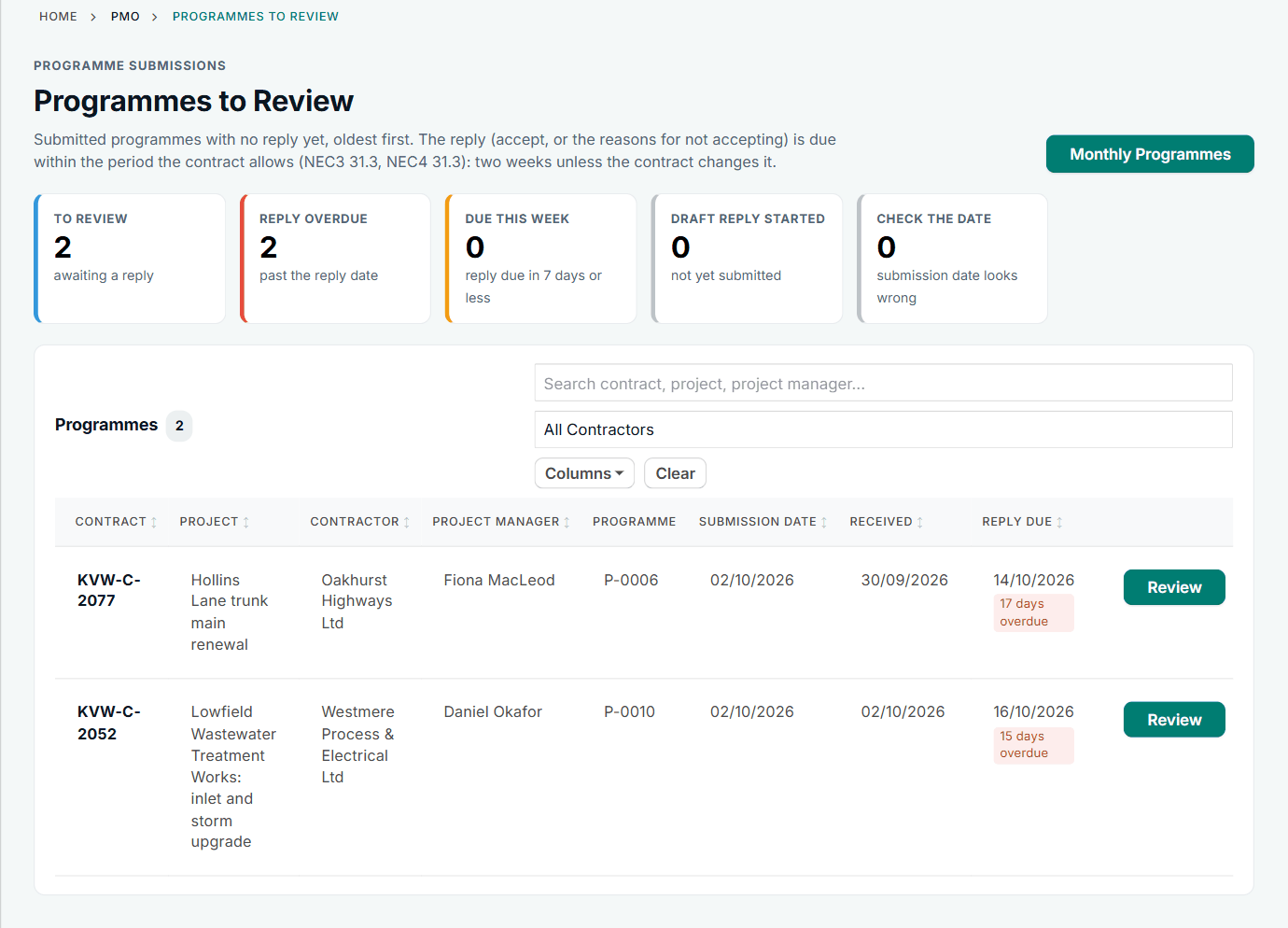
Programmes to Review, with the reply date for each. See the worked example.
See how this works in practice
Click through Contract Status with sample contracts: raise the notice, reply to it, and watch both sides of one record.
Take the guided tour Book a demo
Try the planner role-play, use the free NEC tools or download free NEC templates.
This guide is general information in our own words, not legal advice. Your contract and its Contract Data always govern. NEC, NEC3 and NEC4 are trade marks of Thomas Telford Ltd; Contract Status is not affiliated with or endorsed by NEC.