
The NEC first programme is the plan the Contractor submits for acceptance under clause 31.1, within the period in the Contract Data, unless the Contract Data has already identified a programme. Until a compliant first programme arrives, the Price for Work Done to Date carries a 25% deduction in each assessment.
The rule is the same in NEC3 and NEC4 ECC, though the retention clause moved: NEC4 50.5, NEC3 50.3. Getting this right sets the pattern for the rest of the job. Read it with the NEC programme guide.
Is a first programme needed at all?
| Contract Data says | What happens |
|---|---|
| A programme is identified | That programme is the Accepted Programme from the start. 31.1 doesn't apply, nor does the retention. The next submission is a revision under clause 32 |
| No programme identified, and a period is stated | The Contractor submits within the period. Check where the period starts: in the ECS data it runs from the Subcontract Date, and the form you are using will say so |
A programme identified in the Contract Data can look like a shortcut, but it carries a risk for the Client. A tender programme rarely shows everything, and it gains its status without any review under 31.3. If you plan to identify one, review it before the contract is signed in the same way you would review a submission. The Contract Data guide shows where these entries sit.
What the retention actually says
People often describe this as being held back "until the programme is accepted". The clause is narrower than that. Three details matter:
- The trigger is submission, not acceptance. It ends when the Contractor has submitted a first programme for acceptance that shows the information the contract requires.
- The content has to be there. Submitting a partial programme doesn't end the retention if required information is missing.
- It comes off the Price for Work Done to Date. It applies to that figure, not to the whole amount due, so other amounts in the assessment aren't reduced by it.
So a programme can end the retention even if the Project Manager rejects it for a reason unrelated to missing information, such as an impracticable plan. Price for Work Done to Date explains what the percentage bites on.
An illustrative example
| Assessment | Price for Work Done to Date | Programme position | Amount retained |
|---|---|---|---|
| Month 1 | £120,000 | Period not yet expired; nothing submitted | £30,000 |
| Month 2 | £280,000 | Submitted without required information | £70,000 |
| Month 3 | £450,000 | Resubmitted with the information; Project Manager has concerns about sequencing | £0 |
Figures are fictional. Note month 1: the retention text refers to whether the programme has been submitted, not to whether the Contract Data period has ended. So it can apply even before the first programme falls due, which is one reason to get it in early. And once released, the money isn't lost: the next assessment simply stops deducting it.
Beyond the retention: other costs of delay
- Who assesses events. If the first programme hasn't been sent when a compensation event is quoted, the Project Manager can make the assessment (64.1), using its own view of the programme for the remaining work (64.2).
- No Accepted Programme dates. Until there is one, you have no programme dates to rely on for access or Client-supplied items.
- Weak foundations. Without a baseline, every early event becomes a debate about what the plan was.
A practical sequence
- Read the Contract Data entries and Scope requirements before you start, including the required form under NEC4.
- Build from the tender programme, then update it for pre-construction changes and supplier dates.
- Check it against each item clause 31.2 requires, since the retention depends on it.
- Share a draft with the Project Manager. It isn't required, but an informal walk-through often avoids a formal rejection. Be clear that the draft isn't the submission.
- Submit it formally, naming it as the first programme under 31.1, and record the date. The Project Manager then has two weeks to reply.
Related guides
- The NEC Programme: A Complete Guide
- How Often to Revise the Programme
- Terminal Float in NEC
- Time Risk Allowance in NEC
- Deemed Acceptance of a Programme Under NEC4
- NEC Clause 32: Revising the Programme
How this looks in Contract Status
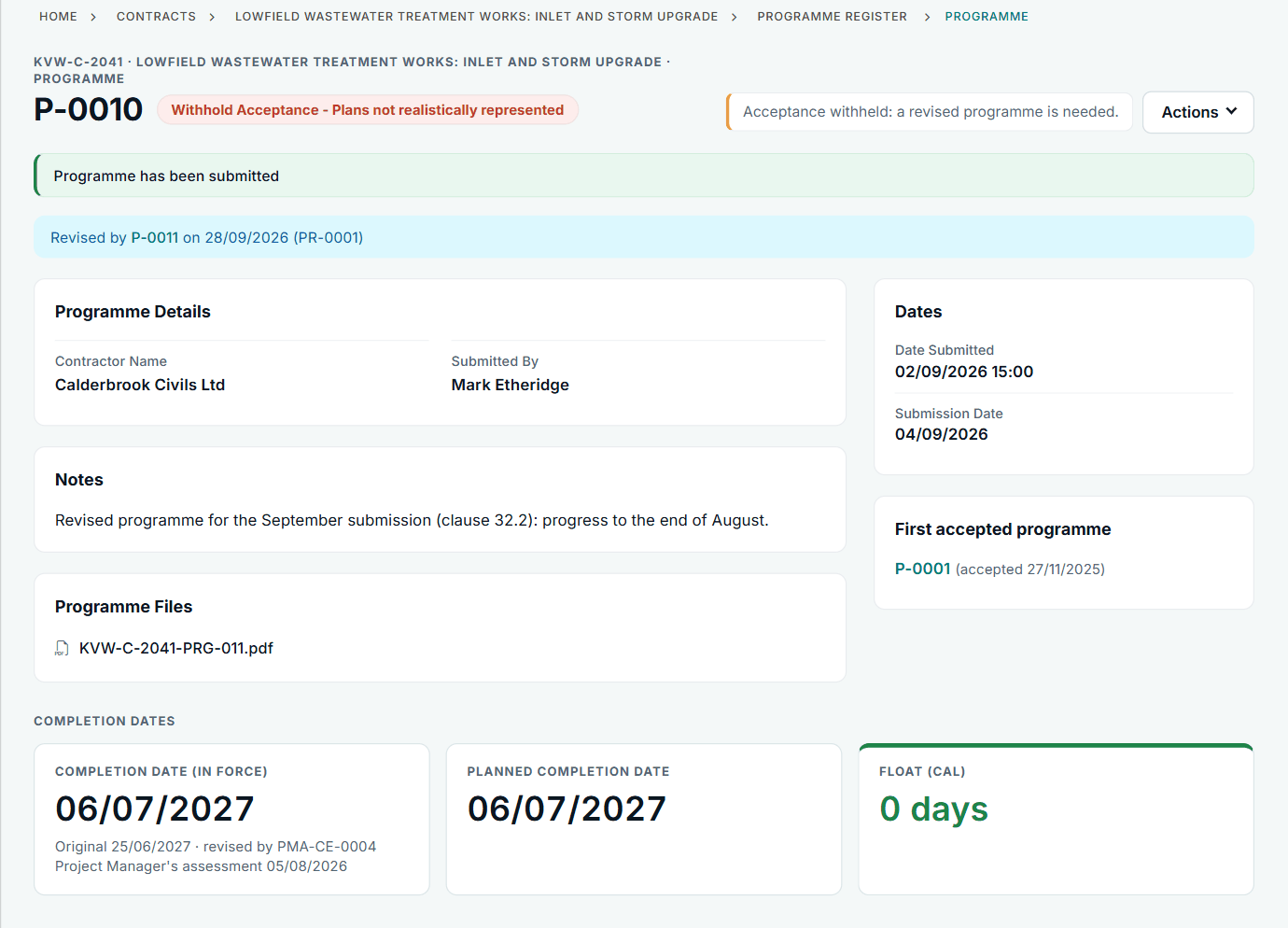
A programme not accepted, from the Contractor side, with the reason in its status. See the worked example.
See how this works in practice
Click through Contract Status with sample contracts: raise the notice, reply to it, and watch both sides of one record.
Take the guided tour Book a demo
Try the planner role-play, use the free NEC tools or download free NEC templates.
This guide is general information in our own words, not legal advice. Your contract and its Contract Data always govern. NEC, NEC3 and NEC4 are trade marks of Thomas Telford Ltd; Contract Status is not affiliated with or endorsed by NEC.