
NEC clause 32 is the rule for revising the programme. Sub-clause 32.1 sets out what each revision records, and 32.2 says when one is due: when the Project Manager instructs it, when the Contractor chooses, and at least as often as the Contract Data requires.
A revision is submitted for acceptance like any other programme, so everything in clause 31 applies to it too. Until it is accepted, the previous version stays in force. This page covers NEC4 ECC and notes where NEC3 ECC differs. It is part of the NEC programme guide.
What 32.1 adds
| A revision records | What this looks like on the job | NEC3 ECC | NEC4 ECC |
|---|---|---|---|
| Actual progress on each operation and how it affects the remaining work | Status date, actual starts and finishes, percentage complete, and updated forecast dates | Yes | Yes |
| Effects of implemented compensation events | Completion Date and Key Dates reflect what has been implemented | Stated | Not listed |
| The plan for dealing with delays and correcting notified Defects | Recovery measures and Defect correction activities | Yes | Yes |
| Other changes the Contractor proposes to the Accepted Programme | Resequencing, changed methods, changed resources | Yes | Yes |
The NEC4 wording leaves out the compensation event bullet. In practice, a realistic revision should still show events affecting the remaining work, whether or not they have been implemented, because 31.3 asks for a realistic picture of the Contractor's plans. Make it clear which events you have included and on what basis.
Three triggers in 32.2
- The Project Manager instructs one. The Contractor submits within the period for reply. Instructing a revision doesn't require a reason, but it is useful to say why.
- The Contractor chooses. It can submit whenever it wants, which is useful following a major change or to get a more current baseline ahead of an expected compensation event.
- The interval is reached. The Contract Data states the longest gap allowed. The duty starts at the starting date and ends at Completion of the whole works. See how often to revise the programme.
A worked example
A fictional water treatment contract has a four-week interval, using illustrative dates. Revision 7 was accepted in early May, with planned Completion on 14 November.
| Date | Trigger | Revision content | Status |
|---|---|---|---|
| 29 May | Interval | Rev 8: progress to status date, two-week slip on tank base, recovery using a second gang | Not accepted: second gang shown with no access route (plans not practicable) |
| 12 June | Project Manager's instruction following a site flood | Rev 9: corrected rev 8 and flood recovery; planned Completion moves to 28 November | Accepted on 24 June |
| 26 June | Interval | Rev 10: progress and no changes of logic | Under review |
Throughout the period up to 24 June, revision 7 stayed as the Accepted Programme, including during the flood. Any compensation event with a dividing date in June before the 24th would be measured from revision 7, adjusted for what had already happened, as the NEC4 assessment rule asks.
When a revision goes wrong
- Late or missed revisions. Beyond the obvious breach of 32.2, this can take away the Contractor's right to have its quotations used: when it quotes, the Project Manager may assess the event itself if a required programme hasn't been sent (64.1).
- A revision that doesn't show what changed. Without a comparison against the Accepted Programme, the reviewer has to work it out. A narrative and a baseline comparison help greatly, and you can ask for them in the Scope.
- Using a revision to reset the Completion Date. A programme can't change the Completion Date, whether or not it is accepted. Only the contract's mechanisms can, such as an implemented compensation event or an accepted acceleration quotation.
- Keeping only the update files. Keep the native file for each revision, with its submission and acceptance dates. You will need them when assessing compensation events.
Revising the programme does not replace a quotation's programme alterations, either: if a compensation event alters the plan for remaining work, the alterations go with the quotation under 62.2. Using the programme to assess compensation events explains how these fit together.
Related guides
- The NEC Programme: A Complete Guide
- Submitting the First Programme
- How Often to Revise the Programme
- Terminal Float in NEC
- Programme Acceptance and Reasons for Not Accepting
- Deemed Acceptance of a Programme Under NEC4
How this looks in Contract Status
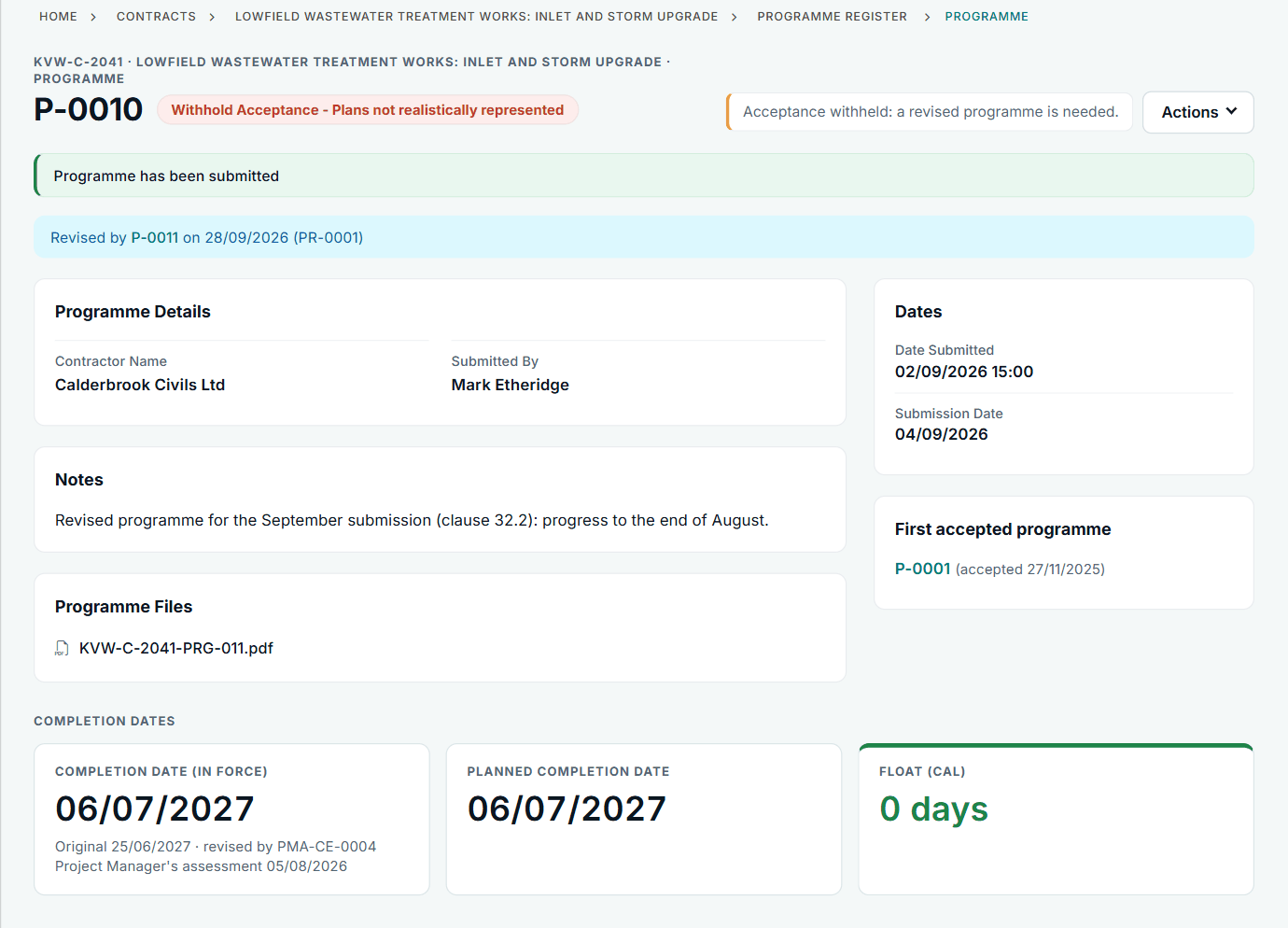
A programme not accepted, from the Contractor side, with the reason in its status. See the worked example.
See how this works in practice
Click through Contract Status with sample contracts: raise the notice, reply to it, and watch both sides of one record.
Take the guided tour Book a demo
Try the planner role-play, use the free NEC tools or download free NEC templates.
This guide is general information in our own words, not legal advice. Your contract and its Contract Data always govern. NEC, NEC3 and NEC4 are trade marks of Thomas Telford Ltd; Contract Status is not affiliated with or endorsed by NEC.