
The accepted programme in NEC is either the programme named in the Contract Data or the most recent one the Project Manager has accepted. Only one exists at a time: each new acceptance replaces the previous version, and the contract measures time against that version.
The definition is at clause 11.2(1) in NEC3 ECC, and at the same place in the NEC4 subcontract. It is a capitalised term, so "Accepted Programme" means something specific. A programme on the site office wall, or one sent to the Project Manager last week and not yet answered, doesn't qualify. For how the wider process runs, see the NEC programme guide.
Three routes to the status
| Route | How it happens | Editions |
|---|---|---|
| Identified in the Contract Data | The tender programme or another named document is written into the contract. It has the status from the outset | NEC3, NEC4 |
| Accepted by the Project Manager | The Project Manager notifies acceptance under 31.3 | NEC3, NEC4 |
| Treated as accepted | The Project Manager misses the reply, the Contractor notifies the failure and a further week passes (31.3) | NEC4 only |
The third route has its own page: deemed acceptance of a programme under NEC4.
What the status does
- It is the baseline for delay. A compensation event's effect on the Completion Date and Key Dates is measured against it (NEC4 63.5; NEC3 63.3).
- It sets dates the Client has to meet. Access to the Site, and things the Client is to provide, are tested against the dates shown on it (60.1(2), 60.1(3)).
- It records what Others are expected to do. Work by the Client or Others outside the times shown can be a compensation event (60.1(5)).
- It affects who assesses. With no Accepted Programme, the Project Manager assesses the programme for the remaining work itself, and uses that view for the compensation event (64.2).
What it doesn't do
Acceptance doesn't move the Completion Date, even when the programme shows planned Completion later than that date. The Completion Date changes only as the contract allows, usually when a compensation event is implemented. The Completion Date and planned Completion guide covers the difference.
Nor does it transfer responsibility. Under clause 14.1, acceptance leaves the Contractor's duties on delivering the works, and any design liability, where they were. A Contractor can't later argue that a flawed sequence became the Project Manager's problem by being accepted.
A worked example
Take a fictional highways drainage contract with these illustrative dates:
| Date | Event | Which programme is the Accepted Programme? |
|---|---|---|
| 2 March | Revision 3 accepted | Revision 3 |
| 30 March | Revision 4 submitted | Still revision 3 |
| 6 April | The Project Manager instructs a design change: the dividing date for the event | Still revision 3 |
| 10 April | Revision 4 accepted | Revision 4 |
Under NEC4, the event is assessed against revision 3, the version in force at the dividing date, even though revision 4 was accepted before the quotation was due. The assessment should take account of events between revision 3's date and the dividing date, so the out-of-date picture isn't simply carried through. Under NEC3, 63.3 refers only to the Accepted Programme without mentioning the dividing date, so in this situation the two editions can lead to different discussions.
What people get wrong
- Treating submission as acceptance. Under NEC3 the status comes only from acceptance. Under NEC4 it comes from acceptance or the treated-acceptance route.
- Losing track of the revision. Record the revision, the acceptance date and the reply that gave it status. A disputed assessment often starts here.
- Letting the first programme drift. A contract can run for months with no Accepted Programme at all, leaving the Contractor exposed under 64.2 and, until a compliant first programme is submitted, to the retention described in submitting the first programme.
- Accepting without reading. Once accepted, the dates it shows for Client-supplied items and access count. Review them against what the Client can actually deliver.
The term is also explained briefly in the Accepted Programme definition.
Related guides
- The NEC Programme: A Complete Guide
- NEC Clause 31 Explained
- What an NEC Programme Must Show
- Programme Acceptance and Reasons for Not Accepting
How this looks in Contract Status
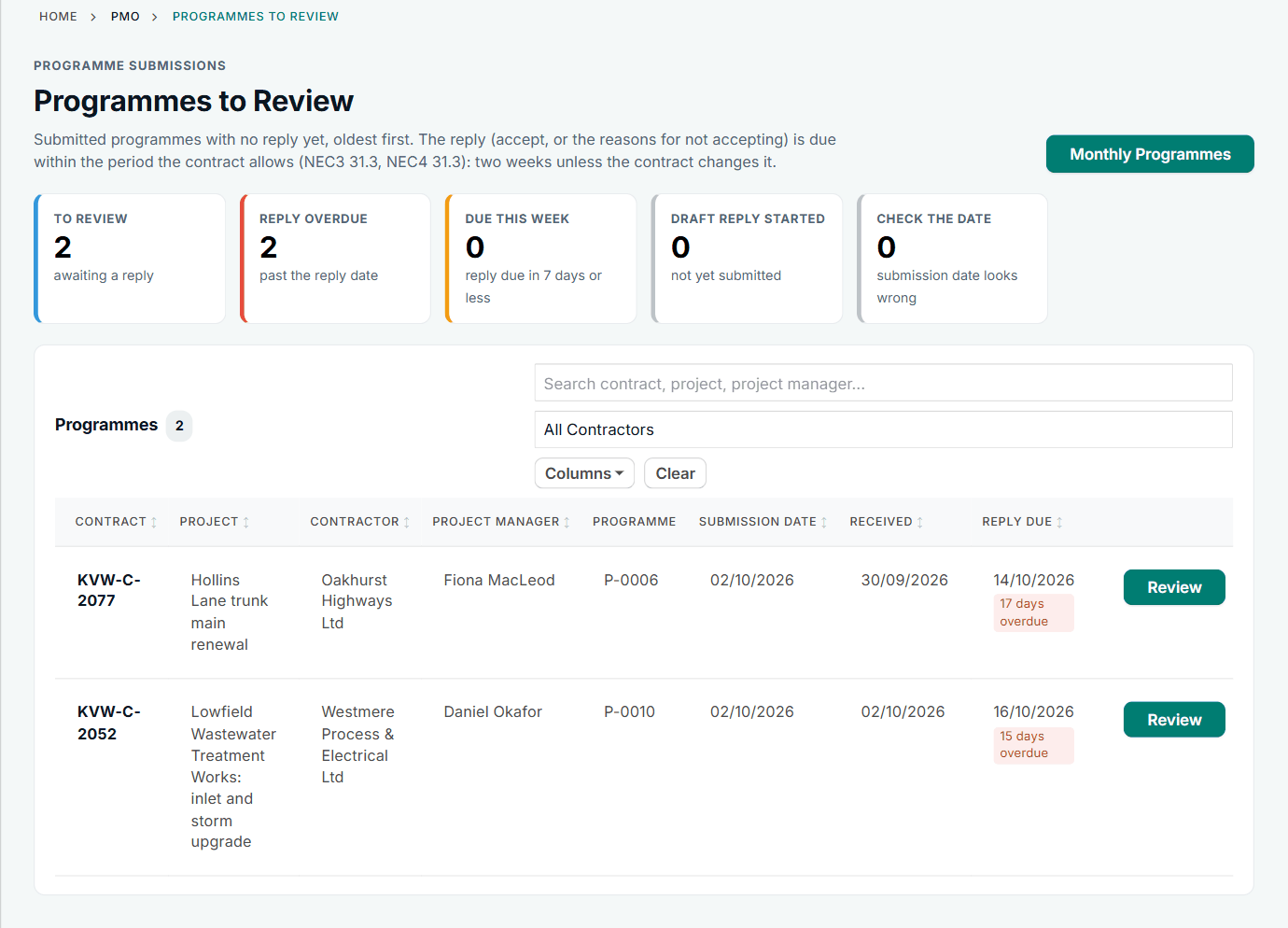
Programmes to Review, with the reply date for each. See the worked example.
See how this works in practice
Click through Contract Status with sample contracts: raise the notice, reply to it, and watch both sides of one record.
Take the guided tour Book a demo
Try the planner role-play, use the free NEC tools or download free NEC templates.
This guide is general information in our own words, not legal advice. Your contract and its Contract Data always govern. NEC, NEC3 and NEC4 are trade marks of Thomas Telford Ltd; Contract Status is not affiliated with or endorsed by NEC.