
An NEC contract gives clients good visibility and control, but only if they prepare a clear Scope and resource the people running it. Most client problems trace back to a Scope that is vague at tender, or a Project Manager too stretched to reply within the periods the contract sets.
This page sets out what a Client should decide and watch on the NEC4 Engineering and Construction Contract (ECC). NEC3 calls the same party the Employer. For the role itself, see the Client under NEC, and for the wider routine, managing NEC contracts.
Before tender
| Decision | Why it matters | Further reading |
|---|---|---|
| Main Option | Sets how cost risk is shared and how much client oversight is needed | Choosing a main Option |
| Secondary Options | Delay damages, retention, sections, the Act and so on | Choosing secondary Options |
| Quality of the Scope | Gaps turn into instructions, and so into compensation events | Scope |
| Site Information | It frames what an experienced contractor could have foreseen | Site Information |
| Z clauses | Each one adds risk of its own and may be priced in. Keep them few | Z clauses |
| Who is Project Manager and Supervisor | They need the time and authority for the role | Project Manager |
| Period for reply | Set something that your team can actually hit | Period for reply |
Resourcing is the biggest decision
NEC relies on prompt decisions from the Client's side. The Project Manager has one week to reply to a notified event, two weeks on a quotation and two weeks on a programme under the unamended ECC. On a busy job that may mean dozens of live items at once. If the role is given to someone as a side duty, replies slip, and a late reply can itself be a compensation event (60.1(6)) or lead to treated acceptance.
A simple test: count the likely number of events per month, multiply by the time each will take to review, and add the programme and payment workload. Then compare that with the Project Manager's available time, and be honest about it. Make a deputy available too. A week's leave can use up most of a reply period.
Your own actions as Client
- Provide what you've promised, on time. A late Client-provided item is a compensation event under 60.1(3), and late access under 60.1(2) if it's also past the Accepted Programme's date. Keep a list.
- Manage Others. Your other contractors and utilities can cause events under 60.1(5).
- Don't instruct directly. Instructions come through the Project Manager. A chat between your stakeholder and a site manager can cause confusion and cost.
- Pay on time. Each certified sum is due within the time set (51.2), and late payment carries interest. If the Construction Act applies, Option Y(UK)2 sets out the pay less notice route.
- Be careful using parts early. Taking over part of the works before Completion and the Completion Date can trigger 60.1(15).
Keeping control of the money
Ask for a monthly forecast from the Project Manager showing the Prices split between implemented events, quoted events, notified events and early warnings. That gives you a realistic outturn range far earlier than a traditional final account would. A reporting template helps.
Make sure your budget includes a contingency for compensation events. That isn't a sign of a badly run job, but reflects how NEC deals with risks you've chosen to keep. On a target contract, the outturn depends on Defined Cost and the share mechanism, so the budget should also show your share range. See pain and gain share.
Traps that catch clients
- Telling the Project Manager what to decide. The Project Manager acts under the contract and has to act as it says. Decisions on quotations are not simply a budget matter for you. Your Project Manager can consult you, but the contract's deadlines still run.
- Refusing compensation events to save money. It rarely does. The event still has a cost, and it usually just ends up in dispute, with fees added.
- Accepting poor Project Manager assessments out of loyalty. An unsupported assessment may not survive adjudication, and it damages trust along the way.
- Rejecting every programme. Without an Accepted Programme current to the job, delay assessments get harder for everyone. Under NEC4, silence leads towards treated acceptance anyway.
- Heavy amendments. Too many Z clauses can price risk in, or undo the features that made you choose NEC. See Z clause mistakes.
A short question to ask every month: are we replying on time, is the programme current, and do we know our likely outturn? If the answer to any is no, you know where to look.
Related guides
- Managing NEC Contracts: A Practical Guide
- An NEC Guide for Subcontractors
- An NEC Guide for Consultants
- NEC on Highways Projects
- Making Clause 10 Work in Practice
- An NEC Guide for Contractors
How this looks in Contract Status
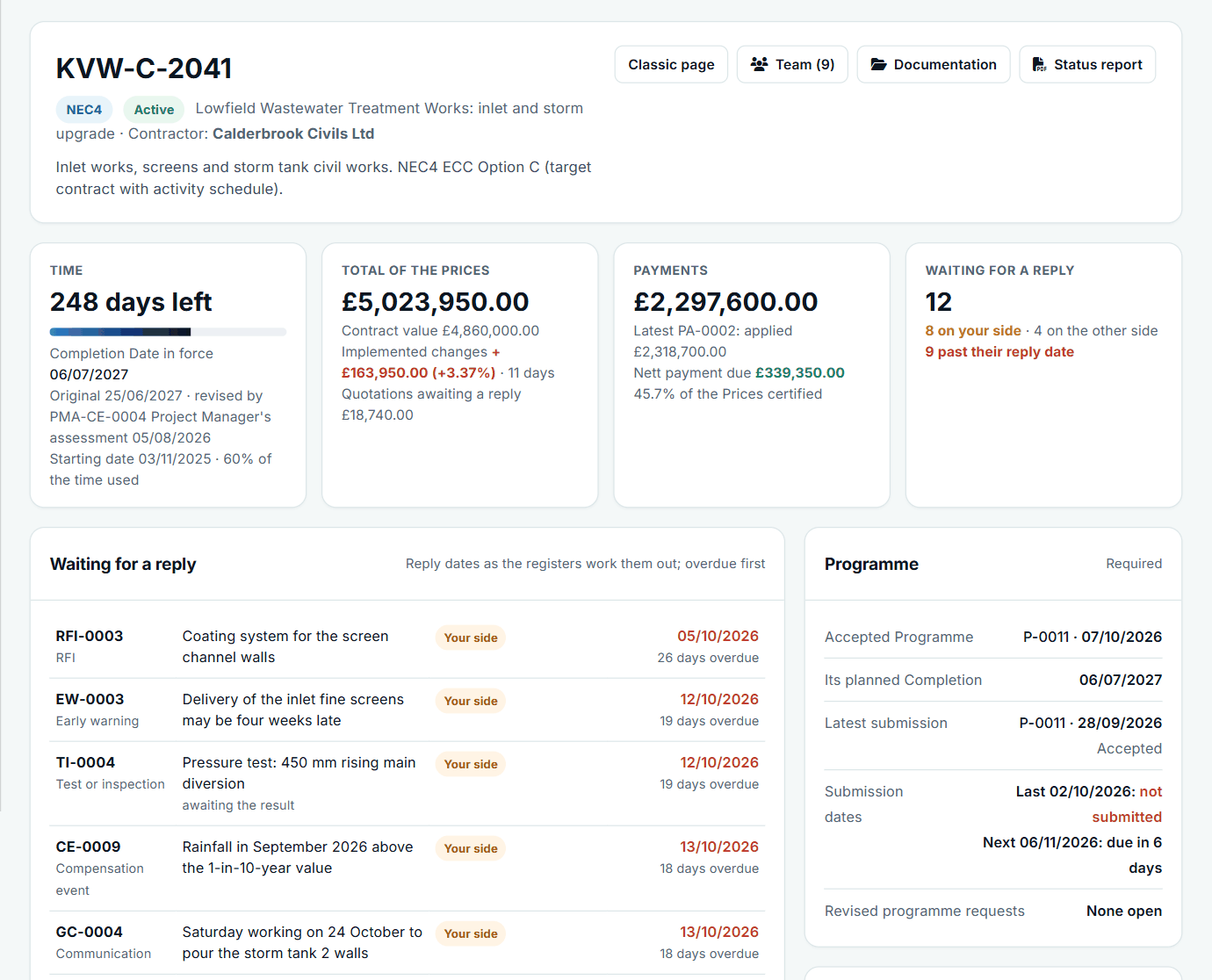
A contract at a glance: time, the total of the Prices, payments and replies waiting. See the worked example.
See how this works in practice
Click through Contract Status with sample contracts: raise the notice, reply to it, and watch both sides of one record.
Take the guided tour Book a demo
Get free NEC templates, use the free NEC tools or download free NEC templates.
This guide is general information in our own words, not legal advice. Your contract and its Contract Data always govern. NEC, NEC3 and NEC4 are trade marks of Thomas Telford Ltd; Contract Status is not affiliated with or endorsed by NEC.