
The main NEC time bar is in clause 61.3: a Contractor has eight weeks from becoming aware that a compensation event has happened to notify it, and after that the Prices and dates generally don't change. There are a few other cut-offs, but many NEC deadlines carry a lesser consequence and aren't time bars at all.
The difference matters, because it affects how hard to chase and how to argue the point. This page sets out each one for the NEC4 Engineering and Construction Contract (ECC), with notes on NEC3. Whether a given bar applies in a particular dispute can be a legal question, so take advice on anything significant. It is part of the guide to managing NEC contracts.
The real cut-offs
| Cut-off | Period | Effect of missing it | Clause |
|---|---|---|---|
| Contractor notifying a compensation event | Eight weeks after becoming aware the event has happened (NEC3: aware of the event) | Prices and dates don't change, with exceptions described below | 61.3 |
| Any compensation event notice late in the contract | NEC3: not after the defects date. NEC4 subcontract: not after the Defects Certificate. Check your own NEC4 ECC | The event can't be notified | 61.7 |
| Challenging the final assessment | Four weeks after it is issued, to start the dispute route | The assessment becomes conclusive of what is finally owed | 53.3 |
| Objecting to an Adjudicator's decision | Four weeks to give notice of intention to go to the tribunal | The dispute can't go to the tribunal | W1.4, W2.4 |
| Disputing under W1 | Limits in the Dispute Reference Table and W1.3 | The route to the Adjudicator can close | W1.1, W1.3 |
W2 applies where the UK Construction Act does, and it lets a Party go to adjudication at any time (W2.2), because a contract can't take that statutory right away. But note the four-week tribunal notice that still follows the decision. See Option W2 and time limits for disputes.
The exceptions to 61.3
The eight-week bar doesn't catch an event that comes from an instruction, a notification, a certificate or a changed decision of the Project Manager or Supervisor. Those are events the Project Manager should have notified under 61.1, so the Contractor's lateness doesn't remove them. NEC3's wording also covers a corrected assumption.
So for example, a Scope change instructed and never notified is still open many months later, whereas a late-reported physical condition isn't. Our clause 61.3 guide looks at this closely.
Also note what starts the clock: awareness of the event, not awareness that it might be a compensation event. Site knowledge usually counts.
Deadlines that aren't time bars
| Deadline | What lateness actually does |
|---|---|
| Early warning (15.1) | No fixed date and no bar: the compensation event may be assessed as if the warning had been given (61.5, 63.7) |
| Contractor's quotation (62.3) | The Project Manager may assess instead (64.1). The event itself survives |
| Project Manager's reply to a notified event (61.4) | Opens the route to treated acceptance, once the Contractor gives notice |
| First programme (31.1) | Assessments hold back 25% from the Price for Work Done to Date where the Contract Data identified no programme (50.5) |
| Application for payment (50.2) | Not a bar. The Project Manager still assesses, and the amount is worked out on the basis 50.4 gives where no application came in |
| Pay less notice (Y2.3) | The notified sum generally stands for that payment; it is a right lost for that cycle, not for the underlying point |
A worked example
A fictional job. A Contractor finds out on 1 June that a neighbouring utility crew has blocked the agreed access road outside the times shown on the Accepted Programme. Work continues slowly. On 10 August, ten weeks later, the QS notifies an event under 60.1(5).
That event doesn't arise from any Project Manager action, so the Project Manager can respond under 61.4 that the Prices and dates won't change because it was notified late. Under NEC4, late notification is one of the listed grounds for that reply.
Now suppose the road was blocked again on 3 August. Whether that is a new event or part of the first one depends on the facts, and it may be arguable. The safest approach is simply to notify at the first sign.
Keeping out of trouble
- Train the people who see events first. A foreman or engineer's knowledge starts the clock, but they rarely know about it.
- Notify early and often. A notification doesn't assert a final position, so the cost of giving one is low compared with losing the event.
- Review Z clauses. Amendments often add time bars, including conditions on quotations and on what has to accompany a notice. Your contract may be harsher than this table.
- Diary every four-week dispute window when a final assessment or Adjudicator's decision arrives. Treat the date as immovable.
The final assessment guide and the table of NEC time periods give the related figures.
Related guides
- Managing NEC Contracts: A Practical Guide
- A Table of Key NEC Time Periods
- NEC Contract Reporting
- The Registers Every NEC Contract Needs
- Managing NEC Communications
- Tracking Periods for Reply
How this looks in Contract Status
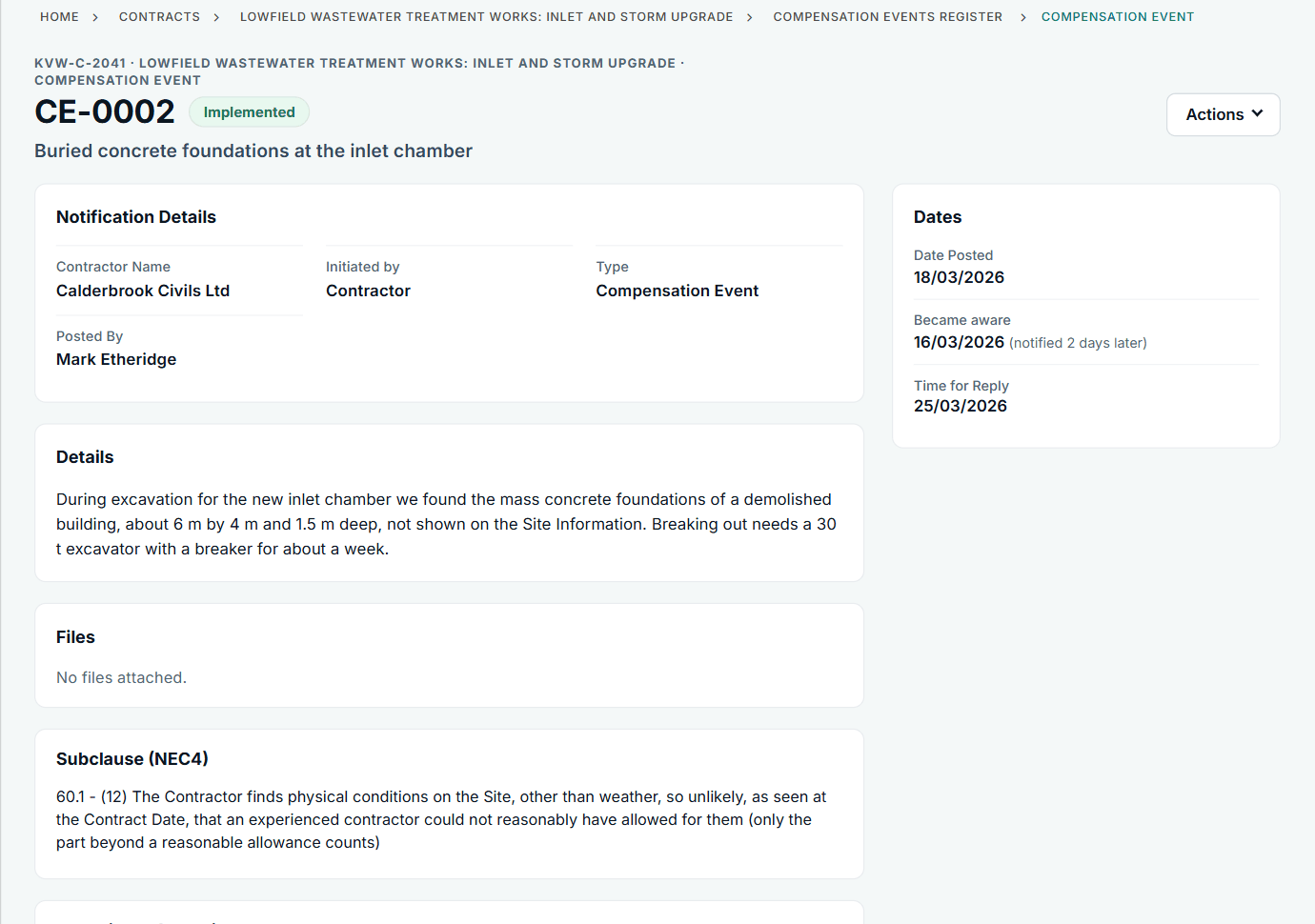
The record shows the date you became aware and how long you took to notify. See the worked example.
See how this works in practice
Click through Contract Status with sample contracts: raise the notice, reply to it, and watch both sides of one record.
Take the guided tour Book a demo
Get free NEC templates, use the free NEC tools or download free NEC templates.
This guide is general information in our own words, not legal advice. Your contract and its Contract Data always govern. NEC, NEC3 and NEC4 are trade marks of Thomas Telford Ltd; Contract Status is not affiliated with or endorsed by NEC.