
An early warning meeting is where the Project Manager, the Contractor and anyone else needed decide what to do about each matter on the register. Under the NEC4 Engineering and Construction Contract (ECC), the first must be called within two weeks of the starting date, with later meetings at the Contract Data interval at most and whenever either side calls one.
NEC3 calls this a risk reduction meeting and sets no fixed timetable. The purpose is the same, and most of the advice below applies equally. It sits within the wider early warning process.
How often to meet
The Contract Data states the longest gap allowed under 15.2. It is a ceiling rather than a schedule, and the contract doesn't suggest a number, so set a gap that suits the job.
- Closer together during critical periods, such as enabling works, possessions, outages, commissioning or handover.
- Further apart during steady, low-risk phases, as long as the Contract Data limit is respected.
- Immediately when something can't wait. Either side can instruct the other to attend at any point.
Scheduled meetings carry on right up to Completion of the whole of the works, so don't let them drop off during a busy final push. That is often when they are most useful.
Who should attend
The Project Manager and the Contractor are the core attendees. Under 15.2, either side can bring in others, provided the other side consents. Choose people according to the matters being discussed.
| Person | Bring them when |
|---|---|
| Contractor's site or project lead | Always; they can commit resources |
| Planner | Time effects need testing against the Accepted Programme |
| Quantity surveyor or commercial manager | Options need a cost view, or a compensation event may be involved |
| Designer | A design change could solve the problem |
| Supervisor | Tests, quality or Defects are in play |
| Subcontractor or supplier | They own the risk or the solution |
| Client's representative or end user | An operational decision is needed |
Keep the group small and fit for purpose. One person who can decide is worth more than five who need to report back.
A practical agenda
- New matters. The person who raised each explains it in a minute or two. Check that it has been entered correctly.
- Actions from last time. Done, late or no longer right? NEC4 expressly asks those attending to review recorded actions and change them if needed (15.3).
- Options for the open matters. Start with whichever needs a decision soonest. Ask for ways to avoid the effect first, then ways to reduce it.
- Decisions. For each matter, record one action, one owner and one date. Note whether the Scope needs to change.
- Looking ahead. Walk through the next few weeks of the programme and ask what could go wrong. This often brings out new warnings.
- Removals. Agree which matters can come off the register, and why.
- Compensation event check. Ask of each live matter whether anyone needs to issue a separate notice.
The outputs, and who owes them
| Output | Owner | Timing |
|---|---|---|
| Revised Early Warning Register showing the decisions | Project Manager | Within one week of the meeting (15.4) |
| Instruction for any Scope change a decision needs | Project Manager | At the same time as the revised register (15.4) |
| Compensation event notice, where relevant | Project Manager or Contractor | As the 61.1 and 61.3 rules require |
| Agreed actions | Named owners | The dates agreed |
Minutes aren't a contract requirement in themselves. The revised register is the record that counts. Many teams simply edit it live on screen, which saves writing up the meeting twice.
The first meeting
The first meeting sets the tone, and it usually comes before much of the programme has been tested. Use it to do more than read out the Contract Data matters.
- Go through the risks each side priced or allowed for, as far as each is willing to share them.
- Agree how notices will be sent, numbered and acknowledged.
- Agree a meeting pattern within the Contract Data limit.
- Check the Client's commitments, third-party approvals and interfaces against the first programme.
The first 30 days guide shows how this fits with the other early contract tasks.
Keep these limits in mind
A meeting can only decide actions that fit the contract. Agreeing that "the Contractor will just absorb this" or "we'll build it the other way" doesn't change the Prices or Scope. Scope changes need the Project Manager's instruction, which is normally a compensation event under 60.1(1), and those attending can't waive other notices in passing.
Related guides
- NEC Early Warnings: The Complete Guide
- What Should Be Early Warned?
- Who Gives an Early Warning?
- What Happens If No Early Warning Is Given?
- The Early Warning Register
- Early Warning Register Template
How this looks in Contract Status
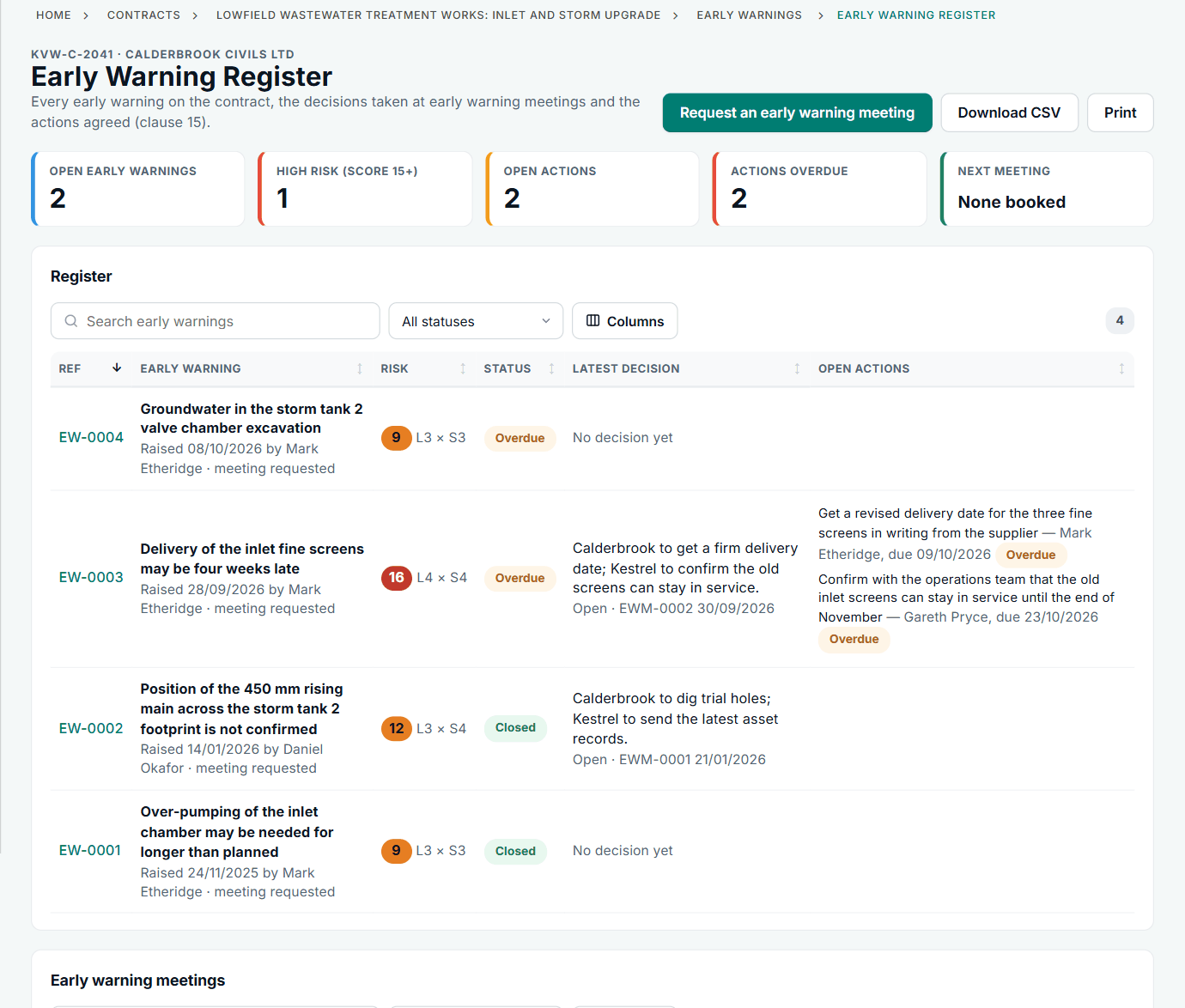
The Early Warning Register page, with risk scores, decisions and open actions. See the worked example.
See how this works in practice
Click through Contract Status with sample contracts: raise the notice, reply to it, and watch both sides of one record.
Take the guided tour Book a demo
Try the Project Manager role-play, use the free NEC tools or download free NEC templates.
This guide is general information in our own words, not legal advice. Your contract and its Contract Data always govern. NEC, NEC3 and NEC4 are trade marks of Thomas Telford Ltd; Contract Status is not affiliated with or endorsed by NEC.