
NEC4 clause 15 is the early warning clause of the Engineering and Construction Contract (ECC). It has four sub-clauses: the duty to warn, the timetable for the register and meetings, what meetings do, and how decisions are recorded and instructed. NEC3 ECC covers the same ground at clause 16, without most of the fixed times.
This page is a plain-English reading of the clause. Use it alongside your own contract, since Z clauses can alter any of it. The overall process is in the NEC early warnings guide.
Clause 15 at a glance
| NEC4 | What it deals with | Who acts | Time | NEC3 |
|---|---|---|---|---|
| 15.1 | Giving a warning; entering it in the register | Project Manager and Contractor; Project Manager enters it | As soon as aware | 16.1 |
| 15.2 | First register and meeting; later meetings; who attends | Project Manager prepares and instructs; either can call later meetings | One week and two weeks from the starting date; then the Contract Data interval at most | 16.2, no fixed times |
| 15.3 | What those attending do | Everyone attending | At each meeting | 16.3 |
| 15.4 | Revised register; any instruction to change the Scope | Project Manager | Within one week of the meeting | 16.4, no fixed time |
Clause 15.1: the duty
Either side notifies the other on learning of a matter that could add to the total of the Prices, push back Completion, put a Key Date at risk, or harm how the works perform once in use. The Contractor may also warn about anything else that could raise its own total cost.
The Project Manager enters each matter in the Early Warning Register. A warning is not needed for something already notified as a compensation event, which prevents duplicate paperwork. For more detail on who holds the duty, see who gives an early warning.
Clause 15.2: register and meeting timetable
This is where NEC4 moved on from NEC3. The clock starts at the starting date, not at the first problem:
- Within one week, the Project Manager draws up the first Early Warning Register and sends it to the Contractor. It can contain matters already listed in the Contract Data.
- Within two weeks, the first early warning meeting is called. The Project Manager instructs the Contractor to attend.
- After that, a meeting is held whenever either side instructs the other to attend, and in any case often enough to stay within the maximum gap the Contract Data sets, right up to Completion of the whole of the works.
Other people can be brought in, such as a designer or subcontractor, if the other side agrees. The Contract Data interval is a maximum rather than a schedule. For guidance on agenda and frequency, see running an early warning meeting.
Clause 15.3: what the meeting is for
Those attending are expected to co-operate on five jobs:
- putting forward and weighing up ways to avoid or reduce the effect of each registered matter,
- looking for answers that help everyone affected,
- deciding the actions and who, within the contract, takes them,
- deciding what can leave the register, and
- reviewing actions already recorded and changing them if needed.
The last job is the NEC4 addition; NEC3 clause 16.3 lists only the first four. Note the phrase about actions being taken within the contract. A meeting cannot rewrite anyone's obligations, and agreeing an action there does not change the Scope without the next step.
Clause 15.4: recording decisions
The Project Manager updates the register to show what was decided and gets it to the Contractor no more than a week after the meeting. Where a decision calls for a Scope change, the instruction goes out at the same time.
That instruction is a separate contractual step, and it is normally a compensation event under 60.1(1), so the usual change in Scope route then applies. Without the instruction, the Contractor has no contractual basis for changing what it builds.
Where to look outside clause 15
- Clause 11.2: the definition of the Early Warning Register, which says what the register contains.
- Clauses 13.1 and 13.7: a warning is a notification, so it travels on its own and has to be readable, copyable and recordable.
- Clauses 61.5 and 63.7: what happens to a compensation event if an experienced contractor could have warned and did not. There is more on this in the clause 61.5 guide.
- Contract Data: the matters to include in the first register, and the longest interval between meetings.
Checklist for a new NEC4 contract
- Have the Contract Data matters and the meeting interval been filled in?
- Has a Z clause changed the one-week or two-week periods?
- Are the first register date and first meeting date in the diary from the starting date?
- Is it clear who issues the revised register if the Project Manager has delegated that task?
- Do your notice templates cite clause 15, not clause 16?
Related guides
- NEC Early Warnings: The Complete Guide
- How to Write an Early Warning Notice
- Early Warning Notice Template
- The Early Warning Register
- What Is an Early Warning Under NEC?
How this looks in Contract Status
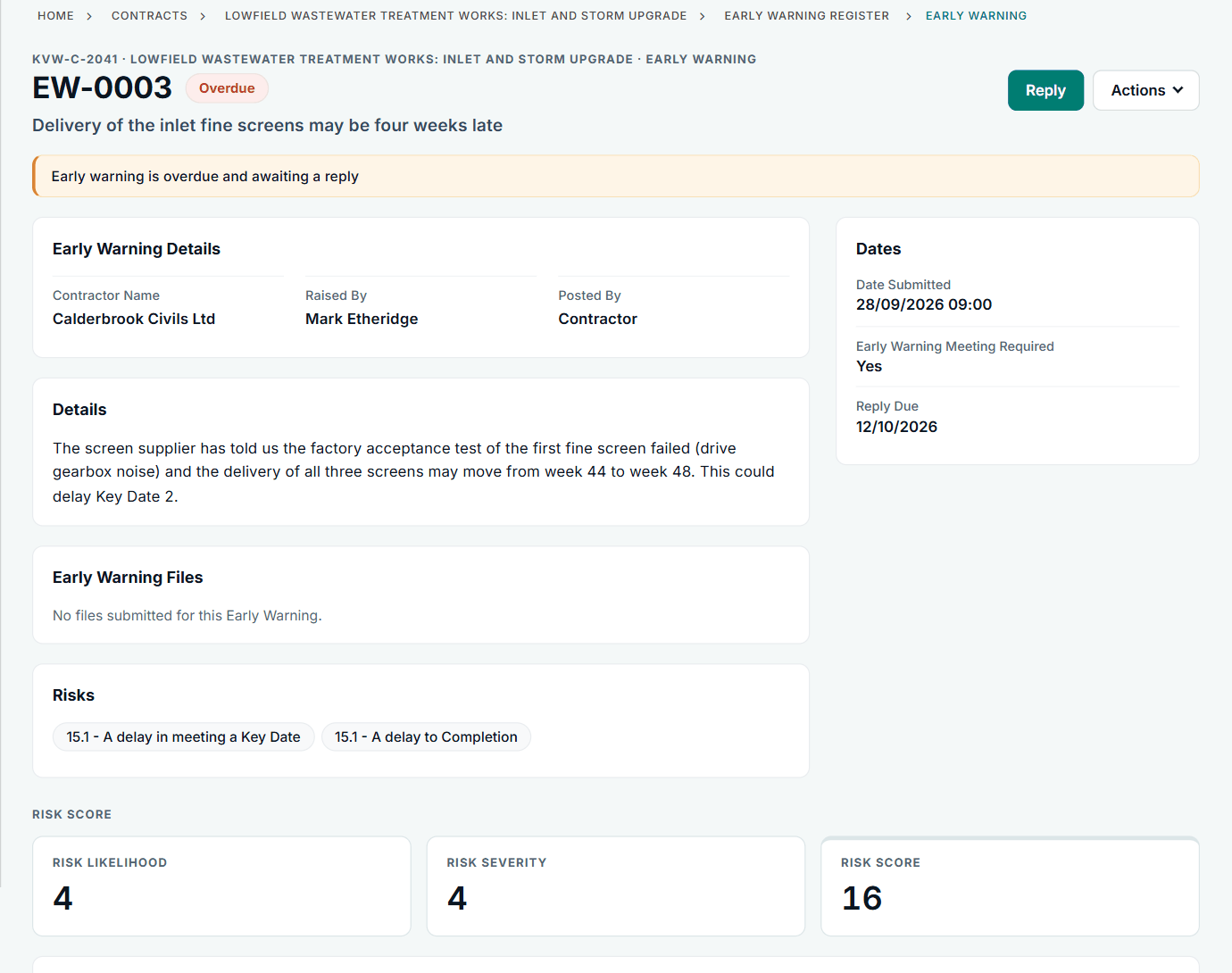
An early warning in Contract Status, with its risks, reply date and score. See the worked example.
See how this works in practice
Click through Contract Status with sample contracts: raise the notice, reply to it, and watch both sides of one record.
Take the guided tour Book a demo
Try the Project Manager role-play, use the free NEC tools or download free NEC templates.
This guide is general information in our own words, not legal advice. Your contract and its Contract Data always govern. NEC, NEC3 and NEC4 are trade marks of Thomas Telford Ltd; Contract Status is not affiliated with or endorsed by NEC.