
Under the NEC Engineering and Construction Contract (ECC), both the Contractor and the Project Manager give early warnings, and each owes that duty to the other. Early warning is a two-way obligation: a Project Manager who treats it as something only the Contractor does has misread the clause.
The rule is at 15.1 of NEC4 and 16.1 of NEC3. This page sets out who does what. The early warnings guide gives the full process.
Who does what
| Task | Project Manager | Contractor |
|---|---|---|
| Warn of matters that could affect the Prices, Completion, a Key Date or performance in use | Yes | Yes |
| Warn of other matters that could raise the Contractor's total cost | Not required | May choose to |
| Enter matters in the register | Yes | No |
| Issue first register (NEC4) | Yes | No |
| Instruct attendance at the first meeting (NEC4) | Yes | No |
| Instruct the other to attend a later meeting | Yes | Yes |
| Bring other people to a meeting, if the other agrees | Yes | Yes |
| Issue the revised register and any Scope change | Yes | No |
It is unusual for a contractor to be able to instruct a project manager, but the attendance rule works both ways. A Contractor with an urgent matter doesn't have to wait to be invited.
What the Project Manager should be warning about
A Project Manager often has information the Contractor can't get. Typical matters include:
- A likely change of mind by the Client, end user or funder.
- Delays to anything the Client is to provide, such as access, free-issue items or information.
- Approvals from third parties that the Client controls.
- Other contractors working next to the Site, and any slippage on their part.
- Concerns seen on site visits or in the Contractor's programme.
In practice, a warning from the Project Manager often leads to a better outcome for the Client than a later compensation event would. For the wider duties of the role, see Project Manager responsibilities.
What the Contractor should be warning about
The Contractor sees the work first, its supply chain and its resources. Common sources are procurement, ground and existing conditions, subcontractor capacity, and design development. The warning should come from whoever finds the problem, so site teams need to know how to pass it on and who sends the notice. A warning stuck on a foreman's phone isn't doing anybody any good.
Everyone else
| Role | Duty under the ECC clause? | What to do in practice |
|---|---|---|
| Client | Not named in the ECC clause. The Project Manager acts here | Tell the Project Manager early, so it can give the warning |
| Supervisor | Not named in the clause | Tell the Project Manager of anything that could have a listed effect; attend meetings if asked |
| Designers (either side) | Not named; they have no direct duty under the clause | Report through whoever appointed them. Their appointment may require it |
| Subcontractors | Under an NEC subcontract, owed to the Contractor, not to the Project Manager | See early warnings for subcontractors |
The roles change across the suite, so check your form. In the short contracts, the warning passes directly between the Contractor and the Employer (NEC3) or Client (NEC4), since there is no Project Manager. The professional service contracts use their own role names, too.
Delegation and awareness
A Project Manager can delegate actions after notifying the Contractor, so a commercial or site representative may issue notices and the register. Make sure the Contractor knows who that is.
A harder practical question is whose awareness counts. If a junior engineer on site knew about a problem weeks before the commercial team did, the Contractor can't easily argue it was unaware. In any event, the test for reducing a compensation event looks at what an experienced contractor could have warned of. Treat knowledge anywhere in your team as your organisation's knowledge, and build a route for it to reach the person who sends notices.
Related guides
- NEC Early Warnings: The Complete Guide
- What Happens If No Early Warning Is Given?
- Common Early Warning Mistakes
- Early Warnings for Subcontractors
- Running an Early Warning Meeting
- What Should Be Early Warned?
How this looks in Contract Status
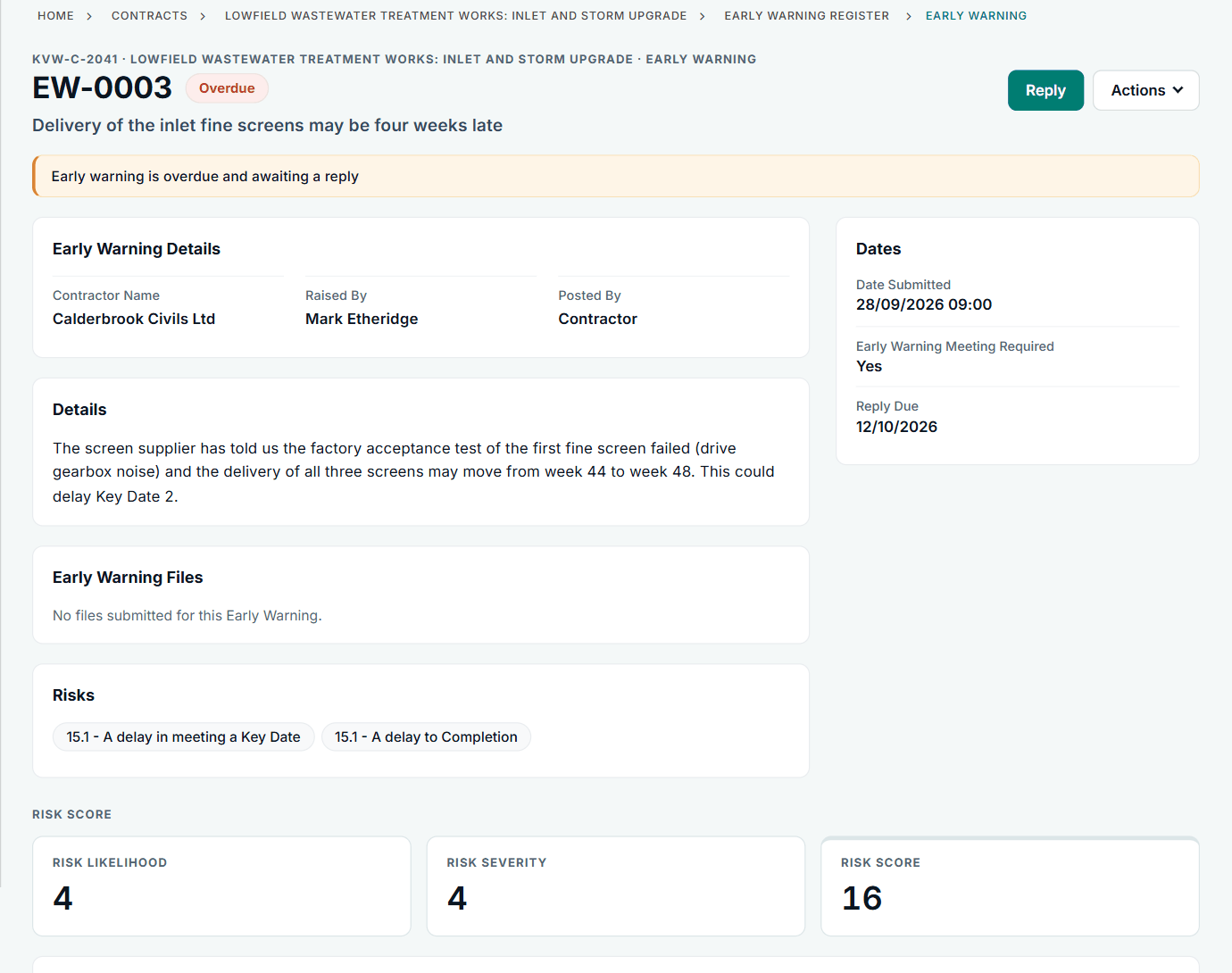
An early warning in Contract Status, with its risks, reply date and score. See the worked example.
See how this works in practice
Click through Contract Status with sample contracts: raise the notice, reply to it, and watch both sides of one record.
Take the guided tour Book a demo
Try the Project Manager role-play, use the free NEC tools or download free NEC templates.
This guide is general information in our own words, not legal advice. Your contract and its Contract Data always govern. NEC, NEC3 and NEC4 are trade marks of Thomas Telford Ltd; Contract Status is not affiliated with or endorsed by NEC.