
If a Contractor gives no early warning when an experienced contractor could have, the Project Manager can have the related compensation event assessed as if the warning had been given. The Contractor doesn't lose the event, but it does pay for whatever a timely warning would have avoided.
This is the main price consequence of giving no early warning under NEC. It applies under both NEC3 and the NEC4 Engineering and Construction Contract (ECC), and the steps are explained below. For the general duty, see the NEC early warnings guide.
How the mechanism works
| Step | What happens | NEC4 ECC | NEC3 ECC |
|---|---|---|---|
| 1 | The Project Manager decides an experienced contractor could have warned of the event and didn't | 61.5 | 61.5 |
| 2 | It says so in the instruction to submit quotations | 61.5 | 61.5 |
| 3 | The event is assessed as if the warning had been given | 63.7 | 63.5 |
The details matter. The test is objective: it asks what an experienced contractor could have done, not what this Contractor actually knew. The statement also belongs in the instruction to quote. A Project Manager who raises the point only after quotations are in has missed the moment the clause provides for, so don't assume it can be added at any stage.
A worked example
A fictional Option A contract for a pumping station, with illustrative figures. The Client is due to supply a set of pumps in week 20 on the Accepted Programme. In week 16, the Contractor's planner hears from the pump manufacturer that the order is running about four weeks late. The Contractor says nothing. The pumps arrive in week 24, and the Contractor notifies a compensation event under 60.1(3).
| What actually happened | If warned in week 16 | |
|---|---|---|
| Response available | Crew stood idle on site, then returned after a remobilisation | Crew reprogrammed to other work; pump installation moved to the end of the sequence |
| Effect on the Prices | £46,000 | £18,000 |
| Effect on the Completion Date | Three weeks later | One week later |
The Project Manager states under 61.5 that the warning could have been given. Assuming that view holds up, the event is assessed on the right-hand column. The Contractor recovers £18,000 and one week. It carries the remaining £28,000 and has two weeks less time, which may expose it to delay damages if Option X7 applies.
The contract gives no formula for the "as if" assessment. It is a judgement about what would have happened, so it often leads to argument. Clear records of what the options actually were will help whichever side you are on.
The second exposure on cost-based Options
Under Options C, D and E, the definition of Disallowed Cost includes cost incurred only because the Contractor failed to give a warning the contract required. In NEC4 ECC this definition is at 11.2(26) of those Options; in NEC3 ECC it is at 11.2(25), and NEC3 Option F has an equivalent at 11.2(26). It is a separate point from the compensation event assessment and can apply to cost that has nothing to do with a compensation event. More on this in the Disallowed Cost guide.
The word "only" limits it. The Project Manager has to link the cost to the missing warning, not simply point to an overrun. And only warnings the contract requires count: the optional warning about the Contractor's own cost shouldn't fall within it.
What it does not do
- It doesn't cancel the compensation event. The assessment changes; the entitlement remains.
- It isn't automatic. The Project Manager has to decide and state it.
- It doesn't reach every missed warning. If an earlier warning wouldn't have changed anything, the assessment should come out the same.
- It isn't the same as the time bar. Missing the 61.3 period for notifying a compensation event is a different, much harsher problem. See clause 61.3.
If you receive a 61.5 statement
- Note whether it came with the instruction to quote.
- Establish when anyone in your team first knew, using diaries, emails and supplier correspondence. Be honest about what you find.
- Ask what an experienced contractor could have known at that time.
- Set out what a warning would realistically have changed. Would the Project Manager have had options? Would any have cost less?
- Reflect your view in the quotation. Showing both the effect as it happened and the "as if" effect makes the difference visible and the conversation more concrete.
If you are the Project Manager
Use the clause when it's justified, not as a routine reduction. Record the facts that support your decision, state it in the instruction and explain what you think would have happened. Also look at your own record: if you knew of the same matter and didn't warn either, expect that to be raised. The clause 61.5 guide goes further into how the decision is made.
Related guides
- NEC Early Warnings: The Complete Guide
- Common Early Warning Mistakes
- Early Warnings for Subcontractors
- What Should Be Early Warned?
- Who Gives an Early Warning?
How this looks in Contract Status
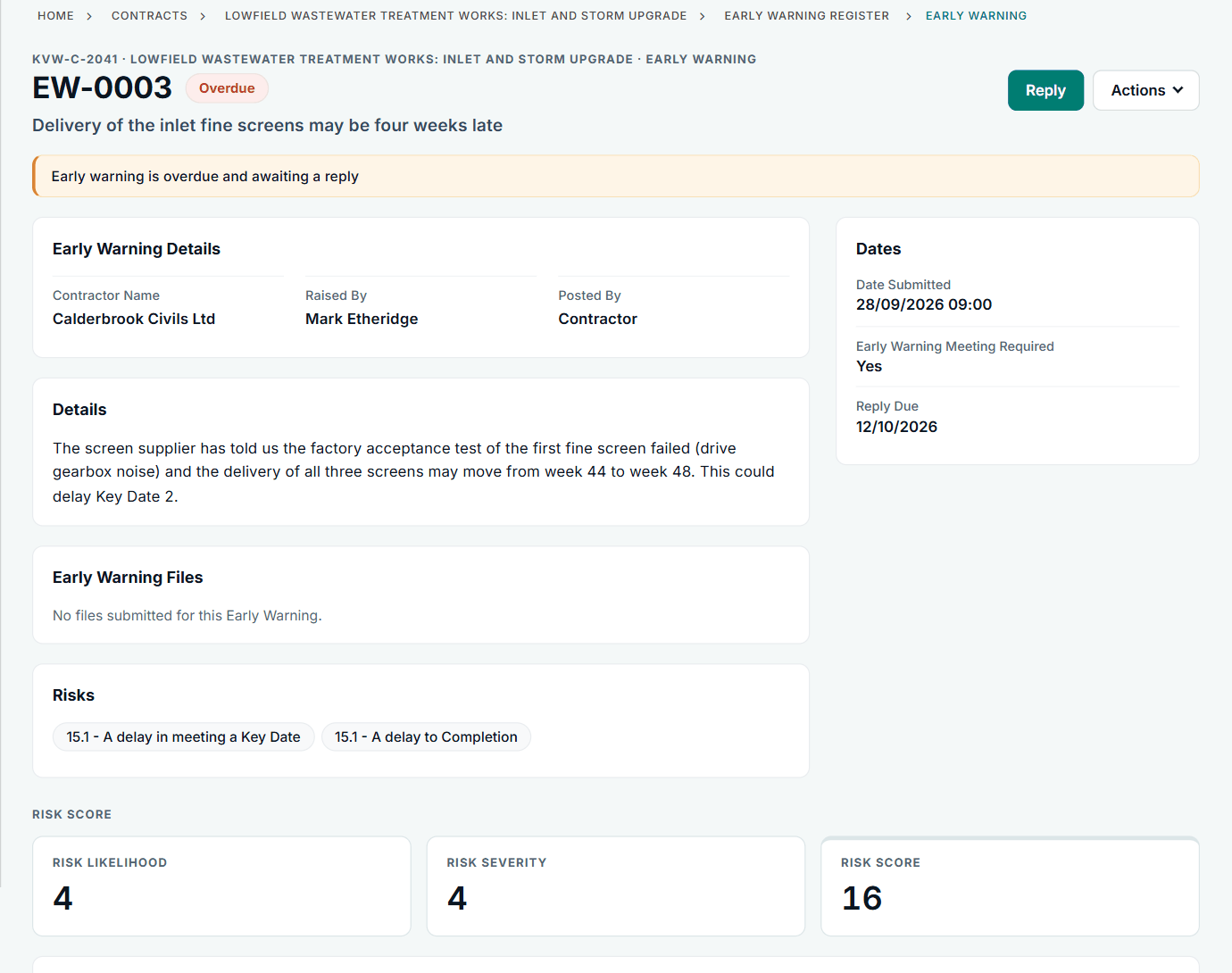
An early warning in Contract Status, with its risks, reply date and score. See the worked example.
See how this works in practice
Click through Contract Status with sample contracts: raise the notice, reply to it, and watch both sides of one record.
Take the guided tour Book a demo
Try the Project Manager role-play, use the free NEC tools or download free NEC templates.
This guide is general information in our own words, not legal advice. Your contract and its Contract Data always govern. NEC, NEC3 and NEC4 are trade marks of Thomas Telford Ltd; Contract Status is not affiliated with or endorsed by NEC.