
A good early warning notice says what the matter is, which contract effects it could have, and what you suggest doing next. It should take minutes to write, because the aim is speed, and it doesn't need a price, a programme analysis or a view on who is responsible.
NEC sets no required format beyond the general communications rules, so the choices below are good practice rather than contract requirements. They are designed to make the notice useful at the meeting and clear if anyone looks back at it later. To copy a ready-made layout, use our early warning notice template.
The two contract rules that apply
A warning is a notification, so two general clauses apply under both NEC3 and the NEC4 Engineering and Construction Contract (ECC):
- Separate communication (13.7). It goes on its own, not buried in a progress report, a minute or an email about something else.
- Recorded form (13.1). It needs to be readable, copyable and recordable. A phone call is sensible as well, but does not take the place of the notice.
Also check your Scope for any stated system or form of communication. For more, see communications under NEC.
What to include
- Contract, reference and date. Use the contract name and your next number, so the notice can be matched to the register.
- A clear label. State that this is an early warning, citing clause 15.1 (NEC3: 16.1).
- The matter, in plain words. What have you learned, and what could happen because of it?
- When you became aware. This protects you later if timing is questioned.
- Which effects could follow. Name them: total of the Prices, Completion, a named Key Date, performance in use, or the Contractor's own cost.
- A rough scale, if known. Give a range or say that it isn't yet known. Don't wait for accuracy.
- Your suggestion. Offer one or two ways to avoid or reduce the effect, and say what decision you need and by when.
- Whether a meeting is needed now. If the matter can't wait for the next scheduled meeting, say so, and instruct attendance where appropriate.
What to leave out
- Blame. The register doesn't decide liability, and accusations make the other side defensive.
- A demand for money or time. That belongs in a compensation event notice and quotation.
- Reservations of rights in long paragraphs. They add nothing to a warning and work against the tone of the process.
- Several unrelated matters. Give each its own notice, so each can have its own action and be closed on its own.
Weak notices and better ones
These examples come from fictional projects.
| Weak | Why it fails | Better |
|---|---|---|
| "Weather may affect the programme." | Too general for anyone to act on, and true of any project | "Forecast high river levels could flood the cofferdam access from Tuesday. This could delay the Key Date for bridge deck handover by about a week. We suggest bringing forward the temporary pumps. Decision needed by Friday." |
| "The design is late and we reserve our rights." | Reads as a claim, and gives no detail on what, when or how much | "Revision C of the drainage drawings, needed for our order on 12 June on the Accepted Programme, has not arrived. Long-lead pipe could be delayed, putting Completion at risk. Can you confirm the issue date, or may we order to Revision B quantities?" |
| "Possible cost increase on steel." | Doesn't say whether the Prices or only the Contractor's cost are affected | "Our steel supplier has told us prices may rise next month. On our Option A contract this would affect our own cost and not the Prices, so we give this under the optional limb of 15.1. We propose to place the order early." |
When should it be a compensation event notice as well?
Ask this question each time you write a warning: has a listed event happened, or do I expect one? If so, the warning isn't enough. A compensation event notice has its own limit of eight weeks from becoming aware under 61.3 of the ECC, and the warning does not satisfy it. Our guide to notifying a compensation event covers what that notice needs.
The reverse also applies. If the compensation event was notified first, a further warning about that same matter isn't required.
If you are receiving one
There is nothing to accept or reject, and NEC sets no period for replying to a warning. Project Managers should enter it in the register, acknowledge it, and either put it on the next meeting's agenda or call a meeting now. Replying "rejected" misreads the process. The full routine is in our early warnings guide.
Related guides
- NEC Early Warnings: The Complete Guide
- Early Warning Notice Template
- The Early Warning Register
- Early Warning Register Template
- What Is an Early Warning Under NEC?
- NEC Clause 15 Explained
How this looks in Contract Status
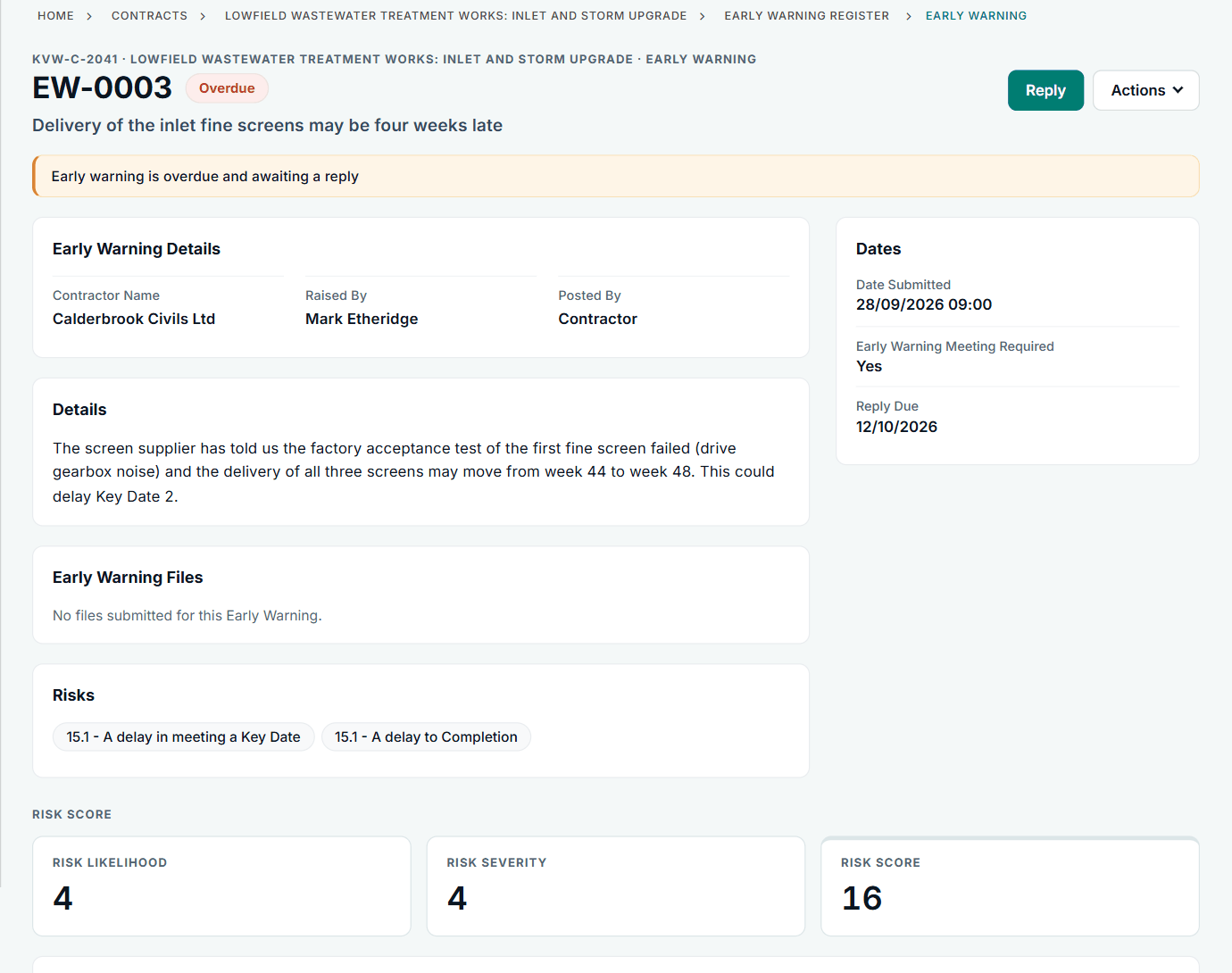
An early warning in Contract Status, with its risks, reply date and score. See the worked example.
See how this works in practice
Click through Contract Status with sample contracts: raise the notice, reply to it, and watch both sides of one record.
Take the guided tour Book a demo
Try the Project Manager role-play, use the free NEC tools or download free NEC templates.
This guide is general information in our own words, not legal advice. Your contract and its Contract Data always govern. NEC, NEC3 and NEC4 are trade marks of Thomas Telford Ltd; Contract Status is not affiliated with or endorsed by NEC.