
Clause 60.1(20) makes it a compensation event when the Project Manager notifies the Contractor that a quotation for a proposed instruction isn't accepted. It's new in NEC4 ECC: pricing an option for the Client takes real effort, and this entry stops that effort going unpaid when the Client decides not to proceed.
NEC3 has no such entry. There, the Project Manager can ask for a quotation for a proposed instruction under 61.2 and 62.3, but it isn't an event if the quotation goes nowhere. The wider procedure is in the guide to NEC4 proposed instructions.
What triggers it
Clause 65 sets up a process, and the event sits near the end of it.
- The Project Manager instructs the Contractor to quote for a proposed instruction, and states the date by which it may be given (65.1). The Contractor doesn't act on it.
- The Contractor quotes, as if for a compensation event (65.2).
- The Project Manager replies by the stated date. There are three possible replies.
| Reply under 65.2 | What happens next |
|---|---|
| Instruction to send a revised quotation, with reasons | The process repeats. No event yet |
| The instruction is given and the quotation accepted | A compensation event, usually under 60.1(1), with its price settled by the quotation |
| Notification that the quotation isn't accepted | A compensation event under 60.1(20) |
Under 65.3, the Project Manager may still issue the instruction after turning down the quotation, notifying it as a compensation event and asking for a fresh quotation. That's a way of saying, "We want this, but not at that price".
If there's no reply at all
Under 65.2, a quotation with no reply by the date isn't accepted. But 60.1(20) is written around the Project Manager's notification. So there's a gap in the logic: silence means no acceptance, but is it an event? It's reasonable to expect that a duty to reply was missed, which may lead to 60.1(6), but the point isn't clear-cut. If you've spent real money, ask the Project Manager to notify the outcome, and look at both routes. Project Managers should simply reply.
What it's worth
The event relates to what the Contractor did because of the request. The effect is usually the cost of preparing the quotation: estimator time, design development, Subcontractor pricing and any surveys needed to price it properly. Time is rarely affected, because the work never went ahead, although it could be if key people were taken away from critical work.
The amount recoverable is limited to what fits the Defined Cost rules for your Option, so an item outside the schedule of cost components isn't covered. Check it before you assume all your head-office time can go in.
How it is usually evidenced
- The instruction to quote and its date.
- The quotation and any revisions, with their dates.
- The notification that it isn't accepted.
- Time records and invoices for the quotation effort.
Keep a separate cost code from the day you receive the request. These costs are small and easy to lose.
Worked example
A fictional hospital car park deck on Option C, with illustrative figures. The Client is thinking about adding a third level. The Project Manager instructs a quotation for the proposed instruction, stating 30 June as the date by which it may be given. The Contractor engages its structural designer for a preliminary check, and gets two steelwork prices. It quotes £620,000 and four weeks. The Client's funding doesn't stretch, so on 28 June the Project Manager notifies that the quotation isn't accepted.
| Effect | Defined Cost |
|---|---|
| Designer's preliminary structural check (Subcontract cost) | £3,900 |
| Ground investigation review (Subcontract cost) | £1,200 |
| Staff time that fits within the schedule | £1,500 |
| Subtotal | £6,600 |
| Fee at an illustrative 10% | £660 |
| Change to the Prices | £7,260 |
The £620,000 has no bearing on this event, as nothing was built. Only the effort of quoting is assessed.
How it is assessed
The event arises from a notification, so the Project Manager notifies it as a compensation event at the same time (clause 61.1), and the dividing date is that date (63.1). Almost all the cost will already have been incurred, so this is one of the few events assessed mostly at actual Defined Cost. A further quotation is needed, which is a small irony, but keep it short and proportionate.
What people get wrong
- Project Managers using proposed instructions as a free pricing service. Each rejected option can cost the Client money. Ask for quotations when the decision is real.
- Contractors putting work in hand. The Contractor doesn't act on a proposed instruction. If you've ordered materials to save time, that isn't part of this event.
- Expecting lost profit. The event doesn't pay for the Fee on a job that never happened. It covers only the effect of the request.
- Mixing it up with a normal quotation. A quotation for a compensation event has its own route if it isn't accepted, and this entry isn't part of it. The event here only applies to clause 65.
- Applying it to NEC3. It isn't in that edition, unless a Z clause adds it.
Related guides
- NEC Compensation Events: The Complete Guide
- Compensation Event: Additional Events in the Contract Data
- Compensation Events Under Options B and D
- Compensation Event: Client Breach of Contract
- Compensation Event: Prevention
How this looks in Contract Status
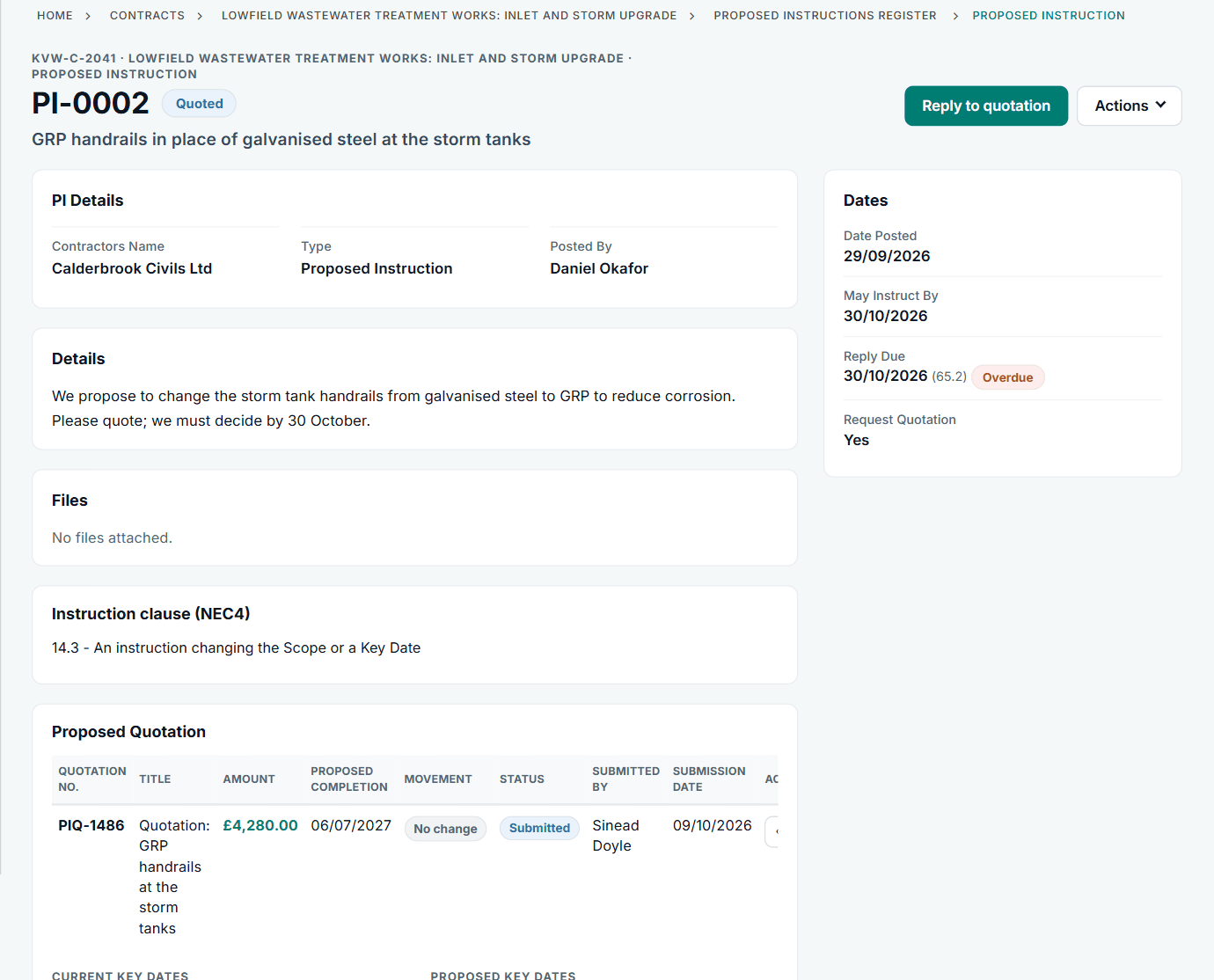
A proposed instruction with the Contractor's quotation and the date to decide by. See the worked example.
See how this works in practice
Click through Contract Status with sample contracts: raise the notice, reply to it, and watch both sides of one record.
Take the guided tour Book a demo
Take the NEC4 ECC quiz, use the free NEC tools or download free NEC templates.
This guide is general information in our own words, not legal advice. Your contract and its Contract Data always govern. NEC, NEC3 and NEC4 are trade marks of Thomas Telford Ltd; Contract Status is not affiliated with or endorsed by NEC.