
An NEC compensation event flow chart comes down to six decisions, each with a time limit and only a few possible outcomes. This page writes that chart out as a set of questions, so that you can follow it from any point and see where each answer leads. It uses NEC4 ECC, with its standard periods.
The same periods apply to NEC3 ECC. NEC3 has clause 65 for implementing, and clause 61.1 for the instruction to quote. Any Z clauses in your contract take priority. The process guide tells the same story in prose, and the compensation events guide is the starting point.
Decision 1: who should notify?
| If | Then |
|---|---|
| It arises from an instruction, notification, certificate or changed decision of the Project Manager or Supervisor | The Project Manager notifies at that time (61.1) and instructs quotations (61.2). Go to decision 3 |
| Anything else, or the Project Manager hasn't notified | The Contractor notifies, within eight weeks of becoming aware (61.3). Go to decision 2 |
Decision 2: does the Contractor's notice qualify?
The Project Manager has one week, or longer if agreed, to apply the tests in clause 61.4.
| Answer | Next |
|---|---|
| No: fault, not happening, too late, no effect, or not on the list | Prices and dates stay. Reasons given. Contractor can use the dispute route |
| Yes | Quotations instructed. Go to decision 3 |
| No reply | Contractor may notify the failure. Two further weeks of silence is treated as a yes, with quotations instructed |
Decision 3: what goes in the instruction?
This isn't a yes or no. The Project Manager considers three questions as it instructs:
- Could an experienced contractor have warned? If so, say so (61.5).
- Are the effects too uncertain to forecast? If so, state assumptions (61.6).
- Are there practical alternatives? If so, discuss them, and consider asking for alternative quotations (62.1).
Decision 4: did the Contractor quote in time?
| Answer | Next |
|---|---|
| Yes, within three weeks (or an extension agreed beforehand) | Go to decision 5 |
| No | The Project Manager assesses it (64.1). Go to decision 6 |
Decision 5: how does the Project Manager reply?
It has two weeks from submission (62.3).
| Reply | Next |
|---|---|
| Acceptance | Implemented |
| Instruction to submit a revised quotation, with reasons | Three weeks. Back to decision 4 |
| Will make its own assessment | Go to decision 6 |
| No reply | Contractor may notify the failure. Two further weeks of silence is treated as acceptance. Implemented |
Decision 6: did the Project Manager assess in time?
| Answer | Next |
|---|---|
| Yes, within the quotation period from when the need became apparent (64.3) | Assessment notified. Implemented. Contractor can dispute it |
| No | Contractor may notify the failure. Two further weeks of silence: its quotation is treated as accepted (64.4). Implemented |
The end point
There are three ways to reach implementation: acceptance, the Project Manager's assessment or treated acceptance. All three lead to the same place under 66.1. The Prices and dates change, and the assessment is not normally reopened.
Reading the chart
Three things stand out once it's written like this:
- There's no dead end for the Contractor. Every stage has a way forward if the other side stays silent, provided the Contractor gives notice.
- The only way out before quotation is the 61.4 decision. After that, the question is what the event is worth, not whether it counts.
- Treated acceptance isn't automatic. In each case, an action by the Contractor is required to start it.
Drawing your own
If you want to draw one for your team, use two lanes, for the Project Manager and the Contractor, with the decision numbers above as the shapes and each period written on the arrow. Add your own contract's amended periods and any Z clause steps, such as a Client approval level. Pin it near the people who hold these clocks, and use it alongside the full list of NEC time periods.
Related guides
- NEC Compensation Events: The Complete Guide
- Compensation Event Examples
- Common Compensation Event Mistakes
- Compensation Event: Change to the Scope
- Compensation Event vs Relief Event
- Keeping a Compensation Event Register
How this looks in Contract Status
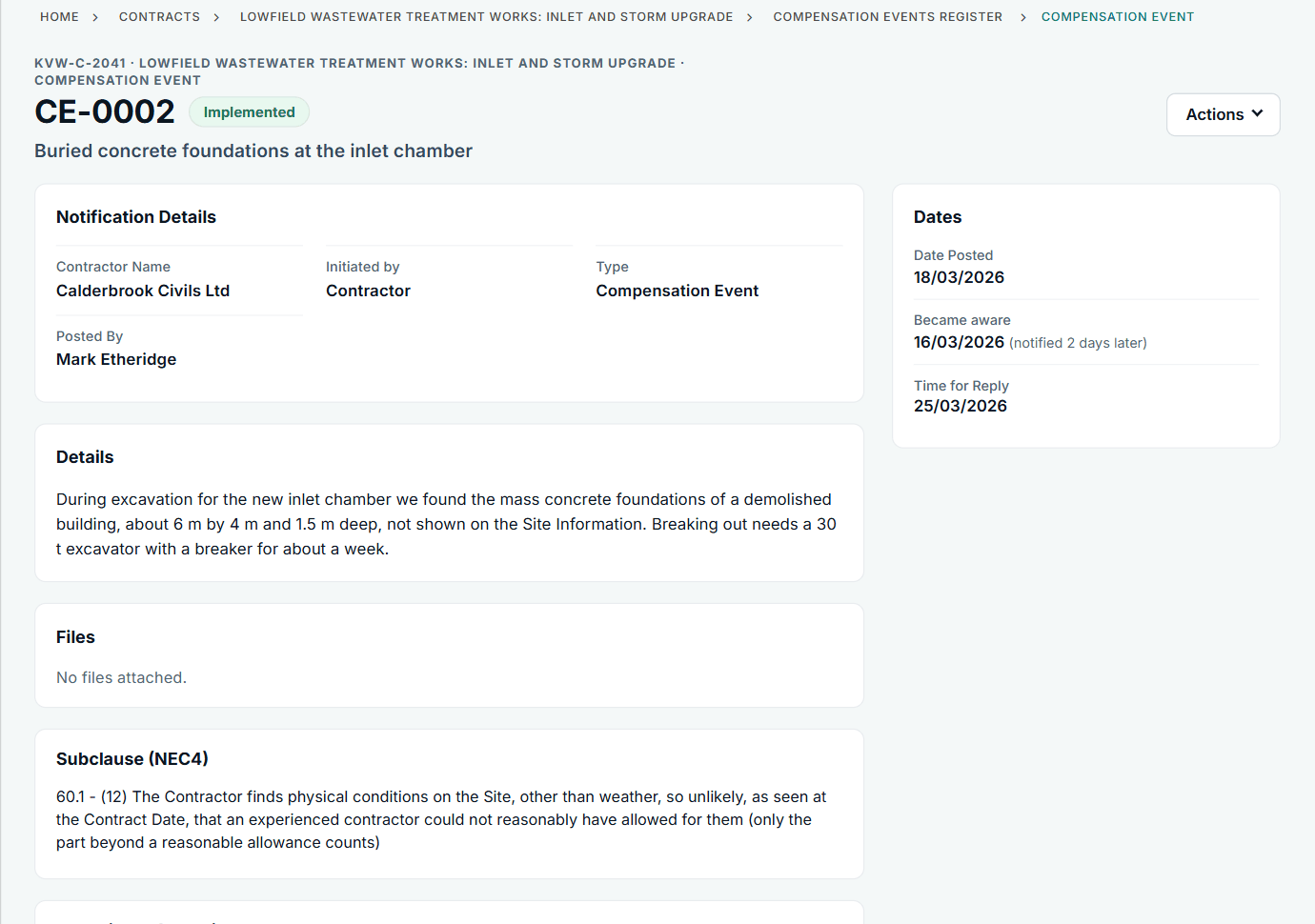
The record shows the date you became aware and how long you took to notify. See the worked example.
See how this works in practice
Click through Contract Status with sample contracts: raise the notice, reply to it, and watch both sides of one record.
Take the guided tour Book a demo
Take the NEC4 ECC quiz, use the free NEC tools or download free NEC templates.
This guide is general information in our own words, not legal advice. Your contract and its Contract Data always govern. NEC, NEC3 and NEC4 are trade marks of Thomas Telford Ltd; Contract Status is not affiliated with or endorsed by NEC.